




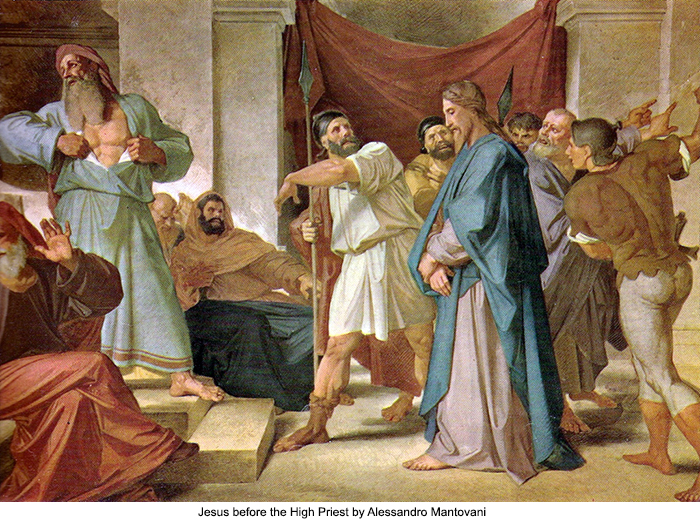
The Trial of Jesus from a Lawyer’s Standpoint
- The Arrest of Jesus was Illegal
Walter M. Chandler’s Argument
Chandler says the arrest contained three separate defects:
- It occurred at night.
- It was accomplished through Judas, whom Chandler regarded as an informer/accomplice.
- It was not the product of a proper judicial mandate designed to conduct a legitimate trial.
Chandler’s own heading in his book is explicit: “The Arrest of Jesus Was Illegal.” (The Trial of Jesus from a Lawyer’s Standpoint: Complete)
He particularly emphasized the use of Judas. Chandler cited Jewish law concerning accomplice testimony and connected it with:
“Thou shalt not go up and down as a talebearer among thy people.”
from Leviticus 19:16–18.
Biblical evidence
The arrest is described in:
- Matthew 26:47–56
- Mark 14:43–52
- Luke 22:47–53
- John 18:2–12
The Gospels clearly establish that:
- Judas identified Jesus.
- The arrest occurred at night.
- A large armed group accompanied Judas.
- The arrest had been planned by the chief priests and elders.
Jesus Himself highlights the unusual nature of the arrest:
Luke 22:52–53 — He asks why they came with swords and clubs as though He were a criminal and notes that He had taught openly in the Temple.
Chandler’s Jewish legal sources
He cited:
- Leviticus 19:16–18
- Rabbinic restrictions concerning accomplice testimony
- Mendelsohn’s Criminal Jurisprudence of the Ancient Hebrews
Chandler argued that Jewish law would not allow an accomplice or informer to endanger another person’s life through his testimony.
Modern assessment
This is one of Chandler’s weaker points in its precise legal formulation.
The fact that Judas betrayed Jesus does not necessarily make the arrest itself illegal. Chandler essentially moves from a rule concerning testimony and false accusation to a rule concerning arrest.
Also, there is no clear biblical or first-century Jewish legal text saying:
“A person may not be arrested at night.”
What we can say with greater confidence is that a capital trial was not supposed to be conducted at night under the later Mishnah’s rules.
Furthermore, Judas wasn’t the principal witness at the Jewish proceeding. His role was primarily identification and betrayal.
Assessment: Weak to Debatable
The nighttime arrest and secretive character are historically significant, but Chandler’s argument that the arrest itself was legally void because Judas was involved goes too far.
- The Private Examination Before Annas/Caiaphas was Illegal
Chandler’s argument
Chandler says the private examination was illegal for three reasons:
- It occurred at night.
- A single judge could not conduct a judicial examination.
- Hebrew criminal procedure did not permit secret preliminary interrogations.
His primary sources included:
- Pirkei Avot 4:8 — “Be not a sole judge…”
- Salvador’s discussion of publicity and liberty
- Rabbinic legal principles concerning criminal procedure.
Biblical evidence
John gives the clearest account:
John 18:12–14
Jesus is taken first to Annas, father-in-law of Caiaphas.
Then:
John 18:19
The high priest questioned Jesus about His disciples and His teaching.
Jesus responds:
John 18:20–21
He essentially says:
I have spoken openly. Why question Me? Ask those who heard Me.
Then an officer strikes Jesus:
John 18:22–23.
This is an extremely important passage for Chandler because Jesus’ own response sounds like an appeal to the principle of public testimony.
Chandler’s legal argument
Chandler viewed Jesus’ words:
“Ask them which heard me”
as virtually a legal objection.
He argued that Jesus was insisting that the authorities produce witnesses rather than compel Him to incriminate Himself.
Modern assessment
This point has two separate questions.
Was there a private interrogation?
Yes. John clearly describes an interrogation.
Was such an interrogation legally forbidden in AD 30?
That is much less certain.
The Mishnah contains elaborate procedural protections, but we cannot simply assume that every later rabbinic rule operated identically in the first century.
Also, Annas may not have been functioning as the formal court at all. John may be describing a preliminary investigation rather than a formal trial.
This distinction is important.
Assessment: Probable irregularity; legal illegality uncertain
Chandler is strongest when he says the interrogation was informal, coercive and inconsistent with the ideal of open testimony.
He is weaker when he claims we can definitively prove that Jewish law in AD 30 prohibited precisely this kind of preliminary interrogation.
- The Indictment was Illegal
This is one of Chandler’s more sophisticated arguments.
Chandler’s argument
He says Jewish criminal procedure did not operate like a modern American criminal proceeding in which a prosecutor files an indictment.
Instead, the witnesses themselves supplied the accusation.
Chandler cites:
- Salvador
- Edersheim
- Innes
- Mendelsohn
and argues that the Sanhedrin could investigate charges but could not originate them.
Biblical evidence
The most important passages are:
Matthew 26:59–60
“The chief priests and elders, and all the council, sought false witness against Jesus…”
Mark 14:55–59
The witnesses testify concerning the Temple, but:
“neither so did their witness agree together.”
Then Caiaphas personally questions Jesus:
Matthew 26:63–66
“I adjure thee by the living God…”
Jesus answers, and Caiaphas declares:
“He hath spoken blasphemy.”
Chandler’s crucial argument
Chandler sees two charges:
- A charge involving destruction of the Temple.
- Blasphemy arising from Jesus’ claim concerning His identity.
The first collapses because the witnesses contradict one another.
Then, according to Chandler, Caiaphas effectively creates the second charge himself by questioning Jesus.
That creates a serious procedural problem under Chandler’s understanding of Hebrew law because the judge has become the accuser.
Modern assessment
This is an interesting argument, but there is a major complication.
The Gospel accounts do not necessarily portray the Temple allegation and the Messiah/Son-of-God issue as two entirely unrelated indictments.
They may represent a developing prosecution in which the authorities are trying to establish what Jesus has claimed.
Moreover, the concept of a formal written “indictment” is itself somewhat anachronistic when applied to first-century Jewish procedure.
Chandler himself acknowledges uncertainty here. He admits that neither the Mishnah nor Gemara clearly describes written indictments and that the exact form of accusation is uncertain.
Assessment: Debatable
The failure of the witnesses to agree is directly stated in Mark and is historically significant.
The claim that Caiaphas therefore committed a legally invalid act by asking Jesus a question is considerably less certain.
- The Sanhedrin Trial was Illegal Because it Occurred at Night
This is probably Chandler’s strongest legal argument.
Chandler’s legal source
He cites:
Mishnah, Sanhedrin 4:1
Capital cases were to be tried during the day and suspended at night.
He also cites Maimonides and Mendelsohn concerning daytime criminal proceedings.
Biblical evidence
Matthew and Mark describe the hearing during the night.
Matthew 26:57–68
Jesus is taken to Caiaphas, where the scribes and elders are gathered.
Mark 14:53–65
The chief priests and council gather, witnesses testify, Caiaphas interrogates Jesus, and they condemn Him.
Luke presents the timing somewhat differently:
Luke 22:66
“As soon as it was day, the elders of the people and the chief priests and the scribes came together…”
That difference is important.
Chandler’s interpretation
Chandler believes:
- the real trial occurred during the night;
- the morning meeting was essentially a second session intended to give the appearance of legality;
- the nighttime session violated Jewish capital procedure.
Modern scholarship
This point has substantial support if the Synoptic nighttime meeting is understood as an actual capital trial.
The Mishnah explicitly prohibits capital trials at night.
Modern scholarship, however, raises the question of whether the Gospel writers are describing a formal Sanhedrin trial at night or a preliminary interrogation.
Raymond Brown, for example, regarded the nighttime Sanhedrin meeting as historically problematic.
On the other hand, T. C. Schmidt’s 2025 study notes that the Gospel descriptions correspond surprisingly well to several Sanhedrin procedures preserved in the Mishnah and Tosefta.
Assessment: Strong, with a historical qualification
If Matthew and Mark accurately describe a formal capital proceeding, Chandler’s point is extremely strong.
The qualification is that the Gospel chronology and the exact nature of the nighttime gathering remain debated.
- The Sanhedrin Met Before the Morning Sacrifice
Chandler’s argument
Chandler cites:
- Jerusalem Talmud, Sanhedrin 1:19
- Mishnah Tamid
- Lémann, Jesus Before the Sanhedrin
The principle was:
The Sanhedrin sat from the close of the morning sacrifice until the evening sacrifice.
Chandler therefore argues that a meeting around 2–3 AM occurred before the morning sacrifice and therefore lacked proper jurisdiction.
Biblical evidence
The key passages are:
- Matthew 26:57–68
- Mark 14:53–65
- Luke 22:54–71
Mark and Matthew imply the nighttime proceedings, while Luke explicitly describes the council meeting “as soon as it was day.”
Modern assessment
This argument is considerably weaker than Point IV because it largely duplicates the nighttime argument.
If capital trials could not occur at night, then naturally they could not occur before the morning sacrifice.
More importantly, Chandler himself admits that it is difficult to establish whether the morning sacrifice was an independent jurisdictional prerequisite or simply the practical beginning of the court’s daytime working hours.
Assessment: Debatable / probably secondary
There may have been a real rule governing court hours, but Chandler’s claim that the morning sacrifice was a separate condition precedent to jurisdiction is not nearly as secure as he presents it.
- The Trial Occurred on the Eve of Sabbath and During Passover
This is another important point.
Chandler’s legal source
He cites:
Mishnah, Sanhedrin 4:1
which states that courts were not to judge on the eve of Sabbath or the eve of a festival.
He also cites Betzah and Rabbi Wise.
Biblical evidence
Important passages include:
- Matthew 26:17–20
- Mark 14:12–17
- Luke 22:7–15
- John 18:28
- John 19:14
- John 19:31
- John 19:42
Here we encounter one of the most important chronological problems in the Passion narratives.
The Synoptic chronology
Matthew, Mark and Luke portray the Last Supper as a Passover meal.
Thus:
Passover meal → Gethsemane → arrest → trial → crucifixion
John’s chronology
John appears to place Jesus’ death on the Preparation Day, before the Passover meal:
John 18:28
The authorities avoid entering Pilate’s residence because they want to remain ceremonially clean:
“that they might eat the Passover.”
And:
John 19:14
calls the day:
“the preparation of the Passover.”
Why this matters
Chandler assumes a particular chronology in which Jesus’ trial occurs on Nisan 14 and the next day is the Sabbath.
But modern scholars recognize that the chronology itself is disputed.
Interestingly, T. C. Schmidt’s recent Oxford study says the Mishnah/Tosefta prohibition on trials on festivals or festival eves creates one of the principal chronological tensions between the Gospel accounts and later rabbinic procedure.
Assessment: Strong if the Synoptic chronology is accepted
The Jewish legal rule itself is quite strong in the later rabbinic sources.
The difficulty is establishing:
- whether that rule was operative in AD 30, and
- exactly which day the trial occurred.
So this point cannot be treated as historically certain without first resolving the Passion chronology.
- The Trial was Improperly Completed in One Day
This is another of Chandler’s strongest arguments.
Chandler’s legal source
Mishnah, Sanhedrin 4:1
A capital case resulting in acquittal could be concluded the same day.
But if the result was conviction:
the decision could not be finalized until the following day.
Chandler interprets this as requiring an intervening night for deliberation.
Biblical evidence
The relevant chronology is extraordinary:
Matthew 26:57–68 — nighttime hearing
Matthew 27:1–2 — morning consultation and delivery to Pilate
Mark 14:53–65 — nighttime proceeding
Mark 15:1 — morning consultation
Luke 22:66–71 — daybreak council
Luke 23:1 — immediately to Pilate
Thus the Gospel narratives portray the Jewish proceedings and Roman proceedings as occurring within the same general day.
Chandler’s argument
Even if the morning meeting was a second hearing, it occurred only hours after the nighttime hearing.
It therefore could not satisfy the requirement that the judges sleep, reflect, reconsider the evidence and return the following day.
Modern assessment
This is a very strong argument against the Gospel narrative when compared with Mishnah Sanhedrin 4:1.
The major qualification remains chronology:
The Mishnah is later than Jesus.
And modern scholars disagree about how much of its procedural system can confidently be projected into AD 30.
Assessment: Strong under the Mishnah; historically probable but not certain
This is one of the best points in Chandler’s brief.
- Jesus was Convicted Upon His Own Uncorroborated Confession
This is perhaps Chandler’s most powerful evidentiary argument.
Biblical evidence
The sequence is crucial.
The witnesses fail:
Mark 14:55–59
“neither so did their witness agree together.”
Then:
Mark 14:60–62
Caiaphas asks Jesus whether He is the Christ.
Jesus answers:
“I am.”
Then:
Mark 14:63–64
Caiaphas declares:
“Ye have heard the blasphemy…”
and the council condemns Him.
Matthew gives the parallel account:
Matthew 26:63–66.
Chandler’s legal sources
He cites:
- Maimonides, Sanhedrin IV.2
- Mendelsohn, Criminal Jurisprudence of the Ancient Hebrews
The principle was that a defendant’s confession by itself could not establish guilt in a capital case.
Chandler’s reasoning
The witnesses had failed.
Therefore:
- there was no valid corroborating testimony;
- Caiaphas then asked Jesus to incriminate Himself;
- Jesus’ answer became the basis for the condemnation.
Chandler therefore argues that the Sanhedrin manufactured its own evidence by eliciting a confession from the defendant.
But there is an important theological/legal complication
Was Jesus actually confessing to a crime?
He says:
“I am.”
He does not say:
“I am guilty of blasphemy.”
His statement is an affirmation of His identity.
The court interpreted that claim as blasphemous.
Therefore, the legal issue is not simply “Did Jesus confess?” but:
Can an assertion of religious identity constitute the confession of a capital offense?
That is a much more complicated question.
Assessment: Strong evidentiary argument; historical qualification
The procedural principle is powerful if the later rabbinic law applies.
But the characterization of Jesus’ statement as a confession of guilt is Chandler’s legal interpretation, not something Jesus Himself says.
- The Unanimous Verdict was Illegal
This is one of the most fascinating points.
Biblical evidence
Mark 14:64 says:
“And they all condemned him to be guilty of death.”
Chandler interprets “all” literally.
Jewish legal rule
Chandler cites:
- Mendelsohn
- Rabbi Wise
- Mishnah Sanhedrin
The principle was extraordinarily unusual:
A unanimous guilty verdict in a capital case could invalidate the conviction.
Why?
Because the judges were supposed to function not merely as prosecutors but also as protectors of the accused.
If everyone voted guilty, it suggested that nobody had seriously defended the prisoner.
Chandler explains that unanimity was therefore associated with conspiracy or mob judgment rather than careful deliberation.
Modern assessment
The rule itself is genuinely found in rabbinic tradition.
Mishnah Sanhedrin 4:1 says a unanimous conviction was treated differently from a divided conviction.
But again, the historical question is whether this exact rule governed the first-century Sanhedrin.
There is also a Gospel problem.
Matthew and Mark say “all,” but:
Luke 23:51
says Joseph of Arimathea:
“had not consented to the counsel and deed of them.”
That potentially undermines Chandler’s assumption of absolute unanimity.
Chandler himself recognizes this problem and discusses Joseph and Nicodemus at length.
Assessment: Debatable
If Mark’s “all” is literal and the Mishnah rule was operative, Chandler’s point is devastating.
But both the historical meaning of “all” and the first-century applicability of the rule are uncertain.
-
- The place, the High Priest’s Torn Garments, and the Voting Procedure were Illegal
Chandler actually combines three separate procedural problems under Point X.
- The sentence was pronounced in the wrong place
Chandler’s argument
The Great Sanhedrin was supposed to meet in the Hall of Hewn Stones, the Lishkat ha-Gazit.
Chandler cites:
- Babylonian Talmud, Avodah Zarah 8
- Maimonides, Sanhedrin XIV
- Deuteronomy 17:8–13
He argues that after the Sanhedrin left its authorized location, it could no longer pronounce capital sentences.
Gospel evidence
Matthew and Mark put the trial at the high priest’s residence.
Matthew 26:57
“where the scribes and the elders were assembled.”
Mark 14:53
says the high priest’s house.
John later says:
John 18:28
that Jesus was taken from Caiaphas to Pilate.
Modern assessment
If the later Mishnah’s description of the Sanhedrin’s location is projected directly backward, this is a serious problem.
But historical evidence about precisely where the Great Sanhedrin met during the time of Caiaphas is not sufficiently clear to declare this conclusively illegal.
Assessment: Probable irregularity; historical certainty low
- Caiaphas tore his garments
Biblical evidence
Matthew 26:65
“Then the high priest rent his clothes…”
Mark 14:63
says essentially the same.
Chandler’s law
He cites:
Leviticus 21:10
which prohibits the high priest from tearing his garments.
Also:
Leviticus 10:6
prohibits Aaron and his sons from tearing their garments in the specified context.
But Chandler acknowledges an opposing Jewish tradition
This is important.
Edersheim argued that the high priest was actually required to tear his garments when blasphemy was spoken.
Chandler himself discusses this objection.
So this is not nearly as clear-cut as Chandler initially suggests.
Assessment: Weak/Debatable
This is one of Chandler’s least secure claims.
- The voting procedure was irregular
The Mishnah says judges were to vote individually.
In capital cases, the younger judges were to vote first so that they would not simply follow the authority of older judges.
Chandler argues that Caiaphas first announced:
“He hath spoken blasphemy”
and then asked for the verdict.
That could have influenced the judges before they voted.
Biblical evidence
Matthew 26:65–66
Caiaphas declares the blasphemy and then asks:
“What think ye?”
Mark 14:64
Then:
“And they all condemned him…”
Assessment: Probable procedural irregularity
If the Mishnah reflects actual first-century procedure, this is a significant point.
But once again, the Gospel narrative does not describe the mechanics of the vote in sufficient detail to prove precisely how each judge voted.
- The Judges Were Legally Disqualified Because of Their Hostility Toward Jesus
This is Chandler’s bias/disqualification argument.
Chandler’s legal principle
He cites Mendelsohn:
There should not be on the judicial bench a relation, particular friend, or enemy of either the accused or accuser.
He also cites Benny’s Criminal Code of the Jews, which says a known enemy of the accused could not serve as judge.
Biblical evidence
This is where the Gospels become particularly important.
Before the trial:
Matthew 26:3–5
The chief priests and elders already discuss killing Jesus.
John 11:47–53
The chief priests and Pharisees discuss what to do about Jesus and Caiaphas says:
“it is expedient for us, that one man should die for the people…”
Matthew 26:59
says:
“the chief priests, and elders, and all the council, sought false witness against Jesus, to put him to death.”
That is extraordinarily damaging from the standpoint of judicial impartiality.
Chandler’s argument
The judges had already decided that Jesus should die before the hearing began.
Therefore, they were not neutral judges.
Chandler goes even further and argues that their behavior during the trial—spitting upon Jesus and striking Him—demonstrated judicial hostility.
Modern assessment
This is stronger historically than some of Chandler’s technical arguments.
Even if we cannot establish every rabbinic disqualification rule as first-century law, the Gospel evidence itself portrays the leadership as having a predetermined interest in Jesus’ death.
However, we should distinguish:
“They were prejudiced”
from
“They were legally disqualified under a codified rule applicable in AD 30.”
The first is strongly supported by the Gospel narratives.
The second is harder to prove.
Assessment: Strong on bias; moderate on formal legal disqualification
- The Sanhedrin Failed to Consider Jesus’ Defense
This is Chandler’s final and perhaps most fundamental point.
Chandler’s legal sources
He cites:
Deuteronomy 13:14
“Then shalt thou inquire, and make search, and ask diligently…”
and:
Mishnah, Sanhedrin 4:5
judges were to weigh the matter sincerely.
Biblical evidence
Consider what actually happens.
The witnesses contradict one another:
Mark 14:56–59
Then Jesus is questioned.
He initially remains silent:
Matthew 26:62–63
Then Caiaphas asks the decisive question.
Jesus answers.
Caiaphas immediately says:
Matthew 26:65
“He hath spoken blasphemy.”
Then:
Matthew 26:66
“What think ye?”
and they condemn Him.
Chandler’s argument
Chandler says the Sanhedrin should have:
- examined the witnesses;
- examined contradictions;
- investigated Jesus’ defense;
- called witnesses supporting the accused;
- deliberated carefully;
- reconsidered the case on the following day.
Instead, the prosecution failed to produce coherent witnesses and then relied upon Jesus’ own statement.
Chandler concludes that there was essentially no meaningful defense at all.
Modern assessment
This point depends less on a technical legal rule and more on the general character of the proceedings.
The Gospel narrative certainly does not portray an impartial, leisurely investigation.
But we should be careful about saying there was literally no defense.
Jesus Himself speaks.
And the Gospel of John records an earlier intervention by Nicodemus:
John 7:51
“Doth our law judge any man, before it hear him, and know what he doeth?”
That demonstrates that at least some Jewish legal thinking surrounding Jesus involved the principle of hearing the accused.
Assessment: Strong as a description of the Gospel narrative; moderate as a technical historical claim
Putting the 12 points together
Here is how I would rank Chandler’s arguments from a modern historical perspective, rather than simply repeating Chandler’s conclusions:
| # | Chandler’s allegation | My assessment |
| 1 | Illegal arrest | Weak–Debatable |
| 2 | Illegal private examination | Probable irregularity |
| 3 | Illegal indictment | Debatable |
| 4 | Illegal nighttime trial | Strong |
| 5 | Before morning sacrifice | Debatable / secondary |
| 6 | Sabbath/Passover timing | Strong if chronology is accepted |
| 7 | Capital case concluded in one day | Strong under Mishnah |
| 8 | Conviction based on Jesus’ confession | Strong under rabbinic law; interpretation debated |
| 9 | Unanimous verdict illegal | Debatable |
| 10A | Wrong location | Probable if Mishnah applies |
| 10B | Caiaphas’ torn garments | Weak/Debatable |
| 10C | Irregular voting | Probable |
| 11 | Judges disqualified by bias | Strong concerning bias; less certain as formal law |
| 12 | Defense not properly considered | Strong as procedural criticism; historical details uncertain |
The most important historical issue: Was the Mishnah describing Jesus’ legal system?
This is the question that should accompany every single one of Chandler’s twelve points.
Chandler believed the answer was essentially yes. His entire brief depends on that assumption. He explicitly says he is applying Hebrew criminal law that was “actively in force at the time of Christ.”
Modern scholarship is more cautious.
The Mishnah was compiled approximately 160–200 years after Jesus, even though many of its traditions may be considerably older.
This creates three possibilities:
- The Mishnah preserves genuine first-century procedure
If so, Chandler’s case becomes extremely powerful.
The nighttime trial, same-day conviction, unanimous verdict, festival timing, voting procedure and location all become major legal problems.
- The Mishnah preserves older traditions but idealizes them
This would mean:
“This is how Jewish courts were supposed to operate”
rather than:
“This is exactly how the Sanhedrin actually operated in AD 30.”
That would weaken Chandler’s argument substantially.
- The Gospel accounts themselves have theological/literary shaping
This is another major issue.
Raymond Brown argued that the Passion narratives should not simply be treated as verbatim courtroom transcripts. He noted problems including the nighttime Sanhedrin meeting and differences between the Synoptics and John concerning chronology.
Consequently, the modern historian has to ask two questions simultaneously:
How historically accurate is the Gospel description of the trial?
and
How accurately does the Mishnah preserve first-century Jewish procedure?
You cannot answer one question without considering the other.
An important development: the 2025 Oxford study
There is a fascinating counterweight to the more skeptical approach.
- C. Schmidt’s 2025 Oxford study of Josephus and Jesus argues that the Gospel descriptions of Jesus’ trial correspond “in practically every respect” with procedures described in the Mishnah and Tosefta for proceedings involving an alleged false prophet.
Schmidt points out several correspondences:
- The whole Sanhedrin is involved;
- Scribes are present;
- Elders are present;
- The high priest participates in questioning;
- Witnesses are brought forward;
- Inconsistent testimony is recognized;
- The execution occurs around Passover;
- The execution occurs outside Jerusalem.
His principal difficulty is chronology: the later rabbinic sources prohibit capital proceedings on festivals and festival eves, while the Gospel accounts appear to place the proceedings precisely in that period.
That is important because it means modern scholarship is not simply moving toward:
“Chandler was wrong because the Mishnah was written later.”
The situation is more nuanced.
There is evidence that some rabbinic procedural traditions may indeed preserve older practices.
Five Notable and Important Issues:
- The Authorities had Already Decided Jesus Should Die
Matthew 26:3–5 and John 11:47–53 are extremely important.
The question is not merely whether the trial was technically legal.
The deeper issue is whether the judges approached Jesus seeking truth or seeking a conviction.
- The Witnesses Failed
Mark 14:55–59 explicitly says the witnesses did not agree.
That is an unusually important statement because the Gospel writer himself draws attention to the failure of the prosecution’s evidence.
- Jesus was Questioned After the Witnesses Failed
This is perhaps the most dramatic moment:
Mark 14:60–64
The witnesses cannot establish the charge.
Caiaphas then turns directly to Jesus.
Jesus answers.
And His answer becomes the basis of condemnation.
- The Proceedings were Extraordinarily Compressed
Arrest → interrogation → witnesses → Jesus’ answer → condemnation → morning meeting → Pilate → crucifixion
all occur in an extraordinarily short period.
That is precisely the kind of precipitation the later Jewish legal tradition was designed to prevent.
- The Religious Leaders’ Objective Appears to have Preceded the Trial
This is perhaps the most important theological point.
The trial did not begin with:
“Is Jesus guilty?”
The Gospel narratives suggest that the leadership had already reached:
“Jesus must die.”
Matthew 26:4–5 says they consulted together “that they might take Jesus by subtilty, and kill him.”
Then, after Jesus is arrested:
Matthew 26:59 says:
“the chief priests, and elders, and all the council, sought false witness against Jesus, to put him to death.”
That is enormously significant.
“Walter M. Chandler argued in 1908 that the proceedings against Jesus violated twelve principles of Hebrew criminal procedure. Several of his arguments correspond closely to rules preserved in the Mishnah, particularly the prohibition against nighttime capital trials, the requirement for deliberation across more than one day, restrictions concerning unanimous verdicts, and safeguards for the accused. However, because the Mishnah was compiled generations after Jesus, historians debate which of these rules can confidently be projected back into the first century.”
And there is an even deeper biblical question: Was Jesus condemned because He had committed a crime, or because He was who He claimed to be?
Chandler’s 12 Points with The Desire of Ages
- The Arrest of Jesus was Illegal
This is an excellent place to begin with Ellen White’s description of the arrest.
In The Desire of Ages, chapter 74, “Gethsemane,” White emphasizes the calculated nature of Judas’s betrayal:
“Judas the betrayer did not forget the part he was to act. When the mob entered the garden, he had led the way, closely followed by the high priest.”
— The Desire of Ages, p. 695.2
She then describes the sign Judas had arranged:
“Whomsoever I shall kiss, that same is He: hold Him fast.”
— Matthew 26:48, quoted in The Desire of Ages, p. 695.2.
White’s description is particularly significant for Chandler’s argument because she says the Jewish leadership did not merely send representatives:
“The official dignity of the Jewish leaders had not prevented them from joining in the pursuit of Jesus.”
And then:
“His arrest was too important a matter to be trusted to subordinates; the wily priests and elders had joined the temple police and the rabble in following Judas to Gethsemane.”
Why this matters
This strongly supports the premeditated character of the arrest.
It also corresponds closely with Matthew 26:3–5, where the chief priests and elders had already determined that Jesus should be killed.
White’s theological interpretation goes even further: Judas had surrendered himself to the power of Satan:
“He had given himself up to Satan, and he had no power to resist him.”
— The Desire of Ages, p. 696.1.
So for an educational presentation, I would distinguish Chandler’s technical legal argument from White’s moral/spiritual argument:
Chandler: Was the arrest legally proper?
White: What was happening spiritually behind the arrest?
- The preliminary examination before Annas was illegal
This is perhaps the single strongest place to use The Desire of Ages.
White explicitly describes Jesus’ appearance before Annas as a “preliminary trial.”
“Christ was to be tried formally before the Sanhedrin; but before Annas He was subjected to a preliminary trial.”
— The Desire of Ages, p. 698.3.
That is remarkably close to the distinction Chandler makes between the preliminary interrogation and the formal Sanhedrin proceeding.
But White goes much further.
She says:
“The midnight seizure by a mob, the mockery and abuse before He was condemned, or even accused, was their manner of work, not His.”
Then comes an extraordinary statement:
“Their action was in violation of the law.”
And she explains:
“Their own rules declared that every man should be treated as innocent until proved guilty. By their own rules the priests stood condemned.”
This is highly relevant to Chandler’s Points 1–4.
Jesus’ own legal defense
White then connects Jesus’ response to Annas with the principle of testimony:
“Ask them which heard Me, what I have said.”
— The Desire of Ages, p. 699.3.
That is John 18:21.
Then the officer strikes Jesus.
Christ responds:
“If I have spoken evil, bear witness of the evil: but if well, why smitest thou Me?”
— The Desire of Ages, p. 700.2.
This is extremely useful when explaining Chandler’s argument about evidence, witnesses, and the burden of establishing guilt.
- The Indictment/Accusation was Improperly Constructed
White provides an especially interesting explanation of why the Jewish leaders needed two different charges.
She writes:
“There were two charges which the priests desired to maintain. If Jesus could be proved a blasphemer, He would be condemned by the Jews. If convicted of sedition, it would secure His condemnation by the Romans.”
— The Desire of Ages, p. 698.3.
This is enormously important.
It explains why the trial before the Sanhedrin and the trial before Pilate were not simply the same case repeated twice.
The Jewish authorities needed a charge that would work under Jewish religious law and another that would work under Roman political law.
White says:
“The second charge Annas tried first to establish.”
That charge was essentially sedition.
Then the authorities sought evidence of blasphemy.
The significance
This helps explain the apparent transformation of the charges:
Before the Sanhedrin:
“Are you the Christ, the Son of God?”
Before Pilate:
“We found this man perverting the nation, and forbidding to give tribute to Caesar…”
Luke 23:2.
White’s explanation is that the authorities understood exactly what they needed to do:
Religious charge for the Jewish court → political charge for Rome.
- The Trial was Conducted at Night
Here The Desire of Ages is extraordinarily explicit.
White states:
“The Sanhedrin had pronounced Jesus worthy of death; but it was contrary to the Jewish law to try a prisoner by night.”
— The Desire of Ages, p. 710.1.
She continues:
“In legal condemnation nothing could be done except in the light of day and before a full session of the council.”
This is one of the clearest statements in The Desire of Ages that directly supports Chandler’s fourth point.
Notice the sequence White describes:
Midnight arrest → preliminary examination → nighttime proceedings → condemnation → morning legal session.
She says:
“The Sanhedrin had pronounced Jesus worthy of death…”
and then explains that this itself occurred contrary to Jewish law because it was nighttime.
This is a particularly important comparison
Chandler says:
The nighttime trial violated Hebrew criminal procedure.
White says:
It was contrary to Jewish law.
Therefore, on this particular point, Chandler’s legal analysis and Ellen White’s narrative are remarkably compatible.
- The Proceedings Occurred Before the Normal Legal Time for the Court
White’s description helps here, although she doesn’t emphasize the morning sacrifice in the same way Chandler does.
She repeatedly emphasizes that the authorities were rushing the proceedings.
She writes:
“The authorities were determined to hasten” the legal form of the trial.
Why?
“They feared that if the arrest were noised abroad, a rescue would be attempted.”
And:
“If the trial and execution were not brought about at once, there would be a week’s delay on account of the celebration of the Passover.”
This is an important addition to Chandler.
It provides a motive for the procedural haste.
They weren’t simply accidentally violating normal procedure.
White’s interpretation is that they were deliberately accelerating the process because delay could allow public opinion to turn in Jesus’ favor.
She says:
“The better part of the people would be aroused in Christ’s favor; many would come forward with testimony in His vindication…”
That directly supports Chandler’s larger argument that the proceedings were being manipulated toward a predetermined result.
- The Trial Occurred in Connection with Passover and the Sabbath
Here White provides a fascinating theological observation.
At Pilate’s judgment hall she writes:
“After condemning Jesus, the council of the Sanhedrin had come to Pilate to have the sentence confirmed and executed.”
But the priests would not enter the Roman judgment hall:
“According to their ceremonial law they would be defiled thereby, and thus prevented from taking part in the feast of the Passover.”
Then comes one of White’s most striking observations:
“In their blindness they did not see that murderous hatred had defiled their hearts.”
That is enormously powerful when discussing Chandler’s sixth point.
They were concerned about ceremonial defilement while simultaneously participating in what White regards as the unjust condemnation and death of the Messiah.
She continues:
“They did not see that Christ was the real Passover lamb.”
The irony
This creates a powerful theological contrast:
They would not enter Pilate’s house because they feared ceremonial defilement.
Yet:
they had already defiled themselves through hatred, deception and injustice.
That is one of the major themes you could develop in the study.
- The Capital Case was Improperly Concluded in One Day
White doesn’t use Chandler’s exact legal formulation concerning the required intervening night, but her description of the chronology strongly reinforces the point.
She summarizes the sequence:
“The Saviour seized at midnight in Gethsemane, dragged to and fro from palace to judgment hall, arraigned twice before the priests, twice before the Sanhedrin, twice before Pilate, and once before Herod…”
— The Desire of Ages, p. 759.5.
That is an extraordinary sentence for this study because White compresses the entire legal process into one horrifying chain.
Gethsemane → priests → Sanhedrin → Pilate → Herod → Pilate → crucifixion.
And all of this begins with the midnight arrest.
This gives Chandler’s argument a powerful narrative context:
The problem isn’t merely that one procedural rule was broken.
The entire process was rushed from arrest to execution.
- Jesus was Condemned on the Basis of His Own Testimony
This is probably the most important quotation from The Desire of Ages for Chandler’s eighth point.
White explicitly says:
“Caiaphas was desperate. One last resort remained; Christ must be forced to condemn Himself.”
— The Desire of Ages, p. 706.1.
That sentence is almost a direct theological parallel to Chandler’s legal argument.
Notice the wording:
“Christ must be forced to condemn Himself.”
Then Caiaphas asks:
“I adjure Thee by the living God, that Thou tell us whether Thou be the Christ, the Son of God.”
Jesus answers:
“Thou hast said.”
Caiaphas then declares:
“What further need have we of witnesses?”
And:
“They all condemned Him.”
This is extraordinarily important
The witnesses had failed.
The prosecution had failed.
Then the high priest questions the accused directly.
Jesus gives the decisive testimony.
And the high priest says:
“What further need have we of witnesses?”
That is exactly the sequence Chandler argues is legally defective.
- The Unanimous Verdict
Here the quotation from The Desire of Ages is direct:
“What think ye? And they all condemned Him.”
— The Desire of Ages, p. 708.2.
White therefore reads the Gospel’s “all” as an actual condemnation by the council.
This is useful alongside Chandler’s ninth point.
However, I would add the qualification we discussed earlier concerning Joseph of Arimathea.
Luke 23:51 says Joseph:
“had not consented to the counsel and deed of them.”
Therefore, I would present Chandler’s unanimous-verdict argument as a legal argument based on the Gospel description, while acknowledging that the Gospel traditions contain evidence that at least Joseph did not support the decision.
- The High Priest’s Torn Garments and Irregular Procedure
Here Ellen White is very emphatic.
She writes:
“Caiaphas, raising his right hand toward heaven, addressed Jesus in the form of a solemn oath…”
After Jesus answers, Caiaphas:
“Rending his robe, that the people might see his pretended horror, he demanded that without further preliminaries the prisoner be condemned for blasphemy.”
The phrase “without further preliminaries” is important.
Then:
“What further need have we of witnesses? he said; ‘behold, now ye have heard His blasphemy.’ What think ye? And they all condemned Him.”
White then directly addresses the legal status of Caiaphas:
“A high priest was not to rend his garments.”
And she connects this with:
Leviticus 10:6.
She concludes:
“By the law of God he was disqualified for the priesthood.”
This is important
Earlier we classified Chandler’s argument concerning Caiaphas’ torn garment as debatable, because there is a Jewish interpretive tradition concerning the high priest’s response to blasphemy.
In specifically examining Ellen White’s interpretation, we should clearly state that White agrees strongly with Chandler on this point.
She regards Caiaphas’ action as unlawful and spiritually significant.
- The Judges were Biased Before the Trial Began
Here again The Desire of Ages is exceptionally strong.
White says:
“Annas was the head of the officiating priestly family…”
And then:
“He must first see Jesus a captive to priestly power.”
Even more explicitly:
“His artifice, cunning, and subtlety must be used on this occasion; for, at all events, Christ’s condemnation must be secured.”
That last phrase is crucial:
“Christ’s condemnation must be secured.”
Not:
“We must determine whether Jesus is guilty.”
But:
“Christ’s condemnation must be secured.”
That is essentially the heart of Chandler’s bias argument.
White later says:
“The enemies of Jesus were in great perplexity. They were bent on securing His condemnation…”
And:
“False witnesses had been bribed to accuse Jesus…”
That is very important for Chandler’s Point 11.
- The Defense was not Fairly Considered
This is another place where White’s account is particularly powerful.
She says:
“Patiently Jesus listened to the conflicting testimonies. No word did He utter in self-defense.”
Then:
“At last His accusers were entangled, confused, and maddened. The trial was making no headway; it seemed that their plottings were to fail.”
That is a remarkably revealing description.
The problem wasn’t that the evidence demonstrated Jesus’ guilt.
According to White:
“The trial was making no headway.”
So Caiaphas resorts to another method:
“One last resort remained; Christ must be forced to condemn Himself.”
That gives us a very coherent progression:
False witnesses → contradictory testimony → failed prosecution → direct interrogation of Jesus → Jesus’ declaration of His identity → immediate condemnation.
Then comes Pilate
Ellen White’s chapter “In Pilate’s Judgment Hall” is particularly valuable for extending Chandler’s analysis from the Jewish proceedings into the Roman trial.
She writes:
“After condemning Jesus, the council of the Sanhedrin had come to Pilate to have the sentence confirmed and executed.”
But Pilate immediately asks:
“What accusation bring ye against this Man?”
White explains why this question troubled them:
“Knowing that they could not substantiate their charges against Christ, they did not desire a public examination.”
This is an extremely important quotation.
The Jewish leaders had already condemned Him.
But now they had to produce a Romanly recognizable crime.
White says:
“The priests said, ‘He stirs up the people, teaching throughout all Jewry, beginning from Galilee to this place.’”
And White states plainly:
“Pilate at this time had no thought of condemning Jesus.”
Then:
“He knew that the Jews had accused Him through hatred and prejudice.”
And perhaps the strongest statement:
“Justice demanded that Christ should be immediately released.”
That is a very important statement for the legal study.
Pilate’s great failure
White doesn’t portray Pilate as ignorant of Jesus’ innocence.
She says:
“Justice demanded that Christ should be immediately released. But Pilate dreaded the ill will of the people.”
This changes the character of Pilate’s role.
The problem wasn’t:
“Pilate could not determine whether Jesus was guilty.”
Rather:
Pilate knew the case was driven by hatred and prejudice, but surrendered justice to political expediency.
That makes Pilate’s trial a fascinating counterpart to the Sanhedrin.
The Sanhedrin
Religious prejudice over justice.
Pilate
Political expediency over justice.
Then Pilate sends Jesus to Herod
This is another excellent quotation from The Desire of Ages.
White says:
“When he heard that Christ was from Galilee, he decided to send Him to Herod, the ruler of that province…”
Why?
“By this course, Pilate thought to shift the responsibility of the trial from himself to Herod.”
That is an important legal observation.
Pilate wasn’t sending Jesus to Herod because he had discovered evidence of guilt.
He was trying to avoid responsibility.
And White adds the bitter irony:
“He also thought this a good opportunity to heal an old quarrel between himself and Herod.”
Then:
“And so it proved. The two magistrates made friends over the trial of the Savior.”
That is one of the most striking lines in the entire Passion narrative.
Two political authorities reconciled themselves to one another while condemning an innocent man.
Herod’s trial
White’s description of Herod is equally important.
She says:
“When Herod saw Jesus, he was exceeding glad.”
But his interest was not repentance or justice.
He wanted a miracle:
“He hoped to have seen some miracle done by Him.”
And White reminds us:
“This Herod was he whose hands were stained with the blood of John the Baptist.”
That connection is significant.
Herod had previously responded to God’s prophet with murder.
Now he stands before God’s Son.
The silence of Jesus before Herod
This is a beautiful theological connection.
Jesus refuses to perform a miracle for Herod.
He doesn’t defend Himself before a ruler who is not genuinely seeking truth.
The silence is therefore not weakness.
It is judgment.
The same Christ who had answered Caiaphas when His identity was directly challenged does not perform for Herod’s curiosity.
That contrast is worth highlighting in your study.
Ellen White’s overarching summary
“Oh, fearful scene! the Savior seized at midnight in Gethsemane, dragged to and fro from palace to judgment hall, arraigned twice before the priests, twice before the Sanhedrin, twice before Pilate, and once before Herod, mocked, scourged, condemned, and led out to be crucified…”
— The Desire of Ages, p. 759.5.
This functions almost like Ellen White’s own summary of Chandler’s legal narrative.
And immediately following it, White gives the spiritual interpretation:
“It saw the frenzied work of Satan, and his power over the hearts of men.”
This legal study becomes a Great Controversy study.
The deeper theological structure, theodicy.
In the origin of evil the Passion narrative can be organized into four successive levels of injustice:
- Judas — betrayal
Personal Corruption
Judas sells Christ for money and delivers Him into the hands of His enemies.
- Sanhedrin — Religious Corruption
Truth is subordinated to predetermined religious judgment.
The leaders don’t ask:
“Who is Jesus?”
They ask:
“How can we condemn Him?”
White’s phrase is devastating:
“Christ’s condemnation must be secured.”
- Pilate — Political Corruption
Justice is subordinated to political expediency.
White says:
“Justice demanded that Christ should be immediately released. But Pilate dreaded the ill will of the people.”
- Herod — Moral Frivolity
Truth is reduced to entertainment.
Herod wants a miracle.
Jesus gives him silence.
And this connects directly to Chandler’s 12 points
The combined Chandler–White presentation would therefore look like this:
| Chandler | The Desire of Ages connection |
| 1. Illegal arrest | Judas’ premeditated betrayal and midnight seizure |
| 2. Illegal preliminary examination | White explicitly calls Annas’ proceeding a “preliminary trial” |
| 3. Improper accusation | Two charges sought: blasphemy for Jews, sedition for Rome |
| 4. Night trial | White explicitly says nighttime condemnation violated Jewish law |
| 5. Improper timing | Authorities deliberately hastened proceedings |
| 6. Passover/Sabbath problem | Leaders feared ceremonial defilement while plotting Jesus’ death |
| 7. One-day conviction | White describes an extraordinarily compressed sequence |
| 8. Self-incrimination | “Christ must be forced to condemn Himself” |
| 9. Unanimous verdict | “They all condemned Him” |
| 10. Procedural irregularities | Caiaphas’ robe-rending and condemnation “without further preliminaries” |
| 11. Biased judges | “Christ’s condemnation must be secured” |
| 12. Failure to consider defense | “The trial was making no headway” because testimony failed |
The Most Powerful Conclusion
The combination of Chandler + Scripture + The Desire of Ages produces a much more compelling study than Chandler’s legal argument by itself.
The central issue becomes:
Jesus wasn’t condemned because the evidence established His guilt.
According to the Gospel narrative and White’s interpretation, the process moved in the opposite direction:
The leaders wanted condemnation → they sought evidence → the witnesses failed → the prosecution collapsed → Jesus was questioned directly → Jesus confessed His true identity, not a crime → the leaders interpreted His identity as blasphemy → they condemned Him → they changed the charge before Pilate → Pilate recognized the injustice → political pressure overcame justice → Herod treated the matter as entertainment → Pilate finally surrendered Jesus to crucifixion.
And Ellen White explicitly describes the larger spiritual reality:
“It saw the frenzied work of Satan, and his power over the hearts of men.”
The trial becomes a visible earthly manifestation of the conflict between truth and deception, justice and accusation, love and coercion, Christ and Satan.
HIStory isn’t over.