



Heaven’s First Rebellion: A Historical and Theological Study
Introduction
One of the oldest questions humanity has asked is, “Where did evil come from?”
The Bible never presents evil as an eternal force existing alongside God. Rather, Scripture consistently portrays God as the Creator of everything that was originally “very good” (Genesis 1:31). Evil enters the biblical narrative not as a substance created by God, but as a rebellion arising within created freedom.
This study examines the principal biblical passages traditionally associated with the origin of evil:
- Genesis 3
- Isaiah 14
- Ezekiel 28
- Revelation 12
It also surveys how these passages have been interpreted by:
- Seventh-day Adventist scholars
- Roman Catholic theologians
- Eastern Orthodox writers
- Protestant commentators
Finally, it considers how Ellen G. White develops these texts into the “Great Controversy” metanarrative that shapes Seventh-day Adventist theology.
1. Creation Declared Good
Begin with Genesis 1.
Repeatedly God declares creation “good.”
Genesis 1 concludes:
“Then God saw everything that He had made, and indeed it was very good.” (Genesis 1:31)
Historically, nearly all orthodox Christian traditions have understood this verse to mean that evil was not part of God’s original creation.
Comparative View
Catholic
Following Augustine and Thomas Aquinas, Catholic theology teaches that evil is a privation (absence) of good rather than a created thing.
Eastern Orthodox
Orthodox theologians similarly argue evil has no independent existence; it represents the corruption of what God originally made good.
Protestant
Reformation writers such as Calvin and Luther likewise rejected the notion that God created evil.
Seventh-day Adventist
Adventist theology agrees but places particular emphasis on creaturely freedom and the cosmic conflict between Christ and Satan.
2. Isaiah 14 — The King of Babylon or Lucifer?
Isaiah 14 addresses the king of Babylon.
Beginning in verse 12:
“How you are fallen from heaven,
O Lucifer, son of the morning!”
Historical Context
Most biblical scholars agree Isaiah is directly speaking against the Babylonian monarch.
However, many Christians—from the early church onward—have also seen this passage as typologically describing Satan’s original rebellion.
Key Expressions
“I will ascend.”
“I will exalt my throne.”
“I will be like the Most High.”
These five “I will” statements reveal extraordinary pride.
Interpretive Traditions
Catholic
The Catechism does not rely exclusively upon Isaiah 14 for Satan’s fall but recognizes the longstanding Christian tradition of seeing a secondary reference to the devil.
Orthodox
Orthodox commentators likewise see both an earthly king and a deeper spiritual reality.
Protestant
Many evangelical commentators understand the passage typologically.
Some modern scholars interpret it exclusively as royal satire.
Seventh-day Adventist
Adventist scholars consistently interpret Isaiah 14 as having both an immediate historical fulfillment and a larger cosmic application describing Lucifer.
Ellen G. White’s Interpretation
In Patriarchs and Prophets, Ellen White describes Lucifer as occupying the highest position among created angels before pride entered his heart.
Rather than portraying rebellion as immediate, she emphasizes its gradual development.
She argues that dissatisfaction spread quietly through suggestion rather than open revolt.
This understanding closely parallels the biblical emphasis on pride preceding destruction (Proverbs 16:18).
(Readers may consult Patriarchs and Prophets, chapters “Why Was Sin Permitted?” and “The Creation.”)
3. Ezekiel 28 — The King of Tyre
Like Isaiah, Ezekiel addresses an earthly ruler.
Yet the description exceeds any ordinary human king.
“You were in Eden.”
“You were the anointed cherub.”
“You were perfect in your ways.”
These statements have led many Christian interpreters to see a dual application.
Literary Features
The chapter begins with the prince of Tyre.
It shifts to language suggestive of supernatural imagery.
Many scholars therefore identify this as prophetic typology.
Comparative Interpretation
Catholic scholars often read the passage historically while acknowledging traditional application to Satan.
Orthodox writers emphasize symbolic theology.
Protestant commentators are divided.
Adventist scholars strongly identify the “anointed cherub” as Lucifer before his fall.
Ellen White
In Patriarchs and Prophets, she frequently combines Isaiah 14 and Ezekiel 28 into one portrait of Lucifer.
She emphasizes:
- extraordinary beauty
- wisdom
- musical gifts
- nearness to God’s throne
- gradual self-exaltation
Rather than describing arbitrary punishment, she presents rebellion as the inevitable consequence of cherished pride.
4. Revelation 12
Unlike Isaiah and Ezekiel, Revelation explicitly identifies the dragon.
“That serpent of old,
called the Devil and Satan.”
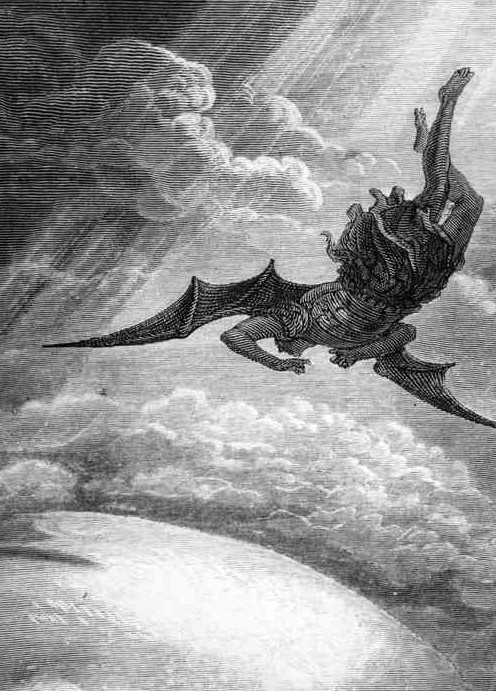
This chapter becomes one of the strongest biblical foundations for the doctrine of a pre-earthly rebellion.
Major Themes
War in heaven.
Michael.
The dragon.
One-third of the stars.
The casting down of Satan.
Interpretive Agreement
Virtually every major Christian tradition identifies the dragon as Satan.
Differences arise concerning chronology.
Some interpret the war symbolically.
Others connect it with Christ’s victory at the Cross.
Adventists generally understand Revelation 12 to encompass multiple stages of the controversy:
- original rebellion
- Christ’s victory
- continuing conflict
- final judgment
Ellen White’s Great Controversy Theme
No theological idea appears more frequently in Ellen White’s writings than the Great Controversy.
Rather than viewing redemption merely as individual salvation, she frames Scripture as one continuous conflict between Christ and Satan.
She repeatedly argues:
God’s government is founded upon love.
Love requires freedom.
Freedom allows genuine choice.
Choice permits rebellion.
Rebellion necessitates redemption.
Christ reveals God’s character.
The Cross ultimately answers Satan’s accusations.
This framework organizes much of Patriarchs and Prophets, The Desire of Ages, and The Great Controversy.
Scholarly Observations
Many historians note that Ellen White’s “Great Controversy” motif differs from classical Augustinian theology by placing greater emphasis on cosmic conflict than inherited guilt.
Modern Adventist scholars—including Richard Davidson, Ángel Manuel Rodríguez, Gerhard Pfandl, and Jiří Moskala—have explored this biblical metanarrative extensively.
Outside Adventism, scholars such as Gregory Boyd have similarly emphasized the “warfare worldview,” though with different theological conclusions.
Looking Ahead
Genesis 3 moves the conflict from heaven to earth.
The serpent’s question—
“Has God indeed said…?”
becomes the first recorded challenge to divine revelation.
The remainder of Scripture can be read as humanity’s response to that question.
Will God’s word be trusted?
Or will another voice redefine truth?