




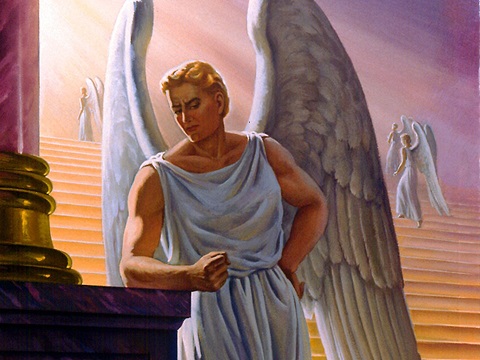
A Story of God’s Patience, Love, Mercy, and the Promise That Sin Will Never Rise Again
Where did evil come from?
It is one of the oldest and most difficult questions humanity has ever asked.
If God is good, why is there evil?
If God is loving, why is there suffering?
If God is all-powerful, why didn’t He simply stop Satan at the beginning?
And perhaps the most difficult question of all:
If God knew what would happen, why did He allow Lucifer to continue his rebellion for so long?
The Bible does not answer every philosophical question about the origin of evil. But it does tell us something far more important.
It tells us what God is like.
And when we look at the origin of evil through the biblical story of the Great Controversy, we discover something remarkable:
God’s response to rebellion was not immediate destruction. It was patience.
God bore long with Lucifer.
He gave His intelligent creatures freedom.
He allowed questions to be raised.
He permitted the universe to see the consequences of rebellion.
And when humanity fell, God did not abandon us.
Instead, He came looking for Adam and Eve.
Ultimately, God Himself came to this world in the person of Jesus Christ.
The story of evil therefore does not begin with God’s absence.
It begins with God’s love being challenged.
And it ends with God’s love being vindicated.
1. Before There Was Sin, There Was Love
The Bible begins with God.
” In the beginning God created the heavens and the earth” (Genesis 1:1).
And the New Testament takes us even deeper.
Paul tells us that through Christ “all things were created”—things in heaven and things on earth (Colossians 1:16).
That means the universe did not begin with chaos, hatred, or evil.
It began with God.
And God is love.
John tells us that God loved the Son “before the foundation of the world” (John 17:24).
This is an extraordinary thought.
Before humanity existed, before sin existed, before our planet was created, there was already love within the Godhead.
The universe was not created because God was lonely.
It was not created because God needed servants.
It was created by a God whose very character is self-giving love.
Creation was an invitation to experience that love.
Angels were created.
Human beings were created.
Life was created.
Freedom was created.
And freedom is essential to genuine love.
A being who has no ability to choose cannot truly love.
God could have created creatures who were programmed to obey Him.
But God wanted something more.
He wanted children who would love Him because they knew Him.
2. Lucifer Was Created—He Was Not Eternal
This is an important starting point.
Lucifer was not God’s opposite.
He was not an eternal evil power competing with an eternal good power.
Christianity is not dualism.
There are not two equally powerful gods—one good and one evil.
There is one Creator.
Everything else is created.
Colossians 1:16 places Christ on the Creator side of that distinction. Everything created—including heavenly beings—owes its existence to Him.
Ezekiel 28 describes a being who was created, beautiful, intelligent, and originally blameless.
The passage says:
“You were the anointed cherub who covers.”
And then:
“You were perfect in your ways from the day you were created.”
The passage goes on to say:
“Till iniquity was found in you.”
(Ezekiel 28:12–15)
From the Seventh-day Adventist perspective, this passage is understood as reaching beyond the earthly king of Tyre and giving a glimpse into the supernatural rebellion behind the earthly conflict.
Isaiah 14 similarly addresses the king of Babylon but contains language that Adventists understand as revealing the deeper rebellion of Lucifer:
“I will ascend into heaven… I will exalt my throne…”
and ultimately:
“I will be like the Most High.”
(Isaiah 14:13–14)
The important point is not merely that Lucifer wanted a higher position.
The deeper problem was self-exaltation.
Lucifer began looking away from the character of God and toward himself.
The center shifted.
From God—
to self.
From love—
to ambition.
From trust—
to suspicion.
From service—
to self-exaltation.
And that is the beginning of sin.
3. The Mystery of Sin
Here we must be humble.
The Bible tells us that sin began with Lucifer.
But it does not tell us why a perfect being in a perfect environment first decided to distrust God.
There is no rational justification for sin.
Ellen G. White expressed this mystery very carefully in The Great Controversy, explaining that the origin of sin cannot be explained in a manner that gives a reason for its existence.
That is an important distinction.
We can understand the nature of rebellion without being able to explain why a perfect being first chose it.
Sin is irrational.
It is rebellion against reality.
It is choosing self over love.
It is distrusting the One who is completely trustworthy.
It is attempting to separate the creature from the Creator while continuing to enjoy the Creator’s gifts.
This is why the Bible does not present God as the author of evil.
James tells us that God is not the source of temptation to evil.
God created free beings.
Freedom made love possible.
But freedom also made rebellion possible.
And God was willing to accept that risk because love without freedom is not love.
4. What Did Lucifer Question?
This is where the Great Controversy theme becomes especially important.
Ellen White’s presentation emphasizes that Satan’s rebellion was fundamentally connected with questions about God’s character and government.
Was God’s government really fair?
Was God’s law really necessary?
Could God’s creatures be trusted to govern themselves?
Was God’s authority truly motivated by love?
The official Seventh-day Adventist statement of Fundamental Belief #8 describes the Great Controversy as a conflict concerning “the character of God, His law, and His sovereignty over the universe.”
This is extraordinarily important.
The central issue was not simply:
“Who is stronger?”
God never needed to prove that He was stronger than Lucifer.
God is the Creator.
The deeper issue was:
“Can God be trusted?”
That question has echoed throughout human history.
And it is still being asked today.
5. Why Didn’t God Destroy Lucifer Immediately?
This may be one of the most important questions in the entire story.
If God knew Lucifer was going to rebel, why didn’t He simply destroy him?
If God had immediately erased Lucifer and his followers, the universe might have continued—but questions would remain.
What would God’s creatures have thought?
Perhaps some would obey God because they were afraid.
Perhaps they would wonder:
“Was Lucifer actually right?”
“Was God’s government really oppressive?”
“What happens when someone questions God?”
Fear can produce obedience.
But fear cannot produce love.
God wanted something deeper.
Ellen White describes God’s response as extraordinarily patient. She writes that “in great mercy” God bore long with Lucifer as the spirit of discontent and rebellion developed.
This is one of the most beautiful insights in the Great Controversy theme.
God did not immediately destroy His rebellious creature.
He gave him time.
God was patient.
God was merciful.
God allowed Lucifer’s accusations to become visible.
God allowed the universe to witness what separation from God actually produces.
This is not divine weakness.
It is divine wisdom.
6. God Reveals His Character
Why was God willing to be patient?
Because His character is revealed in Exodus 34:
“The LORD, the LORD God, merciful and gracious, longsuffering, and abounding in goodness and truth.”
(Exodus 34:6)
Notice the first descriptions God gives of Himself.
Merciful.
Gracious.
Longsuffering.
Abounding in goodness.
This is the God who confronted rebellion.
This is the God who dealt with Lucifer.
This is the God who dealt with Adam and Eve.
This is the God who deals with you and me.
God does not become loving only after Jesus comes to earth.
Jesus came because God already loved us.
The cross does not persuade God to love humanity.
The cross reveals how much God already loved humanity.
7. God Was Patient With Lucifer—But Sin Was Not Harmless
Patience does not mean indifference.
God’s patience toward Lucifer did not mean that rebellion was harmless.
Ezekiel describes the tragic transformation:
“You were perfect in your ways… till iniquity was found in you.”
Eventually the rebellion became destructive.
Ezekiel 28:18–19 describes the devastating consequences and concludes with a solemn picture of final destruction.
This is important because God’s patience has a purpose.
God is not delaying evil forever.
He is not permitting suffering because He enjoys watching His creatures suffer.
He is allowing the full consequences of rebellion to become known.
And there is a final reason for this:
God wants the universe to understand that sin cannot be allowed to return.
8. The Rebellion Reached Earth
Then came humanity.
God created Adam and Eve in His image.
They were given freedom.
They were surrounded by beauty.
They knew God.
They lived in a perfect world.
But the serpent introduced the same question Lucifer had raised in heaven:
Can God really be trusted?
“You shall not surely die.”
That was not merely a statement about fruit.
It was an attack on God’s character.
Satan suggested that God was withholding something good.
He suggested that God’s command was unnecessarily restrictive.
He suggested that human beings could achieve something greater by separating themselves from God.
The same rebellion that began in heaven now entered the human family.
And the tragedy of Genesis 3 is that humanity believed the lie.
9. Yet God Came Looking
Now comes one of the most beautiful moments in Scripture.
After Adam and Eve sinned, God came into the garden.
He asked:
“Where are you?”
God knew where they were.
The question was not for God’s information.
It was an invitation.
“Come out of hiding.”
Humanity ran from God.
God ran toward humanity.
That is the gospel.
The first human response to sin was hiding.
God’s first response was seeking.
Humanity said, in effect:
“We are afraid of You.”
God answered:
“Where are you?”
That pattern continues throughout Scripture.
God pursues.
God calls.
God warns.
God forgives.
God restores.
God waits.
God saves.
10. The Cross Reveals What God Is Really Like
The ultimate answer to Satan’s accusations is not an argument.
It is a Person.
Jesus Christ.
Paul writes that “God was in Christ reconciling the world to Himself” (2 Corinthians 5:19).
Think about that.
The God accused of being harsh, distant, arbitrary, and self-centered came to earth and allowed Himself to be nailed to a cross.
Jesus did not come demanding that humanity die for God.
Jesus came and died for humanity.
Hebrews 2:14 tells us that through death Christ would destroy the one who had the power of death—that is, the devil.
The cross therefore accomplishes several things.
It reveals God’s love.
It exposes Satan’s hatred.
It demonstrates the seriousness of sin.
It provides forgiveness.
It defeats the enemy.
And it opens the way for humanity to return home.
At Calvary, the universe sees something astonishing:
God would rather suffer Himself than abandon His children.
11. Hebrews 1:6—The Universe Is Called to Worship Christ
Hebrews 1:6 commands:
“Let all the angels of God worship Him.”
Why is that significant?
Because Christ is not merely another created being.
He is the divine Son.
He is Creator.
He is Savior.
He is Lord.
Lucifer wanted the worship that belongs to God.
Jesus, by contrast, did not grasp for glory.
Philippians 2 describes Christ as humbling Himself and becoming obedient even to death on the cross.
This gives us a remarkable contrast.
Lucifer said:
“I will exalt myself.”
Jesus demonstrated:
“I will humble Myself.”
Lucifer sought the throne through self-exaltation.
Jesus came from the throne to the cross through self-giving love.
This is the fundamental contrast between the two kingdoms.
12. God Is Not Trying to Win a Power Struggle
This is perhaps the most important theological point.
God does not need to defeat Satan because God is stronger.
God’s ultimate purpose is to reveal the truth.
God wants every intelligent being to understand:
His government is righteous.
His law is love.
His motives are pure.
His judgments are fair.
His mercy is real.
His patience is extraordinary.
His salvation is freely offered.
And eventually:
Sin must end.
Not because God has lost His patience.
But because sin has been demonstrated to be destructive.
13. Why Has God Allowed Evil to Continue?
We now live thousands of years after Eden.
People still ask:
“Why doesn’t God end this?”
The Bible gives us part of the answer.
God is patient because He desires salvation.
Peter explains that God is “longsuffering toward us, not willing that any should perish but that all should come to repentance” (2 Peter 3:9).
God’s delay is not neglect.
It is mercy.
Every additional day of history is another day in which someone can hear the gospel.
Another person can turn toward Christ.
Another sinner can be forgiven.
Another prodigal can come home.
Another human being can discover:
God really does love me.
That is why the overarching theme of the Great Controversy should never be fear.
It should be hope.
14. God’s Patience With Humanity
Think about how patient God has been with the human race.
He was patient with Adam.
Patient with Cain.
Patient with the antediluvian world.
Patient with Israel.
Patient with David.
Patient with Nineveh.
Patient with Peter.
Patient with Thomas.
Patient with Saul of Tarsus.
And patient with you and me.
The same God who bore long with Lucifer continues to bear long with humanity.
His patience is not approval of sin.
His patience is an opportunity for repentance.
Exodus 34:6–7 holds these truths together.
God is merciful.
God is gracious.
God is longsuffering.
But God also takes sin seriously.
Love does not pretend that evil is harmless.
Real love ultimately destroys what destroys its children.
15. The Day Evil Will Finally End
The Bible does not teach that evil will exist forever.
That is tremendously good news.
Malachi describes the final destruction of evil as a fire that leaves neither root nor branch.
Malachi 4:1 points toward a day when evil will be completely consumed.
And Nahum gives us one of the most reassuring promises in Scripture:
“Affliction will not rise up a second time.”
(Nahum 1:9)
Think about that.
God does not merely promise to end the current outbreak of sin.
He promises something much greater:
Sin will never return.
There will be no second rebellion.
No second Lucifer.
No second Eden tragedy.
No second Calvary.
No second Holocaust.
No second war.
No second funeral.
No second child crying because of violence.
No second world where sin begins again.
God will end evil permanently.
16. Why Does God Have to Destroy Evil?
Because love cannot forever coexist with destruction.
Imagine a world in which cancer never ended.
Imagine a world in which war never ended.
Imagine a world in which abuse, murder, hatred, betrayal, injustice, disease, and death continued forever.
That would not be heaven.
God’s final eradication of evil is not contrary to His love.
It is the ultimate expression of His love.
He destroys sin because He loves His creation.
He ends death because He loves life.
He removes suffering because He loves His children.
He eliminates rebellion because He wants peace to remain forever.
17. The Universe Will Never Forget the Cross
There is another profound reason God has allowed the Great Controversy to unfold.
The universe will forever understand what sin really is.
And it will forever understand what God is really like.
The cross will remain the eternal evidence.
The Creator became part of His creation.
The Almighty became vulnerable.
The Judge became the One who was judged.
The innocent One was condemned so guilty people could be forgiven.
God did not merely tell us He loves us.
He demonstrated it.
18. The Great Controversy Is Ultimately About God’s Character
This is why Ellen White’s Great Controversy theme is so powerful.
The battle is not ultimately between two competing gods.
It is between truth and deception.
Between self-exaltation and self-giving love.
Between trust and suspicion.
Between God’s government and Satan’s accusations.
The Adventist understanding emphasizes that Satan continually seeks to misrepresent God’s character. The official Adventist presentation of Ellen White’s Great Controversy teaching highlights this theme repeatedly.
And that means the most important question in the Great Controversy is not:
“How powerful is Satan?”
The most important question is:
“What is God really like?”
Jesus gives us the answer.
Look at Christ.
Look at the cross.
Look at His treatment of sinners.
Look at how He treated the woman caught in adultery.
Look at how He treated Peter after Peter denied Him.
Look at how He touched lepers.
Look at how He welcomed children.
Look at how He prayed for His executioners.
Look at Calvary.
Then ask:
Could this God be cruel?
No.
This is the God who says:
“Come to Me.”
This is the God who says:
“I will never leave you.”
This is the God who searches for the lost sheep.
This is the God who waits for the prodigal son.
This is the God who gives His only Son.
19. God Wants Us to Know His Character
The Great Controversy therefore changes the way we think about salvation.
Salvation is not simply escaping punishment.
It is learning to trust God.
It is discovering what He is really like.
It is allowing the Holy Spirit to restore His image in us.
It is moving from fear to trust.
From suspicion to faith.
From self-exaltation to humility.
From rebellion to love.
From hiding to relationship.
That is why Jesus said:
“If you have seen Me, you have seen the Father.”
Jesus is God’s answer to Satan’s accusations.
20. The Final Victory Will Be Complete
Eventually the Great Controversy will end.
Ezekiel 28:18–19 points toward the destruction of the one who rebelled.
Malachi 4:1 describes the final consuming of evil.
Nahum 1:9 assures us that affliction will not arise a second time.
And Revelation 21 gives the final picture:
No more death.
No more sorrow.
No more crying.
No more pain.
The story that began with rebellion ends with restoration.
The garden that was lost will be restored.
The separation between God and humanity will be gone.
The universe will be clean.
And God’s children will finally understand what He has been saying all along:
He is love.
21. What Does the Origin of Evil Mean for You and Me?
This subject is not merely ancient history.
It is intensely personal.
Every day we face the same fundamental choice that confronted Lucifer.
Who will be at the center?
God—
or self?
Will I trust God when I do not understand?
Will I believe His character when circumstances seem to contradict His goodness?
Will I believe His promises when life is painful?
Will I trust Jesus even when I cannot see the entire picture?
The Great Controversy teaches us that faith is not merely believing that God exists.
Faith is believing that God is good.
And sometimes that is the greatest act of faith we can make.
22. The Most Hopeful Truth in the Story
The story of evil could have been a story of tragedy.
But God turned it into a story of redemption.
Lucifer rebelled.
Humanity fell.
The world became broken.
Death entered.
Suffering multiplied.
But God came closer.
He did not walk away.
He did not abandon His creation.
He entered our world.
He became one of us.
He suffered with us.
He died for us.
He rose again.
He defeated Satan.
He offers forgiveness.
He promises resurrection.
And He will return.
The Great Controversy will end.
Sin will disappear.
Death will die.
And God’s children will live forever.
23. The God Who Waits
Perhaps the most beautiful way to understand the origin of evil is to understand what God’s patience tells us about Him.
God could have destroyed Lucifer immediately.
But He waited.
God could have abandoned humanity in Eden.
But He came looking.
God could have left humanity to die.
But He gave His Son.
God could end the world immediately.
But He continues to wait for people to come home.
Why?
Because God loves people.
Second Peter says He is patient because He does not want people to perish.
The delay of judgment is therefore also an expression of mercy.
Every sunrise is another invitation.
Every breath is another opportunity.
Every sermon is another invitation.
Every page of Scripture is another invitation.
Every whisper of the Holy Spirit is another invitation.
And the invitation is remarkably simple:
Come home.
24. The Final Answer to Evil
We may never completely understand why Lucifer chose rebellion.
Perhaps we were never meant to.
But we can understand the answer God has given.
God has answered evil with love.
He has answered rebellion with patience.
He has answered accusation with truth.
He has answered sin with grace.
He has answered death with resurrection.
He has answered Satan with Christ.
And He will answer the existence of evil with its complete and final eradication.
The day is coming when the universe will never again ask whether God is trustworthy.
Every question will have been answered.
Every accusation will have been exposed.
Every tear will have been wiped away.
Every wound will have been healed.
And every redeemed person will know:
God was right to love.
God was right to wait.
God was right to save.
God was right to end sin forever.
And perhaps the final lesson of the Great Controversy is this:
God’s patience is not weakness. His mercy is not compromise. His love is not sentimental. His grace is the very heart of His government.
The origin of evil began when a created being said:
“I will.”
The victory of God is revealed in Christ, who said:
“Not My will, but Yours, be done.”
And the story ends with the entire universe united in love, trust, worship, and peace.
Because the God who created everything—
the God who patiently endured rebellion—
the God who came searching for His fallen children—
the God who gave His Son—
is the God who will finally make all things new.
And sin will never rise again.