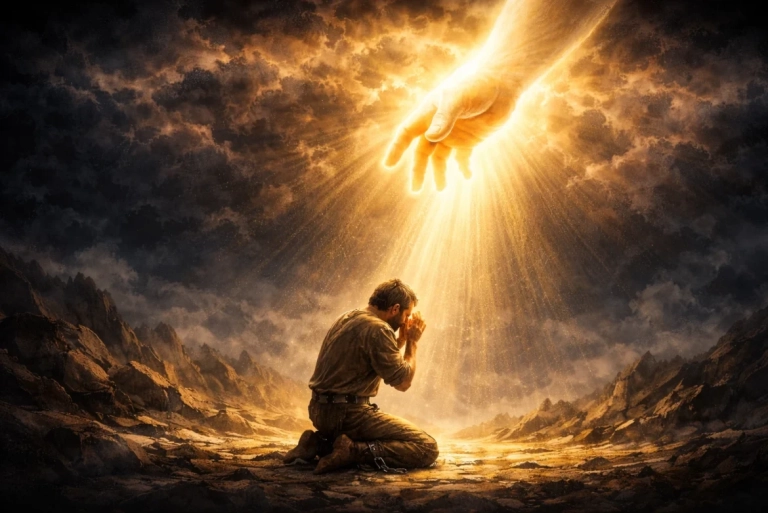





Few subjects evoke more fear, confusion, or sadness than God’s final judgment, otherwise known as hell. And why wouldn’t it? Longstanding Christian beliefs about hell depict a horrifying image: an eternal torture chamber where the wicked remain alive and conscious forever, suffering endlessly in flames without hope.
Unsurprisingly, this image has caused countless people to wonder how a God described in Scripture as “love” (1 John 4:8) could also be the author of never-ending torment.
But what if the Bible presents a far different picture of hell?
What if God’s final judgment is not an act of perpetual torture, but a truly final and complete removal of sin, suffering, and death itself? What if hell isn’t forever?
What the Bible actually says about hell is good news, demonstrating that:
- God’s justice is perfect
- God’s mercy is great
- And His universe will one day be free from evil—forever!
The Fundamental Good News About Judgment and Hell
For many, the word “judgment” carries a negative connotation, especially in spiritual contexts. However, the Bible reminds us that God’s judgment is not focused on condemning the wicked. Jesus, who illustrated the heart of God to the universe through His earthly ministry and death on the cross, said:
“For God did not send His Son into the world to condemn the world, but that the world through Him might be saved.” (John 3:17)
The Bible adds that judgment actually begins with God’s own people, the redeemed. Writing to fellow believers, Peter pens:
“For the time has come for judgment to begin at the house of God; and if it begins with us first, what will be the end of those who do not obey the gospel of God?” (1 Peter 4:17)
God’s purpose in judgment is to reveal truth and vindicate His character. Ultimately, He will bring justice to every person. This may sound scary, but we know that God wants to save all people and has given each of us the chance to be saved through Jesus. This, in and of itself, is good news about hell: God does not delight in condemnation.
Is Hell Forever? What the Bible Actually Says
‘The Wages of Sin Is Death’
Perhaps the clearest statement about the final judgment/penalty for sin can be found in Romans.
“For the wages of sin is death, but the gift of God is eternal life in Christ Jesus our Lord.” (Romans 6:23)
Notice that the Bible does not contrast eternal life in heaven with eternal life in torment.
Instead, it contrasts:
- Eternal life
- Death
Only those who receive Christ receive immortality. (Eternal life is God’s gift; it is not an inherent feature of humanity.) The alternative to receiving Christ is death, not everlasting life in misery.
The prophet Ezekiel says the same thing:
“The soul who sins shall die” (Ezekiel 18:4).
The Bible is clear: the penalty for sin is the complete loss of life, which means hell cannot last forever.
‘Everlasting Destruction’
Paul explains the final judgment this way:
“These shall be punished with everlasting destruction from the presence of the Lord and from the glory of His power.” (2 Thessalonians 1:9)
Just as eternal redemption does not require Christ to continually redeem His people forever (Hebrews 9:12), everlasting destruction does not require endless destroying. The punishment for sin is everlasting because its results are everlasting. The destruction of the wicked is permanent.
‘Like Natural Brute Beasts’
Peter describes the fate of those who persistently reject God:
“But these, like natural brute beasts made to be caught and destroyed . . . will utterly perish in their own corruption.” (2 Peter 2:12)
This is a powerful verse to study when pursuing knowledge about what the Bible actually says about hell. Peter uses clear language of destruction, dismissing the idea that God’s final judgment will preserve suffering.
‘Unquenchable Fire’ – A Fire That Consumes
John the Baptist spread the good news about hell using agricultural imagery:
“ . . . [Christ] will thoroughly clean out His threshing floor, and gather His wheat into the barn; but He will burn up the chaff with unquenchable fire.” (Matthew 3:12)
The analogy is clear: the “unquenchable fire” of the final judgment is not a fire that burns forever but a fire that cannot be extinguished until it has completely consumed what it was sent to destroy. John was emphasizing the certainty and completeness of God’s judgment.
‘Prepared for the Devil and His Angels’
On the day of final judgment, Jesus will declare to those who refused God’s grace:
“Depart from Me, you cursed, into the everlasting fire prepared for the devil and his angels” (Matthew 25:41).
Scripture never says that the devil will preserve sinners alive forever, nor does it say that he will exist forever. (In fact, it clearly states just the opposite; see Ezekiel 28:18–19). The fire prepared for Satan and his angels is everlasting because its effects are everlasting.
‘Neither Root Nor Branch’
The prophet Malachi gives the clearest Old Testament description of hell, framing the event as good news:
“ ‘For behold, the day is coming, burning like an oven, and all the proud, yes, all who do wickedly will be stubble. And the day which is coming shall burn them up,’ says the LORD of hosts, ‘That will leave them neither root nor branch. But to you who fear my name the Sun of Righteousness shall arise with healing in His wings . . . ’ ” (Malachi 4:1–2)
Stubble. Neither root nor branch. Nothing survives.
The fire of final judgment consumes, destroys, burns up completely.
‘Able to Destroy Both Soul and Body in Hell’
Jesus Himself taught:
“And do not fear those who kill the body but cannot kill the soul. But rather fear Him who is able to destroy both soul and body in hell.” (Matthew 10:28)
Jesus did not say that God will torment souls in hell forever. He said that God will destroy the wicked.
‘Reserved for Fire’
Peter compares the final judgment to Noah’s Flood:
“ . . . the world that then existed perished, being flooded with water. But the heavens and the earth which are now preserved by the same word, are reserved for fire until the day of judgment and perdition of ungodly men. . . . the heavens will pass away with a great noise, and the elements will melt with fervent heat.” (2 Peter 3:6–7, 10)
The fire of God’s judgment is universal. It will cleanse Earth completely to make way for a restored kingdom.
‘The Furnace of Fire’
Jesus described the destiny of the wicked:
“The Son of Man will send out His angels, and they will gather out of His kingdom all things that offend and those who practice lawlessness, and will cast them into the furnace of fire. There will be wailing and gnashing of teeth.” (Matthew 13:41–42)
There is sorrow and regret. There is judgment. But Scripture consistently points toward the complete removal of evil, not its endless preservation.
‘The Second Death’
One element of hell that may confuse people or lead them to believe that it lasts forever is the Bible’s teaching of a resurrection of the wicked:
“But the rest of the dead did not live again until the thousand years were finished.” (Revelation 20:5a)
After the Millennium, a 1,000-year period in which the redeemed will reign with God in heaven, the wicked will be resurrected to face judgment. Then comes the final judgment: final destruction. The scene is remarkably clear:
“Fire came down from God out of heaven and devoured them.” (Revelation 20:9b)
“Then Death and Hades were cast into the lake of fire. This is the second death.” (Revelation 20:14)
In the “lake of fire,” the wicked will experience the second death, an eternal death—the very opposite of eternal life. They will be “devoured.” Consumed. Finished.
The final judgment permanently removes sin, sinners who refuse God’s grace, and death itself from the universe. This is really good news: the hell event will pave the way for the world described in Revelation 21:4, which says:
“And God will wipe away every tear from their eyes; there shall be no more death, nor sorrow, nor crying. There shall be no more pain, for the former things have passed away.” (Revelation 21:4)
‘Ashes Under Your Feet’
Malachi completes the picture of the final judgment:
“You shall trample the wicked, for they shall be ashes under the soles of your feet . . . ” (Malachi 4:3)
Ashes follow complete destruction, clearly demonstrating that God’s universe will not contain an eternal torture chamber. Hell will NOT last forever.
Why the Final Judgment Is Truly Good News
Describing one of the greatest assurances in Scripture, God’s promise of a restored world, Peter wrote:
“Nevertheless we, according to His promise, look for new heavens and a new earth in which righteousness dwells.” (2 Peter 3:13)
Imagine a universe where:
- No hospitals exist
- No funerals are held
- No abuse occurs
- No tears are shed
- No evil remains
- Death itself has forever disappeared
That is God’s plan for us, an existence in which “the righteous will shine forth as the sun in the kingdom of their Father” (Matthew 13:43).
Daniel foresaw this glorious conclusion to the great controversy between good and evil.
“But the saints of the Most High shall receive the kingdom, and possess the kingdom forever, even forever and ever. . . . The Ancient of Days came, and a judgment was made in favor of the saints of the Most High, and the time came for the saints to possess the kingdom. . . . Then the kingdom and dominion and the greatness of the kingdoms under the whole heaven, shall be given to the people, the saints of the Most High. His kingdom is an everlasting kingdom . . . ” (Daniel 7:18, 22, 27)
The Bible repeatedly proclaims that the saints live forever. It never says that sinners live forever.
The Good News About Hell Summed Up
The good news about hell is not that judgment disappears. Judgment is real. Sin matters, as do our choices. Every person will one day stand before “the judgment seat of Christ” (Romans 14:10). The good news about hell is this:
God’s justice is perfectly proportionate, completely fair, and ultimately restorative to the universe.
The final judgment will end evil, rebellion, war—all of sin’s consequences! There will never be another murder, cancer diagnosis, or broken heart. The redeemed will live forever in joy and peace. And you can be a part of this kingdom.
Simply look to the cross of Christ: it reveals God’s justice and love. Jesus willingly bore your sins so that you do not have to experience the second death. As Romans 6:23 reminds us, “the wages of sin is death, but the gift of God is eternal life in Christ Jesus our Lord.”
This is the heart of the Gospel. This is God’s desire for you, for all humans!
He does not delight in the death of the wicked. He yearns for every person to repent, trust in Christ, and receive the gift of everlasting life. Isaiah 28:21 calls hell God’s “awesome work” and “His unusual act.” Why? Because this final judgment event will eradicate sin so that love, righteousness, and peace may reign forever.
This is truly good news.
Related Articles:
Want to learn more about the beautiful future God has planned for you? Check out our study guides, videos, podcasts, and more!
Scripture quotations are taken from the New King James Version®. Copyright © 1982 by Thomas Nelson. Used by permission. All rights reserved.