

The Grand Story of Scripture: From Adam to the New Creation
by Reiner Kremer
How Paul’s “In Christ” Theology Fulfills the Entire Biblical Story
One of the greatest misunderstandings about the Apostle Paul is the idea that he invented a new theology after the resurrection of Jesus. Nothing could be further from the truth. Paul saw himself not as an innovator, but as an interpreter of the story God had been telling from the opening chapters of Genesis.
His great phrase—ἐν Χριστῷ (en Christō), “in Christ”—is not a theological novelty. It is the culmination of the covenant story that begins in Eden, unfolds through Abraham and Israel, reaches its decisive fulfillment in Jesus the Messiah, and finally blossoms into the new creation when Christ returns.
The entire Bible tells one coherent story.
It is the story of God’s unwavering purpose to restore humanity and all creation to loving communion with Himself.
The storyline can be traced through five great movements:
In Adam.
In Abraham.
In Israel.
In Christ.
In the New Creation.
These are not disconnected chapters. They are one unfolding drama of redemption.
Part One — In Adam: Humanity’s Lost Identity
The Bible begins not with sin, but with blessing.
Genesis opens with humanity created in the image of God. Adam and Eve are entrusted with the care of creation, commissioned to reflect God’s character, and invited into covenant fellowship with their Creator. Humanity’s original vocation was priestly and kingly: to represent God’s reign within His good creation.
This is the first expression of the Kingdom of God.
God dwells with humanity.
Humanity walks with God.
Creation flourishes under His loving rule.
Yet the serpent introduces a different kingdom.
The temptation in Genesis 3 is not merely to eat forbidden fruit. It is to redefine reality apart from God:
“You will be like God” (Genesis 3:5).
The essence of sin is not simply disobedience. It is autonomy—the attempt to establish identity and wisdom apart from the Creator.
The result is tragic.
Alienation from God.
Alienation from one another.
Alienation from creation.
Death enters the world.
Fear replaces trust.
Shame replaces innocence.
The Kingdom is fractured, though not destroyed.
Paul reflects on this catastrophe in Romans 5 and 1 Corinthians 15. Adam becomes the representative head of fallen humanity. To be “in Adam” is to share in the brokenness of a race marked by sin and mortality.
Yet even in judgment God speaks hope.
Genesis 3:15 contains the first gospel promise. The Seed of the woman will crush the serpent’s head, though He Himself will be wounded.
The entire biblical story unfolds from this promise.
The Great Controversy has begun—not merely a conflict over power, but a conflict over the truthfulness of God’s character. The serpent has accused God of withholding life. Every act of redemption that follows is God’s answer to that accusation.
Part Two — In Abraham: The Covenant of Blessing
Humanity continues its downward spiral through Babel, where people seek security and significance by building a tower to heaven.
God’s response is astonishing.
He does not begin with an empire.
He begins with one elderly, childless man.
“Go…and I will bless you…and in you all the families of the earth shall be blessed” (Genesis 12:1–3).
The covenant with Abraham reveals God’s missionary heart. Election is never favoritism. It is vocation. Abraham is chosen so that the nations may be blessed.
Paul seizes upon this promise in Galatians 3.
The gospel, he says, was preached beforehand to Abraham.
The covenant was always about Christ.
The promise was never merely land or descendants.
It was the restoration of humanity through the coming Messiah.
Faith becomes the defining mark of Abraham’s family.
Not ethnicity.
Not social status.
Not human achievement.
Those who share Abraham’s faith belong to Abraham’s family because they belong to Christ.
Paul is not inventing something new. He is reading Genesis through the lens of Jesus.
Part Three — In Israel: A Holy Nation and a Sanctuary People
Through Abraham’s descendants God forms Israel, not because they are superior to other nations, but because He intends them to become “a kingdom of priests and a holy nation” (Exodus 19:6).
Israel’s calling echoes humanity’s original vocation in Eden. They are to reflect God’s character before the nations.
At the center of Israel’s life stands the sanctuary.
The sanctuary is far more than a place of sacrifice. It is a visible proclamation of the gospel.
Its architecture echoes Eden. Cherubim adorn the curtains. The lampstand resembles the tree of life. God’s presence dwells among His people. Israel is invited to approach the Holy One through grace rather than fear.
Every sacrifice points beyond itself. Every priestly ministry anticipates a greater Priest. Every feast rehearses God’s saving acts and nourishes hope for the Messiah.
The sanctuary also reveals God’s response to sin. Sin is real and destructive, but God provides a gracious way of reconciliation. The sanctuary proclaims both His holiness and His mercy.
For Seventh-day Adventists, this sanctuary theme extends into Christ’s heavenly ministry. Hebrews portrays Jesus as our great High Priest who ministers in the heavenly sanctuary, applying the benefits of His once-for-all sacrifice and interceding for His people. The heavenly sanctuary does not replace the Cross; it unfolds the continuing ministry of the crucified and risen Lord until all things are made new.
Yet Israel repeatedly mistakes the sign for the substance. The covenant becomes external. Ritual eclipses relationship. National privilege overshadows the mission to bless the nations.
The prophets call Israel back to the heart of the covenant: justice, mercy, humility, and wholehearted love for God.
Part Four — In Christ: The Fulfillment of Every Promise
Into this story steps Jesus.
Matthew introduces Him as the Son of Abraham and the Son of David.
John calls Him the Word made flesh who “tabernacled” among us.
Paul calls Him the last Adam.
Jesus gathers all the threads of Scripture into Himself.
Where Adam failed, Jesus remains faithful.
Where Israel grumbled in the wilderness, Jesus overcomes temptation.
Where kings abused power, Jesus serves.
Where priests offered repeated sacrifices, Jesus offers Himself once for all.
He is the faithful Israelite, the true Temple, the perfect Priest, the spotless Lamb, the righteous King, and the promised Seed.
This is why Paul can say that all the promises of God find their “Yes” in Christ (2 Corinthians 1:20).
Paul’s phrase “in Christ” is covenant language. By faith, believers are united with the One who has fulfilled Israel’s vocation and humanity’s destiny.
Everything Adam lost is restored in Christ.
Everything Abraham anticipated is fulfilled in Christ.
Everything Israel foreshadowed finds its reality in Christ.
This is why baptism is so significant in Paul’s writings. It is not merely a ritual. It is participation in Christ’s own story. We die with Him, rise with Him, and begin a new life shaped by His resurrection.
The church, then, is not a replacement for Israel but the international covenant family gathered around Israel’s Messiah. Jews and Gentiles alike become “one new humanity” in Christ (Ephesians 2). The dividing wall is broken down because the covenant reaches its intended goal: blessing for all nations.
Part Five — In the New Creation: The Kingdom Made Visible
The story does not end with personal salvation.
It ends with cosmic renewal.
The prophets envisioned a renewed earth where justice, peace, and God’s presence fill creation.
Jesus proclaimed this hope when He spoke of “the renewal of all things” (Matthew 19:28). The Greek word palingenesia means regeneration or re-creation. God’s purpose is not to abandon His creation but to restore it.
Paul echoes this vision in Romans 8. Creation itself groans, awaiting liberation. The destiny of redeemed humanity and the destiny of creation are inseparable.
Revelation brings the story to its climax. John sees a new heaven and a new earth. God dwells with humanity once more. The tree of life returns. The river of life flows from God’s throne. There is no more curse.
Notice how the Bible ends where it began.
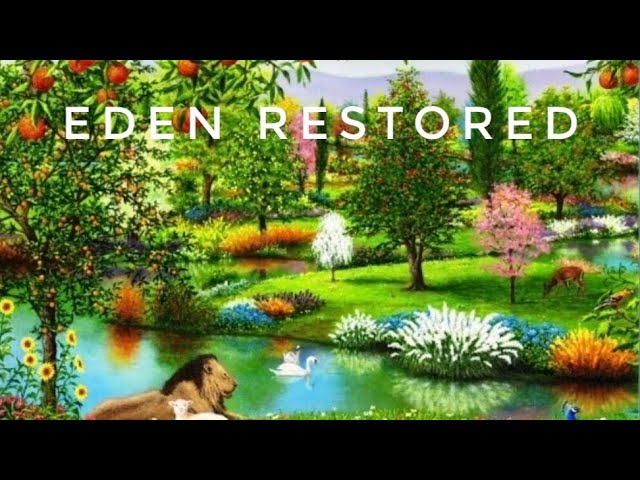
Genesis begins with God dwelling with humanity in a garden.
Revelation ends with God dwelling with humanity in a garden-city.
The Kingdom lost in Eden is restored—not by reversing history, but by redeeming it through Christ.
This is why the New Testament consistently speaks of believers as those who already belong to the age to come. Eternal life begins now because union with Christ begins now. Yet its fullness awaits His glorious appearing.
For Seventh-day Adventists, the Second Coming is therefore not an escape from the world but the public unveiling of God’s completed work of restoration. The resurrection of the dead, the renewal of creation, the final eradication of sin, and the vindication of God’s character before the universe all converge in that climactic event.
The investigative judgment, understood within the larger sanctuary framework, is not a contradiction of the gospel but an expression of it. It reveals before the watching universe that God’s judgments are righteous, His grace is effective, and His redeemed people stand secure because they are united with Christ. The final issue is not whether Christ’s sacrifice is sufficient—it is—but how that saving work has transformed a people who have trusted Him.
The Thread That Holds the Whole Bible Together
When we step back, a remarkable pattern emerges.
In Adam, humanity loses its identity.
In Abraham, God promises restoration.
In Israel, God illustrates redemption through covenant, priesthood, and sanctuary.
In Christ, every promise is fulfilled through His faithful life, atoning death, victorious resurrection, heavenly priesthood, and reigning lordship.
In the New Creation, God’s original purpose reaches its glorious completion as heaven and earth are united under Christ.
Paul’s theology is therefore not a departure from the Old Testament. It is its fulfillment.
The Kingdom that Jesus proclaimed is the Kingdom Paul explains.
The covenant God established with Abraham reaches its goal in Christ.
The sanctuary points to Christ’s priestly ministry.
The Great Controversy reaches its decisive turning point at Calvary and its final resolution when sin is forever abolished.
Adoption into God’s family is not an isolated doctrine but the restoration of humanity’s original calling as sons and daughters who reflect the Father’s character.
And the new earth is not merely heaven relocated. It is creation finally healed, where God’s dwelling is once again with humanity, His image fully restored in His people, and His kingdom established forever.
The story of Scripture is therefore one story.
It begins with a garden.
It ends with a garden-city.
It begins with humanity hiding from God.
It ends with humanity seeing His face.
It begins with exile.
It ends with home.
And at the center of the entire story stands Jesus Christ—the faithful Second Adam, the true Seed of Abraham, the faithful Israel, the great High Priest, the crucified Lamb, the risen Lord, and the coming King.
As Paul writes in Ephesians 1:10, God’s eternal purpose is “to unite all things in Christ, things in heaven and things on earth.”
That single sentence may be the best summary of the Bible ever written.
The whole story is God’s gracious work of bringing a fractured universe back into harmony under the lordship of Jesus Christ. To be “in Christ” is therefore to discover not only who we are, but where history itself is headed. It is to live today in the light of the coming Kingdom, participating now in the life that will one day fill the renewed creation with the glory of God.