



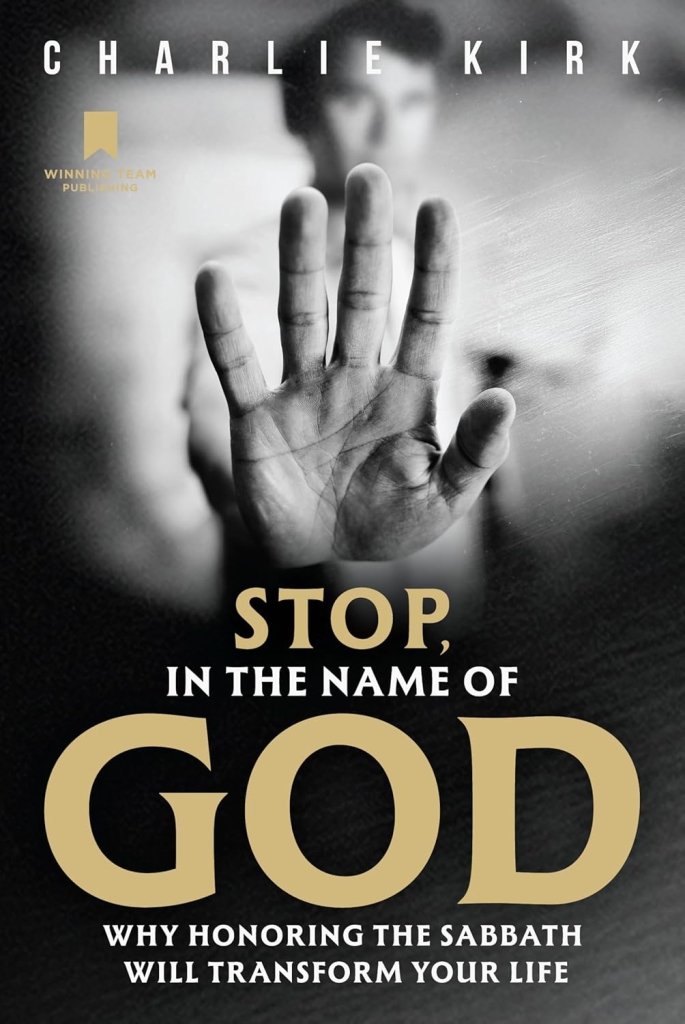
Stop, in the Name of God: Why Honoring the Sabbath Will Transform Your Life
This book by Charlie Kirk, who I listened to in person earlier this year at the Dream City Church, March 29, 2025, presented and supported the practice of seventh-day Sabbath keeping.
There are different Christian views about how the Sabbath applies today, so I’ll note where the Bible is straightforward and where careful interpretation is required. I’ll cite the key passages and recent writing about Kirk’s book so you can follow up.
1) Core biblical texts and the simple argument
- Creation as the foundation (Genesis 2:1–3).
Genesis presents God creating in six days and “resting” on the seventh day, and the text says God “blessed the seventh day and made it holy.” Many who defend a seventh-day Sabbath take this as the root: the rhythm of six days of work and one day of rest is established at creation, before the Mosaic covenant. This is the narrative anchor that the rest (and a seventh-day pattern) is woven into the created order. - The fourth commandment (Exodus 20:8–11).
When the Decalogue is given, the Sabbath command ties the practice to creation language: “Remember the Sabbath day, to keep it holy… for in six days the LORD made heaven and earth…and rested on the seventh day.” For many interpreters this shows the Sabbath is not merely a social custom but a commanded rhythm grounded in God’s creative act. - The Sabbath as a covenant sign (Exodus 31:12–17).
Exodus later calls Sabbath-keeping a “sign between me and you” and describes it as a perpetual covenant for Israel. That verse is often used to argue the Sabbath has covenantal significance (like circumcision historically did): it identifies God’s people and marks them as set apart. How that “covenant sign” language applies to non-Israelite believers is one of the interpretive questions Christians debate. - The New Testament perspective — Hebrews and “God’s rest.”
The writer of Hebrews reflects on Sabbath-rest language and argues that “there remains a Sabbath-rest for the people of God” (Hebrews 4). Hebrews ties the idea of Sabbath to the deeper spiritual reality of resting in God’s finished work (and points back to the Eden/creation motif). Interpreters differ about whether Hebrews requires literal observance of a seventh-day weekly Sabbath or whether it uses Sabbath as a typological picture of the believer’s spiritual rest in Christ — but Hebrews definitely preserves the theological importance of rest as part of God’s plan.
2) How theologians typically frame these texts (briefly)
- Creation → command → covenant: many who argue for a continuing seventh-day Sabbath move from Genesis (pattern) → Exodus (command) → Exodus 31 (sign) → Hebrews (typology and abiding rest). Together these passages form the spine of the traditional seventh-day case.
- Two major Christian approaches:
- Seventh-day continuity: the Sabbath as a moral/perpetual command grounded in creation and therefore still binding as a weekly seventh-day rest (often practiced from Friday sundown to Saturday sundown).
- Typological/fulfillment view: the Sabbath points to Christ and eternal rest; the weekly strict letter of Saturday observance is not required of Christians, though the principle of regular rest is. Hebrews is a central text for this line of thought.
3) Practical emphases in the Biblical material
- Rest for all (social justice angle): Exodus 20’s Sabbath instructions include servants and even animals — the Sabbath was designed to give rest across social lines. That ethical element (care for others through a rhythm of rest) is prominent in Old Testament law.
- Sabbath as worship and holiness: Psalmic and prophetic literature repeatedly links rest and worship (the day is set apart, holy). Exodus 31 explicitly calls Sabbath observance a sanctifying mark.
- Typology toward ultimate rest: Hebrews encourages entering God’s rest by faith; the weekly rhythm is a signpost to a final, spiritual rest with God. That gives Christian Sabbath practice an eschatological flavor whether one keeps Saturday specifically or adopts Sunday or another holy practice as the church developed.
4) How Charlie Kirk’s Stop, in the Name of God fits this Biblical picture
Charlie Kirk’s book, subtitled Why Honoring the Sabbath Will Transform Your Life, is a contemporary cultural and spiritual argument for recovering seventh-day Sabbath practice. Recent coverage and reviews summarize his thrust: Kirk treats Sabbath observance as a corrective to modern hustle culture, a practical discipline rooted in scripture that can renew families, communities, and spiritual life. The book frames seventh-day Sabbath not merely as a legal duty but as a freedom-giving, life-preserving antidote to relentless work and secular pressures.
Concrete points reported about Kirk’s treatment that connect to the biblical case above:
- Rooted in creation and Scripture: Kirk reportedly leans on the biblical narrative (creation, the Ten Commandments, and New Testament reflections) to argue for the Sabbath’s authority and goodness — i.e., the same passages many Sabbath advocates appeal to.
- Practical, restorative emphasis: the book emphasizes practical transformation — rest, family time, unplugging from technology — and presents Sabbath-keeping as a spiritual practice with measurable mental, relational, and moral benefits. That echoes the Bible’s social and spiritual emphases (rest for servants, sign of covenant, God’s rest).
- Personal/testimonial angle: press about the book says Kirk was influenced personally by conversations with pastors and public intellectuals who encouraged Sabbath rhythms; the book includes personal testimony and cultural critique alongside biblical argumentation.
5) Where people disagree (and why)
- Is the Sabbath moral/eternal or ceremonial/Israel-specific? Exodus 31’s “sign” language and the Mosaic context lead some scholars to say the Sabbath was a sign specifically for Israel under the old covenant, while others point to Genesis and Hebrews to argue it has continuing, creation-level force. Which way you tilt depends on how you define “moral” vs. “ceremonial” law and how you read Hebrews.
- Is weekly Saturday observance required for Christians? Some Christians (Seventh-day groups and others) answer “yes” and practice a Saturday Sabbath. Many other Christians accept the Sabbath principle but place corporate worship emphasis on Sunday (the Lord’s Day) or describe the Sabbath’s moral norm as fulfilled in Christ and expressed differently in the church. Hebrews is the central text in those debates because it reframes Sabbath in terms of entering God’s rest.
6) Short annotated reading list (see following chart)
- Genesis 2:1–3 — creation and God blessing the seventh day.
- Exodus 20:8–11 — the fourth commandment connecting Sabbath to creation.
- Exodus 31:12–17 — Sabbath as a covenant sign.
- Hebrews 4 (esp. 4:9–11) — theological reflection on Sabbath/rest that shapes New Testament interpretation.
- Charlie Kirk, Stop, in the Name of God (reviews/summaries) — for his contemporary case linking biblical theology to cultural reform and personal practice. See recent coverage summarizing the book’s aims and influences.
7) A balanced takeaway
- The Bible consistently presents a seventh-day pattern (Genesis → Exodus) and treats Sabbath as both ethical (rest for people) and sacramental/significant (a sign of covenant). The New Testament preserves the theological weight of Sabbath/rest but interprets it in Christ-centered, often typological ways (Hebrews). Those two facts explain why thoughtful Christians can arrive at different, faithful applications: some keep the literal seventh-day weekly Sabbath; others keep the Sabbath principle in different forms while affirming the duty to “enter God’s rest.”
Seventh-Day Sabbath
Biblical Comparison Chart
(Designed for printing, teaching, and study)
| Topic | Seventh-Day Sabbath (Saturday) | Common Sunday / Non-Sabbath View |
| Origin | Established at Creation (Genesis 2:1–3); God blessed and sanctified the seventh day | Often understood as a later church practice following the resurrection |
| Day Identified in Scripture | Explicitly called the seventh day (Exodus 20:8–11) | Scripture never calls Sunday the Sabbath |
| Basis for Observance | Rooted in Creation and the Ten Commandments | Rooted in tradition, resurrection celebration, or church custom |
| Commandment Status | Part of the Ten Commandments, written by God’s finger | No direct command to keep Sunday as Sabbath |
| Connection to Creation | Directly tied to God’s rest after creation | No creation-based blessing of the first day |
| Jesus’ Practice | Jesus kept the seventh-day Sabbath and taught on it | Jesus never kept Sunday as a Sabbath |
| Jesus’ Teaching | ‘The Sabbath was made for man’; ‘Lord of the Sabbath’ | Often interpreted as spiritualizing or replacing the Sabbath |
| New Testament Example | Apostles regularly worshiped on the Sabbath (Acts 13, 16, 17) | First-day gatherings mentioned, but without Sabbath language |
| Resurrection | Honored and celebrated, but not used to redefine the Sabbath | Resurrection seen as reason for Sunday observance |
| Paul’s Writings | Addresses ceremonial feast Sabbaths, not the weekly Sabbath | Sabbath passages interpreted as abolishing all Sabbath keeping |
| Hebrews 4 | ‘There remains a Sabbath rest’—weekly rest pointing to eternal rest | Interpreted as fully spiritual with no weekly application |
| Covenant Sign | Sabbath identified as a sign of God as Creator and Sanctifier (Exodus 31) | Often viewed as limited to Israel alone |
| Salvation | Not a means of salvation, but a response of faith and obedience | Often seen as unnecessary or optional for believers |
| Purpose | Rest, worship, trust, and recognition of God’s authority over time | Worship emphasis without mandated rest |
| Time Frame | Sunset Friday to sunset Saturday (biblical day) | Sunday morning focus |
| View of Law and Grace | Law upheld through grace; obedience flows from faith | Law often viewed as replaced rather than fulfilled |
Summary Insight
The central biblical question is not whether rest matters, but which day God blessed and sanctified.
The seventh-day Sabbath stands uniquely as:
- Created by God
- Commanded by God
- Kept by Jesus
- Remembered by the apostles
- Pointing to eternal rest in Christ
“The seventh day is the Sabbath of the LORD your God.” — Exodus 20:10
(This chart is intended to inform, not divide. Christians are encouraged to study Scripture prayerfully and walk in grace and humility.)