




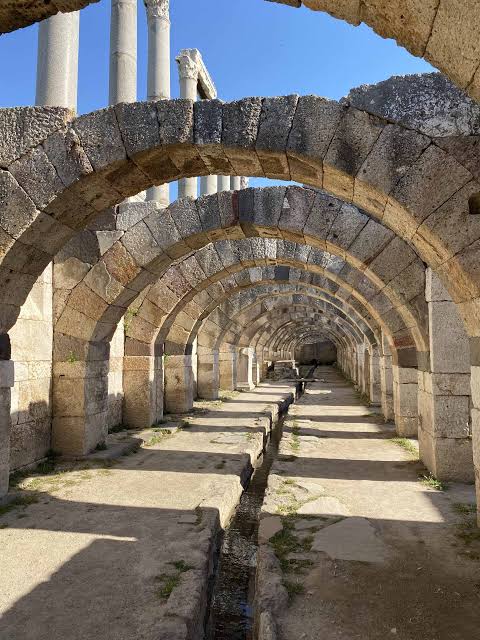
THE PERSECUTED and SUFFERING CHURCH
AD 100–313
2nd to 4th centuries.
We now move from Ephesus to Smyrna.
If Ephesus represents the apostolic church, Smyrna represents the period of severe persecution experienced by Christians under the Roman Empire.
The blood of the martyrs becomes seed.
In the early years, Jewish Christians met with Jews in the synagogue. But after the destruction of Jerusalem in70 AD, the Jews introduced a curse against Christians in their prayers that had to be recited to prevent Christians from worshipping God in their midst. Eventually the Jews slandered Christians before Roman authorities causing their persecution, Acts 18:12-17, 1 Thess. 2: 14-16.
AD 100–313
The traditional Adventist prophetic application identifies this as the great era of pagan Roman persecution where Christian believers were slaughtered for their faith in Jesus Christ.
Polycarp (c 69-155 A.D.), a bishop leader of the early church in Smyrna, gave the memorable answer when commanded to [curse the name of Jesus Christ and] worship Caesar.
Polycarp was denounced by the Jews before the authorities, ending in his martyrdom.
“Eighty-six years I have served Him [Christ] and He has done me no wrong. How then can I blaspheme my King, who saved me?”
THE SALUTATION
Revelation 2:8:
“And to the angel of the church in Smyrna write…”
But notice how Jesus describes Himself.
THE DESCRIPTION OF CHRIST
“These things says the First and the Last, who was dead, and came to life.”
Why would persecuted Christians need to hear this?
Because they were facing death.
Christ essentially says:
“I have already gone through death.”
But He did not remain in the grave.
“who was dead, and came to life.”
Jesus is therefore the perfect Savior for a persecuted church.
He is:
The First.
The Last.
The One who died.
The One who lives.
Death cannot defeat Him.
And therefore death cannot ultimately defeat His people.
THE “I KNOW” STATEMENT
Revelation 2:9:
“I know your works, tribulation, and poverty…”
Again:
“I know.”
Jesus knew what His people were experiencing.
They were experiencing:
- tribulation,
- poverty,
- opposition,
- persecution.
But Jesus adds:
“but you are rich.”
What an extraordinary contrast.
The world saw poverty.
Christ saw riches.
The world saw defeated Christians.
Christ saw victorious saints.
The world could take away their possessions.
It could not take away their eternal inheritance.
THE PERSECUTION
Revelation 2:10:
“Do not fear any of those things which you are about to suffer.”
Christ does not promise:
“You will not suffer.”
He says:
“Do not fear.”
There is a profound difference.
Christianity does not promise an absence of suffering.
It promises the presence of Christ in suffering.
“TEN DAYS”
Revelation 2:10 says:
“you will have tribulation ten days.”
In the Adventist historicist interpretation, this is commonly understood according to the prophetic day-year principle:
One prophetic day = one literal year.
Thus the ten days are understood as ten years of particularly intense persecution.
Adventist interpreters have traditionally associated this with the Great Persecution under the Roman emperor Diocletian, approximately AD 303–313.
This corresponds closely with the closing period of pagan Roman persecution before Constantine’s rise and the legalization of Christianity.
“In the world you will have tribulation. But take courage, I have overcome the world.” John 16:33
THE CROWN OF LIFE
Jesus says:
“Be faithful until death, and I will give you the crown of life.”
Notice the phrase:
“until death.”
Not:
“until inconvenience.”
Not:
“until Christianity becomes unpopular.”
Not:
“until obedience becomes expensive.”
Until death.
The Christian’s loyalty is not dependent upon circumstances.
SMYRNA HAS NO REPROOF
This is important.
Jesus does not say:
“I have this against you.”
Smyrna receives no condemnation.
The suffering church is presented as faithful.
Sometimes suffering produces what prosperity cannot.
Persecution can strip Christianity down to its essentials.
When everything else is taken away, the question becomes:
Do I still have Jesus?
THE PROMISE
Revelation 2:11:
“He who overcomes shall not be hurt by the second death.”
This is especially meaningful from the biblical Adventist understanding of the state of the dead.
The Bible distinguishes between:
The first death
Physical death.
The second death
The final destruction of the wicked following the judgment.
Revelation 20:14 calls the lake of fire:
“the second death.”
The promise to Smyrna is therefore ultimate.
The persecutor may kill the body.
But the persecutor cannot destroy the eternal life Christ gives to the faithful.
“The gift of God is eternal life in Christ Jesus our Lord.” Romans 6:23
SMYRNA IN THE HISTORICIST ADVENTIST INTERPRETATION
AD 100–313
Characteristic: Persecuted church
Strengths:
- faithfulness
- endurance
- spiritual richness despite material poverty
Problem:
- no specific rebuke
Admonition:
- do not fear
- be faithful unto death
Promise:
- crown of life
- protection from the second death
THE LESSON
Smyrna teaches:
A church can look poor to the world and be rich before God.
Why does the Lord permit His church to suffer persecution? To prove to the universe that the followers of Jesus can overcome the world as Jesus did. John 16:33
“The gift of God is eternal life in Christ Jesus our Lord.” 1 Cor 15:22
This promise is not only for the martyrs of the first century, but for all Christians throughout the centuries until the coming of the Lord.
This is the victory that has overcome the world- our (His) faith. 1 John 5:4
Appeal:
“Father, help us not merely to understand Revelation, but to hear what Your Spirit is saying to us. If we have lost our first love, bring us back. If we are suffering, give us courage. If we are compromising, give us conviction. If we have tolerated error, give us discernment. Help us hold fast to Jesus and to His Word. Give us the faith of Smyrna, the discernment of Ephesus, the courage to reject Pergamum’s compromise, and the faithfulness of Thyatira’s remnant. And above all, help us to overcome through the blood of the Lamb, so that when Jesus comes, we may receive the crown of life and live with Him forever. In Jesus’ name, Amen.”