




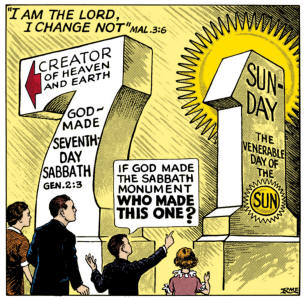
Is Saturday or Sunday the Biblical Sabbath? Why does the Sabbath matter to Christians?
The central biblical conclusion is clear: The Sabbath established at Creation and identified in the Fourth Commandment is the seventh day of the week, not the first day. In the conventional Jewish and Christian weekly calendar, that is Saturday.
The New Testament establishes that Jesus Christ rose on the first day of the week, and it records Christians gathering on that day. However, there is no explicit biblical command transferring the sanctity of the seventh-day Sabbath to Sunday, nor a passage declaring Sunday to be the Sabbath of Creation or the Fourth Commandment.
Christians disagree about whether Sunday worship is nevertheless authorized by Christ’s resurrection, apostolic practice, and the church’s understanding of the new covenant. That distinction—between an explicit biblical command and a theological inference—is essential.
1. The Sabbath began at Creation, before Israel existed
GENESIS 2:1–3
“And on the seventh day God ended His work which He had done, and He rested on the seventh day from all His work which He had done. Then God blessed the seventh day and sanctified it…” (NKJV)
Three divine actions distinguish the seventh day:
-
God rested on the seventh day.
-
God blessed the seventh day.
-
God sanctified the seventh day, setting it apart.
Notice what the text does not say. God did not bless every seventh day according to personal preference, nor did He sanctify the first day. The passage specifically identifies the seventh day.
This occurred before Abraham, Moses, the nation of Israel, and the giving of the Ten Commandments at Sinai.
Why this matters: Seventh-day Sabbatarians understand the Sabbath as a creation institution for humanity, rather than merely a ceremonial law for ancient Israel.
One important qualification: Genesis 2 describes God’s sanctification of the seventh day but does not explicitly record a command to Adam and Eve to observe it. Christians who regard Sabbath observance as specifically Mosaic emphasize that distinction.
2. The Fourth Commandment identifies the seventh day
EXODUS 20:8–11
“Remember the Sabbath day, to keep it holy. Six days you shall labor and do all your work, but the seventh day is the Sabbath of the LORD your God…” (NKJV)
The commandment concludes by connecting the Sabbath directly to Creation:
“For in six days the LORD made the heavens and the earth, the sea, and all that is in them, and rested the seventh day. Therefore the LORD blessed the Sabbath day and hallowed it.” (Exodus 20:11, NKJV)
This is especially significant because the commandment does not simply establish a day of religious assembly. It identifies a particular day based on God’s creative activity.
The Hebrew term shabbat refers to ceasing or resting. The Fourth Commandment identifies which day God set apart.
There is no alternative wording in Exodus 20 designating the first day as the Sabbath.
3. What did Jesus teach about the Sabbath?
MARK 2:27–28
“The Sabbath was made for man, and not man for the Sabbath. Therefore the Son of Man is also Lord of the Sabbath.” (NKJV)
Jesus made two remarkable declarations.
First, the Sabbath was made for humanity. The Greek word anthrōpos refers to a human being or mankind, not exclusively to a Jew.
Second, Jesus identified Himself as Lord of the Sabbath.
In Luke 4:16, Jesus attended synagogue on the Sabbath, as was His custom. In Matthew 12:12, He taught that doing good on the Sabbath was lawful.
Jesus repeatedly challenged burdensome interpretations of Sabbath law. He did not explicitly declare that the Sabbath had moved to another day.
Did Jesus anticipate continued Sabbath observance?
In Matthew 24:20, Jesus told His disciples:
“And pray that your flight may not be in winter or on the Sabbath.” (NKJV)
Seventh-day Sabbatarians see this as evidence that Jesus expected the Sabbath to remain meaningful after His death and resurrection, including during the anticipated destruction of Jerusalem.
Others interpret the passage as reflecting the practical difficulties of travel in Sabbath-observant Judea. Both interpretations deserve consideration, but the passage contains no instruction establishing Sunday as a replacement Sabbath.
4. The resurrection occurred on Sunday. Does that change the Sabbath?
All four Gospels associate the discovery of Jesus’ empty tomb with the first day of the week.
LUKE 23:54–24:1
Luke describes a particularly revealing sequence:
Friday
Preparation Day
Jesus is crucified and buried before the Sabbath begins.
Saturday
The Sabbath
The women rest according to the commandment (Luke 23:56).
Sunday
First Day of the Week
The women discover the empty tomb (Luke 24:1–3).
Luke distinguishes the Sabbath from the first day of the week, even in his account of the resurrection.
Sunday’s significance as Resurrection Day is beyond dispute. The question is whether that significance constitutes a divine command changing the Fourth Commandment.
The New Testament never explicitly makes that declaration.
5. What are the biblical arguments for Sunday as the Lord’s Day?
There are several important New Testament passages used to defend first-day Christian worship.
| Passage | Sunday observance argument | What the passage explicitly establishes |
|---|---|---|
| John 20:19 | Jesus appeared to the disciples on resurrection Sunday. | The disciples were assembled behind locked doors, and Jesus appeared to them. |
| John 20:26 | Jesus appeared again approximately a week later. | A subsequent appearance occurred eight days later; no Sabbath transfer is stated. |
| Acts 20:7 | Christians gathered to break bread on the first day. | A first-day gathering took place at Troas, with Paul preaching. |
| 1 Corinthians 16:2 | Paul instructed believers to set aside offerings on Sunday. | Funds were to be set aside on the first day; a worship service is not explicitly described. |
| Revelation 1:10 | John was in the Spirit on the Lord’s Day. | John mentions the Lord’s Day without identifying its weekday. |
The most debated text: Revelation 1:10
“I was in the Spirit on the Lord’s Day…” (NKJV)
Many Sunday-observing Christians understand this expression to mean Sunday, the day of Christ’s resurrection. Early post-apostolic Christian usage provides historical support for that interpretation.
Seventh-day Sabbatarians point instead to passages identifying Christ as Lord of the Sabbath (Mark 2:28) and the Sabbath as God’s holy day (Isaiah 58:13).
Revelation 1:10 itself does not specify Saturday or Sunday. Its interpretation depends on additional biblical and historical arguments.
Therefore, it cannot independently establish that the Sabbath was transferred to Sunday.
6. The strongest theological argument for Sunday observance
The most substantial Sunday-observance argument is not simply that the disciples gathered on Sunday.
It is that Christ’s resurrection inaugurated the new creation and the new covenant, giving the first day of the week a special Christian significance.
Proponents connect several ideas:
-
Christ rose on the first day (John 20:1).
-
Believers become new creations in Christ (2 Corinthians 5:17).
-
The early church gathered on the first day (Acts 20:7).
-
Christians enter their ultimate rest through Christ (Hebrews 4:1–11).
-
The church historically recognized Sunday as the Lord’s Day.
Within Reformed covenant theology, some Christians argue that the moral obligation of one day in seven continues, while the designated day has changed to Sunday.
The Westminster Confession of Faith, chapter 21, section 7, explicitly teaches this position.
Other Sunday-observing Christians, including many Lutherans, Catholics, and evangelicals, offer different explanations. They do not all believe Sunday literally became the Sabbath of the Fourth Commandment.
The distinction is important: A theological case for Sunday worship is not the same thing as an explicit biblical command changing the Sabbath.
7. What about Paul’s statements concerning days and Sabbaths?
Three passages require careful examination.
Colossians 2:16–17
Paul instructs Christians not to allow others to judge them concerning food, drink, festivals, new moons, or Sabbaths.
Sunday-observing interpreters often understand this as including the weekly Sabbath, meaning Christians are no longer obligated to observe it as an Old Testament requirement.
Seventh-day Sabbatarians argue that Paul’s emphasis concerns ceremonial observances and judgmental religious practices, rather than abolishing the Creation Sabbath.
The recurring Old Testament expression involving festivals, new moons, and Sabbaths is a significant part of the debate because it can encompass annual, monthly, and weekly observances.
Romans 14:5–6
Paul writes that one person esteems one day above another while another esteems every day alike.
Some interpret this as establishing Christian freedom regarding weekly Sabbath observance. Others argue that Paul addresses disputed religious days and personal devotional practices, rather than authorizing believers to disregard the Fourth Commandment.
The passage does not explicitly name the Sabbath.
Galatians 4:9–11
Paul warns the Galatians against returning to bondage through observance of days, months, seasons, and years.
The interpretive question is whether he condemns Sabbath observance itself or a legalistic use of religious calendars as a means of justification.
These passages provide genuine grounds for Christian disagreement over the continuing obligation of the weekly Sabbath. However, none identifies Sunday as the new Sabbath.
8. Why is the Sabbath important?
The biblical case for the Sabbath is much broader than selecting the correct day for church attendance.
1. It commemorates Creation.
Exodus 20:11 connects the Sabbath with God’s work as Creator. The day directs human attention away from self-sufficiency toward the One who gives life.
2. It celebrates redemption.
Deuteronomy 5:12–15 connects Sabbath observance with Israel’s deliverance from Egyptian bondage. The Sabbath therefore recalls both creation and liberation.
3. It is a sign of sanctification.
Ezekiel 20:12 and Exodus 31:13 describe the Sabbath as a sign that the Lord sanctifies His people. These passages directly address God’s covenant with Israel; Sabbatarians see a broader spiritual principle.
4. It protects human rest and dignity.
Exodus 20:10 extends rest to children, servants, strangers, and animals. The Sabbath restrains relentless labor and gives rest to the entire household.
5. It provides time for fellowship with God.
Isaiah 58:13–14 portrays the Sabbath as a delight rather than a burden. Jesus’ teaching emphasizes mercy, restoration, and doing good.
6. It anticipates ultimate rest and restoration.
Hebrews 4 connects God’s rest with the rest available through faith. Isaiah 66:22–23 pictures worship in the new heavens and new earth from Sabbath to Sabbath.
9. Does Hebrews 4 teach that the Sabbath remains?
Hebrews 4:9 is especially important:
“There remains therefore a rest for the people of God.” (NKJV)
The Greek word translated rest is sabbatismos, often understood as Sabbath rest or Sabbath celebration.
Seventh-day Sabbatarians argue that this language supports the continued spiritual and practical importance of Sabbath observance.
Other Christian interpreters emphasize the larger argument of Hebrews 3–4: entering God’s rest through faith and persevering in Christ. They understand the passage primarily as referring to salvation rest, not prescribing a particular weekly day.
Both perspectives agree that Christ is central to the rest Hebrews describes. They disagree over whether weekly seventh-day observance remains a required expression of that rest.
10. How did Sunday become the predominant Christian worship day?
The historical development is important because it helps distinguish New Testament teaching from later church practice.
-
First century — Apostolic Christianity
The New Testament records Jewish and Christian Sabbath activity, alongside first-day Christian gatherings. It does not record a formal command changing the Sabbath to Sunday.
-
Second century — Sunday worship becomes increasingly documented
Writers such as Justin Martyr describe Christian worship on Sunday, connecting it to Creation and the resurrection. His First Apology, chapter 67, is a major early witness.
-
AD 321 — Constantine’s Sunday legislation
Constantine issued a civil law requiring many urban workers and courts to rest on the venerable day of the Sun, while allowing agricultural exceptions. This strengthened Sunday as a public day of rest, but it did not originate Christian Sunday worship.
-
Fourth century — Council of Laodicea
Canon 29 discouraged Christians from resting in the Jewish manner on Saturday and directed honor toward the Lord’s Day. The exact dating of this regional council is debated, generally placed in the mid-to-late fourth century.
-
Later centuries — Sunday becomes widely institutionalized
Civil laws, church teaching, and Christian custom increasingly reinforced Sunday as the principal worship and rest day in much of Christianity.
Historically, therefore, Sunday worship did not suddenly begin with Constantine or a single fourth-century council. It is documented earlier. But the development of Sunday worship is not, by itself, proof of a biblical transfer of the Sabbath commandment.
11. The Sabbath and the final conflict in Revelation
From a Seventh-day Adventist historicist perspective, the Sabbath has particular end-time significance.
Revelation 14:6–7 calls humanity to worship the Creator:
“Worship Him who made heaven and earth, the sea and springs of water.” (Revelation 14:7, NKJV)
This wording closely parallels the Creation language of Exodus 20:11.
Revelation 14:12 then identifies the saints as those who keep God’s commandments and the faith of Jesus.
Seventh-day Adventist interpretation connects these passages with the Fourth Commandment and understands the final conflict as involving divine authority, true worship, and human religious authority.
Other Christians interpret the commandments and worship language more broadly and do not see Revelation as specifically predicting a Saturday-versus-Sunday controversy.
Importantly, Revelation does not explicitly identify Sunday as the mark of the beast. The Adventist application depends on a larger historicist interpretation of Revelation 13–14 and future religious coercion. Adventist teaching also distinguishes present-day sincere Sunday worshippers from those who might knowingly reject God’s authority in a future crisis.
12. Comparing the two positions
| Biblical question | Seventh-day Sabbatarian understanding | Common Sunday-observing understanding |
|---|---|---|
| Which day did God bless at Creation? | Seventh day | Seventh day |
| Which day does the Fourth Commandment name? | Seventh day | Seventh day |
| Did Jesus observe the Sabbath? | Yes | Yes |
| Did Jesus explicitly change it to Sunday? | No | No explicit statement |
| Did Christians gather on Sunday? | Yes, at least on recorded occasions | Yes |
| Is Sunday explicitly called the Sabbath in the NT? | No | No |
| Is the weekly Sabbath obligatory under the new covenant? | Yes | Interpretations vary |
| Why is Sunday significant? | Resurrection day, without replacing the Sabbath | Resurrection and apostolic Christian worship |
| Does salvation depend on observing a particular day? | Salvation is by grace through faith | Salvation is by grace through faith |
13. My conclusion from the biblical evidence
We can distinguish three separate questions and answer them with different degrees of certainty.
First: Which day is the biblical Sabbath of Creation and the Ten Commandments?
The answer is unambiguously the seventh day. Genesis 2:1–3 and Exodus 20:8–11 explicitly identify it.
Second: Is there a definitive biblical text changing that Sabbath to Sunday?
No. The New Testament does not explicitly announce such a change. The biblical case for Sunday as the Christian Lord’s Day rests on the resurrection, apostolic practice, and theological interpretation rather than a direct command transferring the Fourth Commandment.
Third: Must all Christians continue observing the seventh-day Sabbath?
This is the substantive unresolved disagreement among Christian traditions. Sabbatarians argue that the Creation ordinance and moral commandment remain binding. Non-Sabbatarians argue that Christ fulfilled the old covenant’s Sabbath requirements and that believers possess freedom concerning days. Those competing interpretations must be evaluated in light of the whole New Testament, especially Romans 14, Colossians 2, Galatians 4, and Hebrews 4.
The deeper significance
The Sabbath’s theological message is that human beings are created by God, sustained by God, redeemed by grace, and invited into fellowship with Him.
Jesus’ declaration in Mark 2:27 that the Sabbath was made for humanity presents it as a gift rather than merely a restriction.
From a seventh-day Sabbatarian understanding, observing the Sabbath is therefore not an attempt to earn salvation. It is an expression of love, trust, worship, and obedience to the Creator and Redeemer.
And from a broader Christian perspective, the essential question is how faith in Jesus Christ should shape worship, rest, obedience, and freedom under the new covenant.
The most important distinction is this: Scripture explicitly identifies the seventh day as the Sabbath; whether that command remains obligatory for Christians is debated; and Scripture nowhere explicitly redefines the first day as the Sabbath.