


Part 3: We Will Be Liberated, Not Liquidated
by Reiner Kremer
There are moments in our Christian lives when one verse suddenly becomes a lens through which the entire Bible comes into focus. One of those verses is found near the end of the Scriptures, where the risen Christ declares:
“Behold, I make all things new.” (Revelation 21:5, NKJV)
These words are simple enough for a child to understand, yet profound enough to occupy the greatest theologians for a lifetime.
Notice carefully what Jesus says.
He does not say, “Behold, I make all new things.”
He says, “Behold, I make all things new.”
That is not a minor grammatical distinction. It is a window into the very heart of God.
Throughout Scripture, God is revealed as the great Redeemer. He does not delight in abandoning what He has made. He delights in restoring it. He is the Shepherd who searches for the lost sheep, the Father who welcomes the prodigal son, the Physician who heals the sick, the Potter who patiently reshapes the marred vessel, and the Redeemer who purchases back what seemed hopelessly lost.
Redemption, by its very nature, restores.
It heals.
It reconciles.
It renews.
The Gospel, therefore, is not God’s declaration that creation has failed beyond repair. It is God’s announcement that, through Jesus Christ, creation will finally become everything He intended from the beginning.
This has profound implications for how we understand the future.
For many sincere Christians, the dominant picture of the end of the world has been one of total destruction—as though God eventually gives up on His creation, destroys it, and starts over from nothing.
But when we read the whole story of Scripture, another picture begins to emerge.
Not abandonment.
Not surrender.
Not divine frustration.
But victorious redemption.
The God who spoke the universe into existence has not lost His ability to redeem what sin has corrupted.
Indeed, the entire biblical story proclaims exactly the opposite.
The Groaning Creation
No passage unfolds this hope more beautifully than Paul’s words in Romans 8.
Listen to the music of hope that fills these verses:
“For I consider that the sufferings of this present time are not worthy to be compared with the glory which shall be revealed in us.” (Romans 8:18)
Notice that Paul does not minimize suffering.
He knew suffering personally.
He had been beaten.
Imprisoned.
Rejected.
Misunderstood.
Shipwrecked.
Threatened.
Yet Paul refuses to allow present pain to define ultimate reality.
The future glory of Christ is so magnificent that today’s suffering, real as it is, cannot compare.
But Paul immediately broadens the picture.
He begins speaking, not only about believers, but about creation itself.
“For the earnest expectation of the creation eagerly waits for the revealing of the sons of God.” (Romans 8:19)
What remarkable language!
Paul personifies creation as though the mountains, forests, oceans, birds, rivers, deserts, stars, and fields are standing on tiptoe, eagerly waiting for something wonderful to happen.
Why?
Because humanity and creation have always been connected.
In Genesis, when Adam fell, the ground itself was cursed.
Human rebellion affected the entire created order.
Creation has been subjected to frustration—not because God created it defective, but because sin disrupted the harmony that God intended.
Earthquakes.
Disease.
Decay.
Predation.
Thorns.
Floods.
Death.
All remind us that something is profoundly wrong.
The world is beautiful.
But it is not yet whole.
Creation itself bears the scars of humanity’s rebellion.
Yet notice Paul’s extraordinary promise.
Creation is not waiting to be discarded.
Creation is waiting to be delivered.
Paul continues:
“Because the creation itself also will be delivered from the bondage of corruption into the glorious liberty of the children of God.” (Romans 8:21)
There it is.
Liberated.
Not liquidated.
Delivered.
Not discarded.
Freed.
Not forgotten.
The entire created order longs for liberation because God’s purpose has never changed.
The Creator still loves His creation.
He intends to heal it completely.
The Victory of Christ Is Greater Than the Fall of Adam
Sometimes Christians unintentionally speak as though Satan has almost succeeded in ruining God’s project.
Creation was beautiful…
until Satan destroyed it.
Humanity was noble…
until sin ruined everything.
History became little more than God’s attempt to salvage what remained.
But that is not the story the New Testament tells.
Paul constantly compares Adam and Christ.
The first Adam brought sin.
The second Adam brings righteousness.
The first Adam brought death.
The second Adam brings life.
The first Adam introduced corruption.
The second Adam introduces New Creation.
The question, then, becomes beautifully simple.
Which Adam is greater?
Surely Christ.
Which kingdom is stronger?
Surely Christ’s.
Which power has the final word?
Surely the Cross and the Resurrection.
That is why I often return to this simple statement:
Satan is not better at corrupting than Jesus is at redeeming.
If sin ultimately proves stronger than grace, then the Cross has failed.
If corruption finally triumphs over redemption, then evil possesses greater power than love.
If death has the last word, then Easter morning was only temporary.
But the Gospel proclaims something infinitely better.
Grace abounds much more.
Life triumphs over death.
Love overcomes hatred.
Light scatters darkness.
Christ conquers all.
The Cross is not merely God’s response to sin.
It is God’s declaration that His love is stronger than sin has ever been.
The Pattern of God’s Redemption
Consider how consistently God works throughout Scripture.
When Adam and Eve sinned, God sought them.
When Noah’s generation became corrupt, God preserved creation through the ark.
After the flood, He did not abandon the earth.
He renewed it.
When Israel went into exile, God promised restoration.
When Jerusalem lay in ruins, God rebuilt it.
When dry bones covered the valley in Ezekiel’s vision, God breathed life into them.
When Lazarus lay in the tomb, Jesus called him forth.
When Christ Himself entered death, the Father raised Him in immortal glory.
Notice the pattern.
Again and again, God restores.
Again and again, He brings life out of death.
Again and again, He redeems what seemed beyond hope.
The Resurrection is not an isolated miracle.
It is the pattern of God’s kingdom.
The God who raised Jesus is the God who will raise creation itself.
Fire That Purifies
At this point someone may ask,
“But doesn’t Peter say the earth will be burned up?”
This is an important question.
In 2 Peter 3, the apostle speaks of the heavens and earth being associated with fire. Some have concluded that Peter describes the total annihilation of creation.
Yet notice Peter’s comparison.
He reminds his readers that the ancient world perished in the flood.
The flood truly judged the earth.
But after the waters receded, was there another planet?
No.
It was the same earth, cleansed and renewed.
Judgment was real.
Purification was real.
Yet God’s creation remained God’s creation.
Peter then concludes:
“Nevertheless we, according to His promise, look for new heavens and a new earth in which righteousness dwells.” (2 Peter 3:13)
Peter is not describing God abandoning His creation.
He is describing God removing everything that corrupts it.
Throughout Scripture, fire often symbolizes purification.
Gold passes through fire.
Silver is refined.
Isaiah’s lips are cleansed with a burning coal.
Malachi speaks of the Lord as a refiner’s fire.
God’s purpose is never destruction for destruction’s sake.
His judgments are always consistent with His holy love.
He destroys sin because He loves His creation.
He judges evil because He loves His children.
He removes corruption because He intends everlasting life.
The fire of God is never the rage of a tyrant.
It is the holy love of the Redeemer removing forever everything that destroys His beloved creation.
New Creation Has Already Begun
Perhaps the greatest surprise in the New Testament is that New Creation is not merely future.
It has already begun.
Paul declares:
“Therefore, if anyone is in Christ, he is a new creation…” (2 Corinthians 5:17)
Notice again the language.
Not “will someday become.”
Already.
In Christ.
New Creation is not merely a promise waiting on tomorrow.
It is breaking into today.
Every converted heart is evidence that God’s future has already entered the present.
Every forgiven sinner is a miracle of New Creation.
Every restored marriage.
Every healed relationship.
Every transformed life.
Every act of Spirit-filled love.
Every victory over addiction.
Every enemy who becomes a brother.
Every proud heart made humble.
Every fearful heart filled with peace.
These are not isolated religious experiences.
They are signs that the kingdom of God has already arrived in Jesus Christ.
The Church is therefore much more than an institution waiting for heaven.
The Church is the first fruits of God’s renewed creation.
The Holy Spirit is already cultivating in believers the character that will fill the renewed earth.
Love.
Joy.
Peace.
Patience.
Kindness.
Goodness.
Faithfulness.
Gentleness.
Self-control.
These are not merely virtues for personal improvement.
They are the atmosphere of the coming kingdom already breathing through the people of God.
Every Spirit-filled believer becomes a living preview of the world that is coming.
Every congregation that reflects the love of Christ becomes an embassy of the New Jerusalem.
Every act of sacrificial service whispers to the world that another kingdom has already dawned.
This is why Paul can speak with such confidence.
He does not deny that evil remains.
He does not pretend suffering has disappeared.
He knows the whole creation still groans.
So do we.
We groan when disease steals health.
We groan when violence shatters peace.
We groan at gravesides.
We groan when injustice wounds the innocent.
We groan because we know that this world is not yet as God intends it to be.
But Christian groaning is never hopeless groaning.
It is the groaning of childbirth, not the groaning of defeat.
Creation groans because something glorious is about to be born.
The resurrection of Jesus guarantees that death does not have the final word.
The gift of the Holy Spirit guarantees that the future has already begun.
And the promise of Christ guarantees that one day every groan will give way to singing, every tear to joy, every wound to healing, and every shadow to everlasting light.
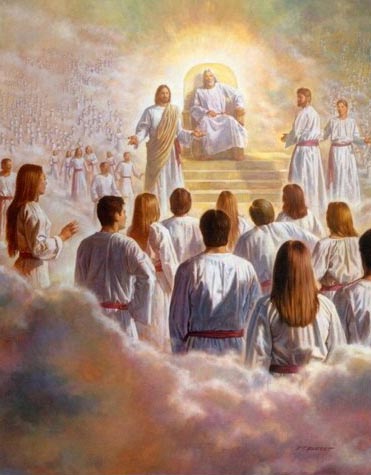
For the One who sits upon the throne has not abandoned His world.
He is redeeming it.
And because He lives, we know with absolute confidence that we, and all creation with us, will be liberated—not liquidated.

Article
The Two Adams
John tells us that, when we understand the love of God, His perfect love will cast out fear and there will be no more fear of the judgment. It is not...
John tells us that, when we understand the love of God, His perfect love will cast out fear and there...