

Introduction: Is Heaven Real?
For many people, heaven is little more than a vague spiritual idea—a place of clouds, harps, and disembodied souls floating through eternity. Yet the Bible presents something far different. Scripture describes heaven as a real place, prepared by a real Savior, inhabited by real people, living in a restored creation under the direct presence of God.
The biblical vision of heaven is not an escape from creation but the restoration of creation. It is the fulfillment of God’s original purpose for humanity—a home where sin, suffering, death, and separation are forever abolished.
The prophets, apostles, and Jesus Himself speak of heaven not merely as a state of mind but as a prepared kingdom, a city, a homeland, and ultimately a renewed earth where God’s people dwell forever.
As Jesus promised:
“In My Father’s house are many mansions; if it were not so, I would have told you. I go to prepare a place for you.” (John 14:2, NKJV)
Notice the language: place. Jesus did not promise merely an experience. He promised a home.
Heaven as Humanity’s True Homeland
The writer of Hebrews tells us that the faithful patriarchs looked beyond earthly kingdoms toward something greater.
“But now they desire a better, that is, a heavenly country. Therefore God is not ashamed to be called their God, for He has prepared a city for them.” (Hebrews 11:16, NKJV)
Again, we encounter physical language:
- A country
- A city
- A prepared place
Abraham understood this.
“For he waited for the city which has foundations, whose builder and maker is God.” (Hebrews 11:10, NKJV)
Unlike every earthly city, built and eventually destroyed by human hands, God’s city possesses eternal foundations.
Old Testament scholar Walter Brueggemann often emphasized that biblical hope is never merely spiritual. God’s purpose is always the renewal of life, community, land, and creation itself. The biblical narrative moves toward restoration rather than abandonment.
The heavenly city represents the ultimate fulfillment of God’s covenant promise: God dwelling permanently with His people.
The New Jerusalem: A Real City
The clearest description of heaven’s capital appears in Revelation.
John writes:
“Then I, John, saw the holy city, New Jerusalem, coming down out of heaven from God, prepared as a bride adorned for her husband.” (Revelation 21:2, NKJV)
Notice that the city comes down from heaven to the renewed earth.
This is a crucial biblical truth.
The final destiny of the redeemed is not an endless existence floating somewhere beyond the stars. Rather, God establishes His kingdom upon a recreated earth where heaven and earth are united.
The city itself is described in astonishing detail.
“The city is laid out as a square; its length is as great as its breadth. And he measured the city with the reed: twelve thousand furlongs. Its length, breadth, and height are equal.” (Revelation 21:16, NKJV)
Twelve thousand furlongs equals approximately 1,500 miles (2,400 kilometers).
John continues:
“Then he measured its wall: one hundred and forty-four cubits.” (Revelation 21:17, NKJV)
The measurements suggest an immense and literal city prepared by God.
C. S. Lewis observed that modern Christians often fail to think deeply enough about heaven. In Mere Christianity he wrote:
“Aim at Heaven and you will get earth thrown in: aim at earth and you will get neither.”
Lewis understood that heaven is not less real than earth; it is more real. The New Jerusalem represents ultimate reality, untouched by decay, corruption, or death.
The Foundations of Precious Stones
John describes the city’s foundations:
“The foundations of the wall of the city were adorned with all kinds of precious stones.” (Revelation 21:19, NKJV)
He then lists:
- Jasper
- Sapphire
- Chalcedony
- Emerald
- Sardonyx
- Sardius
- Chrysolite
- Beryl
- Topaz
- Chrysoprase
- Jacinth
- Amethyst
These stones immediately remind Bible readers of the high priest’s breastplate.
Exodus 28:15-21 describes twelve precious stones worn over the heart of the high priest, each representing one of the tribes of Israel.
The symbolism is profound.
The names of God’s people are forever connected with the foundations of God’s eternal city.
Isaiah anticipated this beauty centuries earlier:
“O you afflicted one, tossed with tempest, and not comforted, behold, I will lay your stones with colorful gems, and lay your foundations with sapphires. I will make your pinnacles of rubies, your gates of crystal, and all your walls of precious stones.” (Isaiah 54:11-12, NKJV)
The city reflects the glory, beauty, permanence, and faithfulness of God Himself.
Streets and Gates of Glory
John continues:
“The twelve gates were twelve pearls: each individual gate was of one pearl. And the street of the city was pure gold, like transparent glass.” (Revelation 21:21, NKJV)
Every gate is fashioned from a single pearl.
Every street shines with transparent gold.
These descriptions communicate more than wealth.
In the present world, gold is rare and treasured. In God’s kingdom, it becomes pavement.
The message is clear: God’s abundance exceeds our highest imagination.
Ellen White wrote in The Great Controversy:
“There the redeemed shall know, even as also they are known. The loves and sympathies which God Himself has planted in the soul shall there find truest and sweetest exercise.”
The beauty of heaven is not merely architectural. It is relational.
The greatest treasure is not the city’s gold but the presence of God and the fellowship of the redeemed.
Life on the New Earth
One of the most remarkable descriptions of eternity comes from Isaiah.
“They shall build houses and inhabit them; they shall plant vineyards and eat their fruit.” (Isaiah 65:21, NKJV)
Notice the continuity with Eden.
Humanity was originally created to:
- Build
- Cultivate
- Create
- Steward
These activities are restored rather than abolished.
Isaiah continues:
“They shall not labor in vain, nor bring forth children for trouble.” (Isaiah 65:23, NKJV)
Work remains, but frustration disappears.
Creation remains, but the curse is removed.
Purpose remains, but suffering ends.
Walter Brueggemann frequently emphasized that God’s future involves flourishing life rather than escape from life. Isaiah’s vision reflects precisely that reality.
The redeemed do not spend eternity idle.
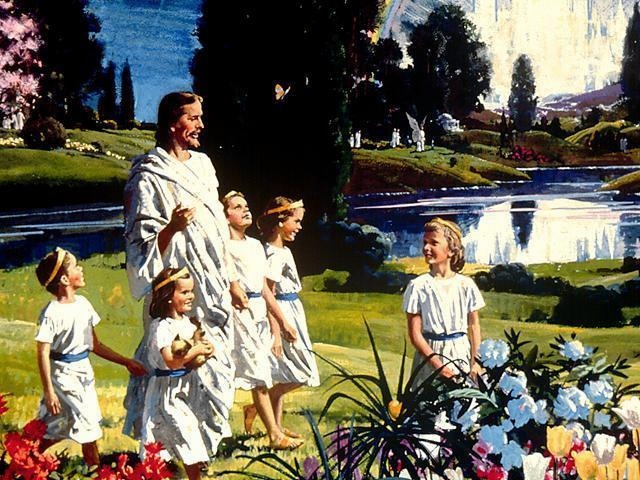
They participate joyfully in God’s restored creation.
Perfect Peace Throughout Creation
Isaiah offers one of the most beautiful pictures in Scripture:
“The wolf and the lamb shall feed together, the lion shall eat straw like the ox, and dust shall be the serpent’s food. They shall not hurt nor destroy in all My holy mountain.” (Isaiah 65:25, NKJV)
Violence disappears.
Predation disappears.
Fear disappears.
The entire created order is reconciled.
The peace lost in Eden is fully restored.
Eternal Worship and Fellowship
Isaiah also reveals the rhythm of eternal worship.
“From one New Moon to another, and from one Sabbath to another, all flesh shall come to worship before Me,” says the Lord. (Isaiah 66:23, NKJV)
The redeemed gather regularly in joyful worship.
This is not worship motivated by obligation.
It is worship flowing naturally from love and gratitude.
The Sabbath, established at Creation, continues as a memorial of God’s creative and redemptive work.
The entire universe becomes a vast congregation praising its Creator.
No More Sorrow, No More Loss
Isaiah declares:
“And the ransomed of the Lord shall return, and come to Zion with singing, with everlasting joy on their heads. They shall obtain joy and gladness, and sorrow and sighing shall flee away.” (Isaiah 35:10, NKJV)
Every human life bears scars.
Grief.
Loss.
Disappointment.
Regret.
In heaven, these things do not merely diminish; they disappear forever.
Ellen White beautifully describes this reality:
“Pain cannot exist in the atmosphere of heaven.”
Every wound caused by sin will be healed.
Every broken relationship restored through Christ will be renewed.
Every faithful sacrifice will find its fulfillment.
The Presence of God as Heaven’s Greatest Glory
Perhaps the most stunning feature of the city is what is absent.
John writes:
“The city had no need of the sun or of the moon to shine in it, for the glory of God illuminated it. The Lamb is its light.” (Revelation 21:23, NKJV)
God Himself becomes the city’s light.
There is no darkness.
No uncertainty.
No hidden danger.
No separation.
The gates remain permanently open:
“Its gates shall not be shut at all by day (there shall be no night there).” (Revelation 21:25, NKJV)
Open gates symbolize perfect security.
No enemies exist.
No threats remain.
No fear survives.
The nations walk in God’s light.
“And the nations of those who are saved shall walk in its light, and the kings of the earth bring their glory and honor into it.” (Revelation 21:24, NKJV)
Human diversity is not erased.
It is redeemed.
Culture remains.
Identity remains.
All are united in worship of the Lamb.
The New Creation Forever
Isaiah concludes with one of the Bible’s most reassuring promises:
“‘For as the new heavens and the new earth which I will make shall remain before Me,’ says the Lord, ‘so shall your descendants and your name remain.'” (Isaiah 66:22, NKJV)
The new creation is permanent.
No second fall.
No return of sin.
No possibility of rebellion.
The Great Controversy between Christ and Satan reaches its final conclusion.
The universe is secure forever.
As Ellen White wrote:
“The great controversy is ended. Sin and sinners are no more. The entire universe is clean.”
Conclusion: Heaven Is Home
The Bible’s vision of heaven is breathtakingly concrete.
It is:
- A real country.
- A real city.
- A restored earth.
- A place of meaningful activity.
- A place of perfect relationships.
- A place of eternal worship.
- A place where sorrow can never enter.
Most importantly, heaven is where God Himself dwells with His people.
Jesus’ promise remains the foundation of Christian hope:
“I go to prepare a place for you. And if I go and prepare a place for you, I will come again and receive you to Myself; that where I am, there you may be also.” (John 14:2-3, NKJV)
The final biblical picture is not humanity ascending to escape earth, but God restoring creation and bringing His people home.
The New Jerusalem descends.
The curse is removed.
The redeemed inherit the kingdom.
And throughout endless ages, they live in the light of Christ, rejoicing in a world made new.