




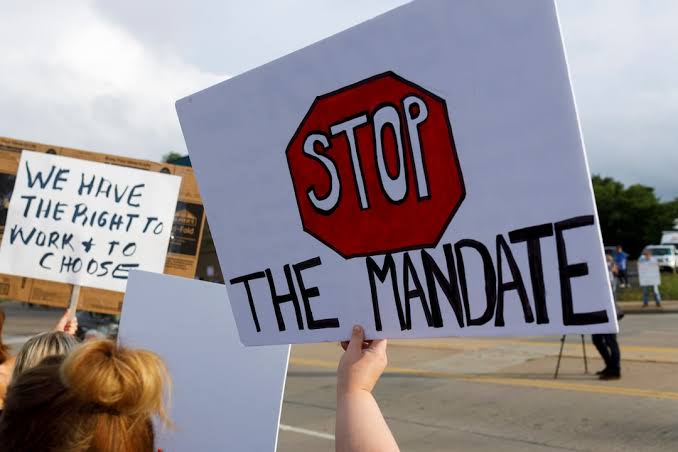
What happens when the conviction of an individual Christian appears to conflict with the official position of her own church—and with the requirements of her employer?
The story of Dr. Marisol Quintanilla at Michigan State University raises that question in a particularly compelling way when one’s convictions clash with employer policies.
During the COVID-19 pandemic, Michigan State University required faculty, staff, and students to receive a COVID-19 vaccination or qualify for an exemption. Dr. Quintanilla, an agricultural scientist and Seventh-day Adventist, chose not to receive the vaccine and sought a religious accommodation.
Her story is not simply about a vaccine.
It is about conscience and conviction.
It is about the boundary between institutional authority and individual faith.
It is about whether a government, university, employer, or even a church should be able to determine what a person’s conscience must believe.
And ultimately, it raises a question that reaches far beyond COVID:
Who has the right to govern the human conscience?
Who Is Dr. Marisol Quintanilla?
Dr. Marisol Quintanilla is an agricultural scientist specializing in plant-parasitic nematodes. She is a faculty member in Michigan State University’s Department of Entomology and serves as an Extension nematologist.
Her scientific work is focused on agricultural problems that directly affect farmers and crop production. She has conducted research involving potatoes, vegetables, soil health, and sustainable approaches to managing plant-parasitic nematodes.
She earned her graduate degrees at Michigan State University and returned to MSU as an applied nematologist in 2017.
This background is important.
Quintanilla’s story is not that of someone who rejected science or abandoned academic inquiry. She is herself a scientist working at a major research university.
Her dispute with MSU concerned something different:
whether the university could require her to violate what she believed was her religious conscience.
She was born in Chile into an Seventh Day Adventist family. Her grandparents became Adventists through a German immigrant that escaped Nazi Germany to Chile because of being a conscientious objector. He did not want to join the Nazi army. Her maternal grandfather became Adventist first and converted several members of his family, including his wife, some of his siblings, and also her paternal grandparents. She was raised in a Christ centered and Bible centered home and continued her life as a practicing Seventh Day Adventist.
The COVID Mandate at Michigan State University
In 2021, Michigan State University implemented a COVID-19 vaccination requirement.
An August 20, 2021 communication to faculty and academic staff stated that vaccination was required, while providing pathways for certain exemptions.
Among those exemptions was a religious exemption for an individual with a sincerely held religious belief or religious practice that prevented vaccination.
But an exemption did not mean that an employee simply walked away from all COVID precautions.
MSU required individuals receiving approved religious or medical exemptions to participate in its testing program. The university also imposed masking and other public-health requirements.
The university policy had teeth.
Employees who did not comply could face disciplinary action, potentially including termination.
That meant the decision confronting Quintanilla was not merely theoretical.
She faced a choice:
Receive the vaccine—or ask her employer to recognize an exception based upon her religious conscience.
Quintanilla’s Decision- Staying True to Conscience and Convictions
She needed a bona fide religious exemption that supported her conscience and convictions, from her SDA church in Lansing, Michigan, to present to the MSU administration. Sadly she was refused one when she explained her situation.
However, she did go to another SDA congregation in Berrien Springs, that supported religious liberty objections to the vaccine mandate.
From an interview in Fulcrum7, January 31, 2023:
“The Village Church at Berrien Springs was wonderful, as they had a program to help navigate through the process of obtaining religious exemptions. They advocated for me and others.
Her LETTER here. (Marisol’s Religious Exemption Letter)
https://static1.squarespace.com/static/55e08bc8e4b0c71256a51904/t/63d93951122b234f499140f4/1675180370044/Marisol%27s+Religious+Exemption+Letter.pdf
She stated that her local church, conference, and the North American Division failed her and many others. A statement (page no longer exists) on the General Conference website that was used to try to deny her and others their religious exemptions. She attended a training meeting at MSU presented by a university physician, informing health professionals and administrators that most churches had compromised on the government mandates and agreed with mandatory vaccination of COVID19. He said that the vaccine did not go against the all church’s teachings, therefore the religious exceptions were not valid.
She communicated back to the administration that religious liberty laws in the US protect the individual regardless of the position their church officially may take. Also, she reported that her local church pastor in Lansing, Michigan was unwilling to provide a letter supporting her choice. He said that the church organization officially decided pastors not to support religious exemptions, letting them know that it was up to individuals. No official church organization support could be given to those who had refused vaccination. She also recalls him saying “they did not want to waste bullets on religious liberty defense and advocacy at this time, as they were being saved for the Sunday law.
She continued: The Lansing church and my pastor took an absolute pro-vaccine stand and did not support freedom. They supported mandates
https://adventist.news/news/reaffirming-the-seventh-day-adventist-churchs-response-to-covid-19-1
and this was disappointing. Our SDA church should support the individual’s liberty of conscience (religious freedom), medical freedom, and freedom of speech.
Quintanilla chose not to receive the COVID vaccine.
According to her own later account, her objection involved both her understanding of the medical circumstances surrounding COVID and, more importantly for the exemption, her religious convictions.
She sought a religious exemption from MSU.
And this is where the story becomes especially significant.
Quintanilla explained that she obtained assistance from the Village Church in Berrien Springs, Michigan, in preparing a religious-exemption letter.
She says she used the church’s letter as a starting point but added substantial material of her own. Other religious liberty advocacy groups helped guide her through the vaccine exemption process.
Quintanilla later stated that her letter was circulated among university administrators and that administrators had to read the arguments she had presented.”
The existence of that original document is important because it means this story is not merely based on a later recollection. There was a contemporaneous written statement explaining her position.
A Crucial Distinction: The Church’s Position vs. the Individual’s Conscience
One of the most interesting dimensions of Quintanilla’s story is the relationship between her beliefs and the official position of the Seventh-day Adventist Church.
The Seventh-day Adventist Church did not teach that COVID vaccination was forbidden.
In fact, the church encouraged responsible vaccination while simultaneously emphasizing individual freedom of choice.
The denomination’s 2015 immunization statement says that Adventists have no religious or faith-based reason to discourage responsible participation in preventive immunization programs.
During the COVID pandemic, the General Conference reaffirmed its support for responsible vaccination.
Its October 27, 2021, statement said vaccination was a matter of personal choice and that vaccination was not a matter of salvation.
It also rejected interpretations connecting COVID vaccination with the mark of the beast.
At the same time, however, the church expressed reservations about using religious-liberty arguments to oppose public-health vaccination mandates.
That created Dr. Quintanilla’s dilemma. She believed the denomination at large would support her, and felt that she was left out on her own to fight a mandate that she was convicted of that was opposed to her conscience and beliefs. She was grateful for an independent religious liberty minded Village Church. Village was the exception not the rule among Adventist congregations.
The Adventist Church could say:
“We recommend vaccination.”
But that did not necessarily mean:
“Every Adventist must receive vaccination.”
And even more importantly, it did not necessarily mean:
“An Adventist whose conscience leads him or her to refuse vaccination has ceased to possess a religious conviction. Its a matter of the individual’s conscience and choice. If you refuse vaccination you are out on your own defending your position of refusal.”
That distinction became central to Quintanilla’s case. Again only the Village SDA church, Berrien Springs, Michigan advocated for her, sadly, not her home church in Lansing, home of the Michigan Conference headquarters.
Can a Christian Have a Religious Conviction That Differs from His Church?
This is the theological heart of the story.
Imagine a church denomination officially recommending a particular medical treatment.
An individual member, after studying Scripture, praying, consulting conscience, and considering the ethical implications, reaches a different conclusion.
Does the individual cease to have a religious belief?
No.
Christianity has always recognized the reality of conscience.
The apostle Paul wrote:
“So, then each of us shall give account of himself to God.”
— Romans 14:12, NKJV
Paul also warned believers against violating conscience.
In Romans 14, he discusses differences among Christians concerning matters that were not explicitly commanded or prohibited by God.
His conclusion is striking:
“Happy is he who does not condemn himself in what he approves.”
— Romans 14:22, NKJV
And then:
“For whatever is not from faith is sin.”
— Romans 14:23, NKJV
The principle is profound.
Faith cannot be outsourced.
A church can teach.
A pastor can counsel.
A denomination can publish statements.
A government can enact laws.
A university can establish policies.
But ultimately, a human being must answer to God for the convictions of his or her own conscience.
The First Amendment and the Christian Conscience
This principle has deep roots in American constitutional history.
The First Amendment states:
“Congress shall make no law respecting an establishment of religion or prohibiting the free exercise thereof.”
The Founders understood religious liberty in large part as protection for a sphere of life that belongs to God rather than government.
Thomas Jefferson famously described religious liberty in the Virginia Statute for Religious Freedom.
Religion, he argued, concerns the relationship between a person and his Creator, and the right to exercise religious belief cannot simply be transferred to another human authority.
That idea is remarkably relevant to the Quintanilla story.
The question is not whether an employer should have legitimate authority to establish health and safety requirements.
The question is:
Where is the boundary?
At what point does a legitimate workplace rule collide with the individual’s duty to God?
And when that happens, who makes the final determination?
Title VII: Religious Accommodation in Employment
The issue is not only theological.
Federal employment law also recognizes religious conscience.
Title VII of the Civil Rights Act of 1964 prohibits employment discrimination because of religion.
Employers are required to reasonably accommodate an employee’s sincerely held religious belief, practice, or observance unless doing so would create an undue hardship.
During the COVID pandemic, the Equal Employment Opportunity Commission specifically addressed religious objections to vaccination.
The EEOC explained that an employee who could not receive a COVID vaccine because of a sincerely held religious belief could request a religious accommodation.
The employer could ask appropriate questions when there was a legitimate reason to question whether the objection was religious or sincerely held.
But an employer could not simply dismiss a belief because it was unusual or because other members of the same religion did not share it.
This point is critical.
Religious liberty is individual as well as institutional.
A denomination does not possess the only possible definition of what constitutes a religious conviction for every member.
Sincerity Matters
That does not mean every objection to a vaccine automatically becomes a religious exemption.
Title VII does not protect a purely political objection simply because someone uses religious language.
It does not automatically protect a philosophical objection.
It does not automatically protect disagreement with government.
The belief must genuinely be religious in nature and sincerely held.
This is an important safeguard.
Otherwise, the religious-exemption system would become meaningless.
But once an employee demonstrates that the objection is rooted in a sincere religious conviction, the employer has a legal obligation to consider reasonable accommodation.
The Meaning of “Undue Hardship” Changed
There is another important legal development.
In 2023, the United States Supreme Court decided Groff v. DeJoy.
The Court clarified the standard employers must meet when claiming that accommodating a religious practice would create an “undue hardship.”
The Court rejected the idea that almost anymore-than-trivial burden was sufficient.
Instead, the employer must demonstrate that the accommodation would impose substantial increased costs in relation to the conduct of the employer’s particular business.
The decision is significant for religious-liberty cases because it strengthened the requirement that employers demonstrate hardship rather than simply assert it.
Although Groff was decided after the height of the COVID mandate controversies, it is relevant to how similar religious-accommodation disputes should be analyzed today.
Was Quintanilla’s Exemption Approved?
This is where we need to be extremely careful.
There is a temptation to tell the story this way:
“Dr. Quintanilla requested a religious exemption, MSU approved it, and she won.”
What we know:
- she refused the vaccine;
- she submitted a religious-exemption request;
- her letter was presented to MSU;
- she remained employed at Michigan State University;
- she continued her academic work;
- and she subsequently became an associate professor with tenure.
Quintanilla successfully remained at Michigan State University without receiving the COVID vaccine, but the publicly accessible record does not establish exactly what formal accommodation MSU granted—or whether the university formally approved her exemption in the manner contemplated by its 2021 policy.
The Broader MSU Story
Quintanilla’s experience also occurred within a larger controversy at Michigan State University.
Other MSU employees challenged the university’s COVID vaccination requirement.
In Norris v. Stanley, employees challenged the mandate and raised arguments including natural immunity.
The Sixth Circuit ultimately rejected their challenge.
The case helps establish that MSU was serious about enforcing its vaccination requirement and did not treat natural immunity as automatically satisfying the university’s vaccination policy.
Quintanilla’s situation, however, should not simply be merged with the Norris litigation.
There is no basis for claiming that the Norris plaintiffs’ legal outcome automatically establishes what happened to Quintanilla.
Her situation was specifically centered on religious accommodation.
The Question of Individual Conscience
Perhaps the most important lesson from this story is that religious liberty is not simply about protecting churches.
It is about protecting people.
A church can be free from government interference.
But a Christian individual must also have room to obey God according to conscience.
Distinction is essential.
Consider the biblical examples.
Daniel continued praying despite a government prohibition.
The apostles continued preaching despite an official command to stop.
Peter and John told the authorities:
“We ought to obey God rather than men.”
— Acts 5:29, NKJV
That statement does not mean Christians should reject every government regulation they dislike.
It means something much more precise:
When human authority directly conflicts with a clear duty to God, the Christian’s ultimate allegiance belongs to God.
That is the foundation of religious liberty.
But Conscience Is Not a License for Anarchy
There is another side to this discussion.
Religious liberty cannot mean that every personal preference automatically overrides every law.
If it did, civil society could not function.
Christians are instructed to respect legitimate civil authority.
Paul wrote:
“Let every soul be subject to the governing authorities.”
— Romans 13:1, NKJV
Jesus said:
“Render therefore to Caesar the things that are Caesar’s, and to God the things that are God’s.”
— Matthew 22:21, NKJV
The Christian position therefore requires balance.
Government has legitimate authority.
Employers have legitimate authority.
Churches have legitimate authority.
But none of them possesses unlimited authority over conscience.
There is a boundary.
Why the Story Still Matters
The COVID pandemic has passed, but the underlying issue has not.
Future controversies will involve different questions.
Artificial intelligence.
Genetic engineering.
Medical procedures.
Gender and sexuality.
Education.
Religious expression in the workplace.
Sunday legislation.
Bioethics.
Government emergency powers.
The question will repeatedly return:
Can the state compel a person to act against a sincerely held religious conviction?
And the answer will depend upon how society understands conscience.
If religious liberty means only that churches can hold services inside their buildings, it is a very thin liberty.
True religious liberty means that people have the freedom to live according to their relationship with God.
That includes the freedom to say:
“I cannot do this because my conscience will not permit me.”
The Adventist Dimension
For Seventh-day Adventists, this issue should receive particular attention.
Adventists have historically emphasized religious liberty.
The prophetic message of Revelation 13 warns about a future crisis involving worship, government authority, and conscience.
The central issue is not merely which day appears on a calendar.
The deeper issue is:
Who has the authority to determine worship?
God—or government?
That is why Adventists have historically defended religious liberty not merely for themselves but for everyone.
The religious liberty principle cannot be:
“Protect my conscience when I agree with it.”
It must be:
“Protect conscience because conscience belongs to God.”
That means defending the liberty of people whose convictions we may not share.
The Lesson From Dr. Quintanilla
Whatever one’s personal opinion about COVID vaccines, Dr. Quintanilla’s story presents an important challenge.
We should resist the temptation to reduce every disagreement to political categories.
A person can disagree with a government policy without being anti-government.
A person can question a medical intervention without rejecting science.
A person can disagree with a denomination without rejecting God.
And a person can exercise conscience without claiming that everyone else must make the same decision.
The healthiest society is not one in which everyone agrees.
It is one in which people are free to disagree peacefully while respecting the rights of others.
A Question for Christians
Perhaps the most important question raised by this story is not:
“Was Dr. Quintanilla right about the vaccine?”
That question can and should be debated on medical and scientific grounds.
The deeper question is:
“Who owns the conscience?”
If the answer is God, then neither government, employer, university, political party, church hierarchy, nor majority opinion can legitimately claim unlimited authority over it.
Paul’s words remain relevant:
“So, then each of us shall give account of himself to God.”
Romans 14:12
That is the essence of religious liberty.
And it is a principle worth defending—not only when it protects people with whom we agree, but especially when it protects people with whom we disagree.
**Because conscience is not a possession of the state.
It is a individual’s responsibility before God.**
A question for all:
What would your church look like if your religious liberty leaders had taken a firm stand for liberty of conscience and provided legal aid for those who suffered job losses regardless of religious affiliation?
Sadly, almost all churches, echoed the most oppressive voices of government and ridiculed those who resisted.
A closing quote from Marisol:
“Sadly, the Adventist organization failed us in this trial run.”
Having missed the target of support for religious liberty during COVID19, does not bode well for hitting the target of religious liberty advocacy in the future.
Where are the men and women?
“To stand in the defense of truth and righteousness when the majority forsake us, to fight the battles of the Lord when champions are few—this will be our test.
At this time we must gather warmth from the coldness of others, courage from their cowardice, and loyalty from their treason.” 5T 136