


What Happens When the Biblical Worldview is Replaced?
Short answer: no nation has ever successfully “put away all rules” and allowed complete freedom without law for any sustained period. What has happened, repeatedly, is the collapse or breakdown of law and order—through revolution, civil war, or state failure. The results are strikingly consistent: violence rises, basic trust collapses, economies fail, and eventually some form of authority (often harsher than before) returns.
Here are several clear historical examples:
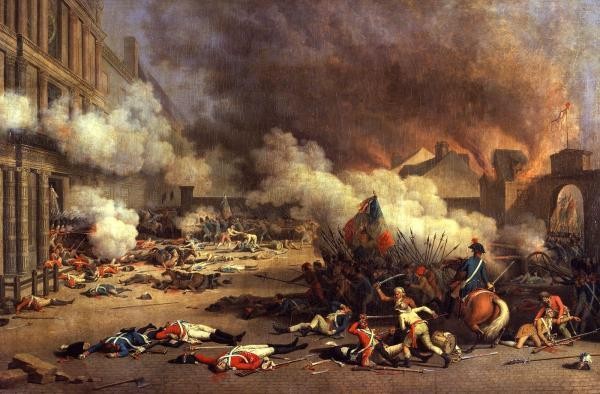
- French Revolution (Reign of Terror)
What happened:
- The monarchy and traditional authority structures were overthrown; the people were impoverished and the rich ruled without mercy. When people asked for food, the queen infamously state “Give them Cake.”
- Old laws and institutions were dismantled rapidly.
- Revolutionary factions competed for power with few stable legal constraints.
Result:
- The Reign of Terror (1793–1794) led to mass executions (tens of thousands). This led to the French Revolution. Secular humanism and Voltaire’s reason prevailed, and Christians were persecuted for their Biblical worldview.
- Suspicion replaced justice; accusations alone could lead to death.
- Ultimately, this chaos paved the way for Napoleon Bonaparte, who restored order—under authoritarian rule.
Takeaway: Removing established Biblical law and order without stable replacement led to fear, violence, and dictatorship.
- Russian Revolution
What happened:
- The Tsarist system collapsed. The poor were impoverished and the rich ruled until social chaos erased and semblance of law and order.
- Competing groups (Bolsheviks, Mensheviks, others) fought for control.
- Law enforcement and civil institutions disintegrated.
Result:
- A brutal civil war (1917–1922) caused millions of deaths.
- Economic collapse and famine spread widely. Marxist theories were implemented
- The outcome was a highly controlled state under Vladimir Lenin and later even stricter rule under Joseph Stalin.
Takeaway: Temporary breakdown of order led not to freedom—but to one of the most tightly controlled regimes in history. Socialism and Communism where absolute power controls absolutely.
- Somali Civil War
What happened:
- The central government collapsed in 1991.
- No effective national legal system remained.
- Local warlords and militias controlled territory.
Result:
- Widespread violence, famine, and lawlessness.
- Rise of piracy and armed conflict.
- Basic services (healthcare, infrastructure) nearly disappeared.
Takeaway: Without law, society fragmented into localized power struggles and survival conditions. Immigration to the United States has led to fraud and abuse of our generous social programs, as seen in Minnesota and California, sending millions to fund the Somalian warlords.
- China: Mao’s Cultural Revolution 1962-1976
What happened:
- Traditional institutions, norms, and authorities were attacked.
- Youth groups (“Red Guards”) were encouraged to challenge all authority.
- Legal norms were overridden by ideological zeal.
Result:
- Social chaos, persecution, and millions of deaths.
- Intellectuals, teachers, and leaders were publicly humiliated or killed.
- Eventually, the government reimposed order.
Takeaway: Undermining law and structure in favor of unchecked ideological freedom led to mass social breakdown and suffering.
- Germany: Weimar Republic collapse
What happened:
- Economic collapse and political fragmentation weakened rule of law.
- Street violence between factions became common.
- Government authority became ineffective.
Result:
- Citizens lost confidence in democratic order.
- This instability enabled the dictator Adolf Hitler to rise to power.
- A totalitarian regime replaced a weakened system.
Takeaway: When law and order erode, people often accept extreme leadership for the sake of stability.
Big Picture Pattern
Across all these cases, a consistent pattern emerges:
- Law/order breaks down (or is intentionally dismantled)
- Power vacuums form
- Violence and instability increase
- People suffer (economically and physically)
- A strong authority re-emerges (often more restrictive than before)
Important Clarification
Even in places often described as “free societies,” like the United States or modern democracies, freedom exists because of law—not in its absence. Laws:
- Protect rights
- Resolve disputes peacefully
- Limit abuse of power
Without them, freedom typically devolves into “rule by the strongest” rather than true liberty.
From a Biblical worldview let us look at the value of law and order to avoid authoritarianism.
The Bible actually speaks very directly to this pattern. It doesn’t just describe political collapse—it shows the spiritual and moral roots behind it, and why both lawlessness and authoritarianism are dangers when God’s design is ignored.
📖 “Everyone Did What Was Right in Their Own Eyes”
The Book of Book of Judges
This phrase appears repeatedly:
- Judges 17:6
- Judges 21:25 — “In those days there was no king in Israel; everyone did what was right in his own eyes.”
What was happening:
- No central authority
- God’s law was known—but ignored
- Moral truth became subjective and personal
The results (Judges 17–21):
- Idolatry (Micah creates his own religion)
- Moral collapse (Judges 19—violence comparable to Sodom)
- Civil war (nearly wiping out the tribe of Benjamin)
👉 The key insight:
This was not true freedom—it was moral chaos, injustice, and suffering.
📖 Other Biblical Examples of Lawlessness & Collapse
- Before the Flood – Book of Genesis
Genesis 6:5, 11–12
- “Every inclination… was only evil continually”
- “The earth was filled with violence”
Result:
- The Flood resets humanity
👉 When moral restraint disappears, violence fills the vacuum.
- Tower of Babel
What happened:
- Humanity unified—but in rebellion against God
- Attempt to build identity and security apart from Him
Result:
- Confusion, chaos and division
👉 Not all “order” is good—unity without God becomes prideful rebellion.
- Sodom and Gomorrah
Genesis 13:13; 19
- Extreme moral corruption
- No protection for the vulnerable
Result:
- Total destruction and annihilation
👉 A society without moral boundaries becomes unsafe and predatory upon the weak and vulnerable.
- Israel’s Kings When Law Was Ignored
Example: King Ahab
- Ignored God’s law
- Allowed injustice (Naboth’s vineyard, 1 Kings 21)
Result:
- National decline and judgment
👉 Even with structure, corruption of law leads to oppression.
⚖️ The Bible’s Balance: Law Is Good—but Must Be Grounded in Love
The Bible does not teach:
- Total freedom without law ❌
- Nor oppressive control ❌
It teaches a third way:
God’s Law=Freedom=Love=Peace= God’s Character
- Law Protects Freedom
From Book of Psalms and Book of Romans:
- Psalm 119:45 — “I will walk about in freedom, for I have sought out your precepts.”
- Romans 13:3–4 — Authorities restrain evil
👉 Biblical law is meant to:
- Protect life
- Defend the weak
- Create trust and stability
- Lawlessness Leads to Bondage
From Book of Galatians:
- Galatians 5:13 — Freedom is not for indulging the flesh
👉 When people reject moral truth:
- Sin becomes the new master
- Society becomes unstable
- Law Without Love Becomes Oppression
From Gospel of Matthew:
- Jesus rebuked legalism (Matthew 23)
👉 Rules alone can become:
- Controlling
- Hypocritical
- Dehumanizing
🧭 Avoiding Authoritarianism (Biblical Principles)
The Bible gives safeguards against tyranny:
- Law Above Leaders
- Kings were subject to God’s law (Deuteronomy 17:18–20)
👉 No human has absolute authority. Mankind is subject to God’s Law, the Ten Commandments, Exodus 20.
- Human Dignity Comes from God
- Genesis 1:27 — all made in God’s image
👉 Prevents abuse of power
- Distributed Authority
- Prophets, priests, and kings checked each other
👉 Prevents concentration of power
- Heart Transformation Over External Control
From Book of Jeremiah:
- Jeremiah 31:33 — law written on the heart
👉 The ultimate solution is internal, not just external
🌿 The Big Biblical Insight
- No law → chaos and destruction (Judges, Flood, Sodom)
- Corrupt law → oppression and injustice (Ahab, Pharisees)
- God’s law + transformed hearts → true freedom
A Simple Way to Think About It
- Law is like guardrails on a mountain road
- Remove them → people fall off the cliff
- Make them too rigid or controlling → people can’t move
- Properly placed → they enable safe freedom
We will continue by connecting this to Ellen G. White brings a very rich and balanced perspective. She consistently warned against both extremes you’ve been exploring:
- Lawlessness (everyone doing what is right in their own eyes)
- Oppressive control (authority divorced from God’s character)
Her central idea is simple but profound:
👉 God’s law is not the enemy of freedom—it is the foundation of it.
🌿 1. Law as the Foundation of Liberty
Ellen White repeatedly describes God’s law as a law of love, not arbitrary rules.
From Steps to Christ:
“The law of God is an expression of His very nature… it is the law of love.”
What this means:
- God’s law reflects who He is (love, justice, mercy)
- Obedience is not about control—but about alignment with reality
This connects directly to:
- Book of Psalms 119:45 — walking in freedom through God’s precepts
👉 In her view, breaking God’s law doesn’t create freedom—it breaks or oppresses the person into bondage.
⚠️ 2. Lawlessness Leads to Bondage (Judges Revisited)
Ellen White directly echoes the pattern seen in the Book of Judges:
From Patriarchs and Prophets (paraphrased theme):
- When Israel set aside God’s law, they didn’t become free
- They fell into oppression, suffering, and enemy domination
She emphasizes a cycle:
- Reject God’s law
- Fall into sin and confusion
- Experience suffering
- Cry out for deliverance
👉 This mirrors exactly what you asked about historically:
removing moral order → chaos → loss of freedom
⚖️ 3. The Danger of Humanly Imposed Control
But Ellen White is just as strong on the other side.
From The Desire of Ages:
“Force is the last resort of every false religion.”
Key idea:
- True obedience cannot be forced
- External pressure may control behavior—but never the heart
She saw this danger in:
- The Pharisees (Matthew 23)
- Historical religious systems that used coercion
👉 So:
- Law without love → legalism and oppression
- Authority without God → tyranny
🕊️ 4. Freedom Requires a Transformed Heart
This is where Ellen White goes deeper than political or social systems.
From The Desire of Ages:
“The only freedom is found in obedience to the principles of heaven.”
And echoing Book of Jeremiah 31:33:
- God writes His law in the heart
Her core insight:
- External laws restrain evil
- But only inner transformation creates true freedom
👉 Without inner change:
- Lawlessness = chaos
- Strict control = rebellion
🧭 5. Safeguard Against Authoritarianism
Ellen White strongly opposed the merging of unchecked human authority with conscience.
From The Great Controversy (theme):
- Every person must be free to follow conscience
- No human authority should replace God’s authority
Principles she emphasized:
- God alone is Lord of the conscience
- Prevents governments or churches from absolute control
- Truth persuades—it does not coerce
- Love, not force, is God’s method
- Moral law is unchanging—but must be freely chosen
- Protects both order and liberty
👉 This creates a powerful balance:
- Stable moral law (prevents chaos)
- Freedom of conscience (prevents tyranny)
🌄 6. The Great Controversy Framework
Ellen White places this whole issue in a cosmic context:
Two competing systems:
God’s government:
- Based on love
- Law is internalized
- Freedom is real and voluntary
Satan’s system:
- Begins with lawlessness (“I will exalt myself…” – Isaiah 14)
- Ends in control and force
👉 Her striking conclusion:
Lawlessness and tyranny are not opposites—they are stages of the same rebellion.
🌿 Final Synthesis
Bringing together:
- The Bible (Judges, Genesis, Romans)
- History (collapsed societies)
- Ellen White’s writings
The pattern becomes clear:
| Path | Result |
| No law | Chaos, violence, collapse |
| Corrupt/forced law | Oppression, fear, control |
| God’s law + transformed heart | Freedom, stability, love |
A Simple Way to Frame It
- God’s law is not a cage
- It is a design for life
Remove it → life breaks down
Force it → love disappears
Live it from the heart → freedom flourishes
The Ten Commandments are not onerous, ten do nots. They are do and live. They are the Law of Love. They reflect God’s character and His love for humanity. They are God’s love speaking to every human being, that lead to horizontal freedom and peace with fellow man and vertical peace and freedom with Jesus Christ and God the Father. Great peace have we that love His Law. In a modern culture that fuels despair, God’s law gives us hope, joy and peace. The ULTIMATE FREEDOM IS IN CHRIST, His law, character in our hearts and minds..
Remember:
In Christ,
No Condemnation
Therefore
No Separation.
Amen.