



What if the greatest events in Christian history had already been revealed nearly two thousand years ago?
What if the rise of Christianity, the persecution of believers, the corruption of religious institutions, the cries of the martyrs, and the approaching judgment of God were all part of one extraordinary prophetic vision?
Welcome to Unveiling Revelation at ASKGOD365 found on SecondComing.org.
Today we are opening one of the most dramatic and misunderstood chapters in the entire Bible: Revelation chapter 6.
Here we encounter four mysterious horsemen, the voices of martyrs beneath a heavenly altar, a devastating earthquake, a darkened sun, falling stars, and a terrified world attempting to hide from the face of God.
But Revelation 6 is not simply a frightening prediction of disasters.
It is a revelation of Jesus Christ.
The One opening the seals is the Lamb who was slain for the sins of the world.
And behind every scene stands a remarkable truth: God has never lost control of human history.
Today we will examine Revelation 6 through the Bible, the writings of Ellen G. White, and the sanctuary-centered prophetic scholarship of Dr. Alberto R. Treiyer.
We will explore how the six seals relate to the history of Christianity, the Great Controversy between Christ and Satan, the heavenly judgment, and the final return of Jesus.
Most importantly, we will answer the question that closes the chapter:
When the great day of God’s judgment arrives, who will be able to stand?
The answer may be the most encouraging truth in the entire book of Revelation.
Central theme: Revelation 6 reveals the unfolding history of the Christian church, the conflict between Christ and Satan, the suffering of God’s faithful people, the approach of divine judgment, and the ultimate question confronting humanity: “For the great day of his wrath is come; and who shall be able to stand?” (Revelation 6:17, KJV).
The chapter contains six seals, but its meaning cannot be understood adequately without examining Revelation 4–5, the heavenly sanctuary, the Lamb who alone is worthy to open the scroll, and Revelation 7, which answers the question raised by the sixth seal.
Our study will distinguish three important levels of interpretation:
-
The biblical text: What Revelation 6 actually says and how its symbols relate to the Old and New Testaments.
-
Ellen G. White’s writings: Her explicit applications of the seals and related prophetic events, distinguishing direct statements from theological connections.
-
Alberto R. Treiyer’s interpretation: His historicist and sanctuary-centered approach, with attention to the relationship between the seals, the heavenly court, the covenant, and the final judgment.
The exposition follows the traditional Seventh-day Adventist historicist framework, while identifying areas where Adventist scholars differ on chronology and symbolism.
Part I — The Heavenly Background: Why the Seals Matter
Before the first horseman appears, John has already seen a magnificent heavenly scene.
In Revelation 4, God sits upon His throne, surrounded by heavenly beings who worship Him as Creator.
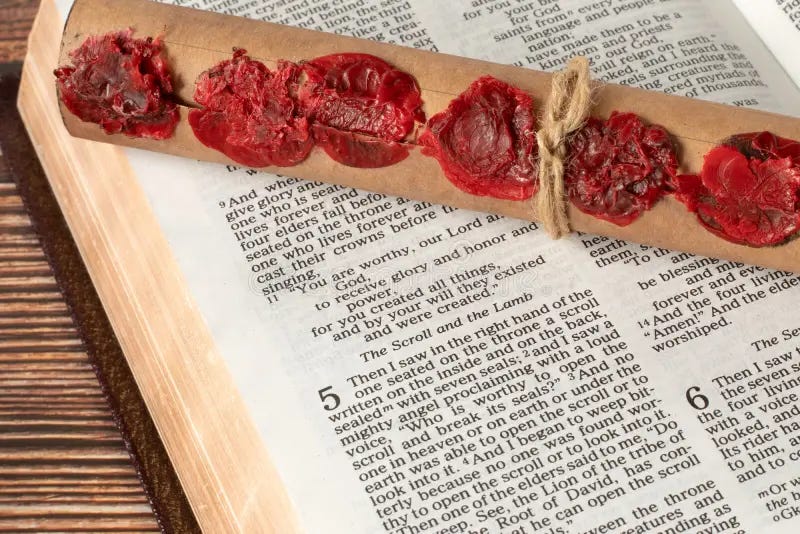
In Revelation 5, John sees a scroll in the right hand of the One seated on the throne. The scroll is sealed with seven seals. No one in heaven or earth is initially found worthy to open it.
John weeps until one of the elders announces:
“Behold, the Lion of the tribe of Juda, the Root of David, hath prevailed to open the book, and to loose the seven seals thereof.” — Revelation 5:5, KJV
John then sees not a conquering lion, but a Lamb standing as though slain.
This is the foundation of the entire prophecy: The One who opens the seals is the crucified, resurrected, and victorious Jesus Christ.
The seals do not represent a universe spinning out of control. Christ remains sovereign throughout the conflict.
The significance of the sealed scroll
Several biblical passages help illuminate the imagery.
-
Daniel 12:4, 9: A prophetic book is sealed until the time of the end.
-
Ezekiel 2:9–10: A scroll contains lamentations, mourning, and woe.
-
Jeremiah 32:10–14: Sealed documents preserve legally significant testimony.
-
Daniel 7:9–10: Books are opened in the heavenly judgment.
-
Revelation 20:12: Books are opened in the final judgment.
These passages establish a biblical association between written heavenly records, covenant accountability, divine government, and judgment.
However, Revelation 5 does not explicitly identify its scroll as the book of life, the book of the covenant, or the title deed to the earth. Those identifications are interpretive proposals rather than direct statements of the passage.
The great controversy dimension
In the Adventist understanding, the conflict is larger than the history of earthly kingdoms.
The central questions are whether God is just, whether His law is righteous, whether Satan’s accusations are true, and whether the Lamb’s sacrifice is sufficient to redeem humanity.
Revelation 6 shows the consequences of sin and apostasy in history, while progressively revealing God’s answer to the suffering of His people.
This is especially important for the fifth seal, where the martyrs cry for justice, and for the sixth seal, where the day of divine reckoning finally arrives.
Part II — Overview of the Six Seals
TRADITIONAL ADVENTIST HISTORICIST CHRONOLOGY
| Seal | Symbol and historical application |
| First | White horse — apostolic purity and gospel conquest, approximately AD 31–100 |
| Second | Red horse — persecution and bloodshed, approximately AD 100–313 |
| Third | Black horse — compromise and spiritual famine, approximately AD 313–538 |
| Fourth | Pale horse — religious oppression and death, approximately AD 538–1517 or into the Reformation era |
| Fifth | Martyrs beneath the altar — appeal for justice, associated with the Reformation and post-Reformation period |
| Sixth | Cosmic signs and the coming of Christ — traditionally beginning with 1755 and extending to the Second Advent |
These dates are approximate interpretive markers, not dates specified by Revelation 6. Historicist commentators differ over the transitions and overlap between seals.
This general sequence is represented in classic Adventist expositions such as Uriah Smith’s Daniel and the Revelation and later Adventist Bible-study materials.
Ellen G. White Writings+1
Part III — The First Seal: The White Horse
REVELATION 6:1–2
1. The biblical text
“And I saw, and behold a white horse: and he that sat on him had a bow; and a crown was given unto him: and he went forth conquering, and to conquer.” — Revelation 6:2, KJV
Four symbols dominate the first seal: the white horse, the rider, the bow, and the crown.
2. The meaning of the white horse
White represents purity, righteousness, and victory in several passages of Revelation.
Revelation 3:4–5 describes the faithful walking in white garments. Revelation 7:14 describes robes washed white in the blood of the Lamb. Revelation 19:11 portrays Christ riding a white horse.
These associations support the traditional Adventist identification of the first horse with the victorious advance of the gospel during the apostolic period.
The book of Acts records the remarkable expansion of Christianity from Jerusalem to Judea, Samaria, Asia Minor, Greece, and Rome.
Paul declares in Colossians 1:23 that the gospel had been proclaimed broadly throughout the world known to his audience.
The white horse therefore represents a church advancing through the power of truth rather than through political or military domination.
3. The rider’s bow
The bow is an instrument of conquest.
Psalm 45:3–5 describes the victorious royal warrior, while Habakkuk 3:9 associates the bow with divine intervention.
Within a gospel-centered interpretation, the bow symbolizes the penetrating power of God’s Word.
Hebrews 4:12 describes the Word as living and powerful, while Ephesians 6:17 calls it the sword of the Spirit.
This is a theological analogy; Revelation 6 does not explicitly identify the bow as Scripture.
4. The crown of victory
The Greek word for the crown is stephanos, frequently associated with victory.
Compare 1 Corinthians 9:25, James 1:12, and Revelation 2:10.
The crown is given to the rider. The passive wording emphasizes that the authority to conquer is received rather than independently possessed.
The gospel triumphs because Christ has already triumphed.
5. Ellen White and the apostolic church
Ellen White’s The Acts of the Apostles repeatedly describes the advance of the early church through sacrifice, persecution, and the power of the Holy Spirit.
In The Great Controversy, chapter 2, “Persecution in the First Centuries,” she portrays the conflict between paganism and the rapidly spreading Christian faith.
Her account emphasizes that persecution could not destroy the gospel.
The historical application of the white horse to apostolic Christianity is clearly stated in traditional Adventist commentary. However, the relevant passages from Ellen White’s historical writings should not be presented as though she explicitly identified every detail of Revelation 6:2.
6. A significant interpretive alternative
Not all interpreters identify the first rider with Christ or the apostolic gospel.
Some understand the rider as military conquest, imperial expansion, or deceptive political power. They note that the four horsemen appear together as a sequence of destructive forces and that the rider carries a bow rather than the sword associated with Christ in Revelation 19.
This objection deserves consideration.
The traditional Adventist interpretation sees the progression from white to red to black to pale as a deterioration in the historical condition of Christianity. Other interpreters understand all four horsemen as manifestations of judgment.
Neither interpretation should be described as a direct, uncontested identification made by the text itself.
7. The spiritual lesson
The early church possessed neither the political influence nor the material wealth of Rome, yet the gospel spread throughout the empire.
Its strength was not governmental power.
Its strength was the crucified and risen Christ.
Podcast emphasis: The church is most victorious when its confidence rests in Jesus Christ, its message remains faithful to Scripture, and its mission is carried forward by the Holy Spirit.
Part IV — The Second Seal: The Red Horse
REVELATION 6:3–4
“And there went out another horse that was red: and power was given to him that sat thereon to take peace from the earth, and that they should kill one another: and there was given unto him a great sword.” — Revelation 6:4, KJV
The contrast with the first horse is striking.
White gives way to red. The imagery of conquest is followed by the explicit removal of peace.
2. The meaning of red
Red is naturally associated with bloodshed and violence.
Isaiah 63:1–3 uses bloodstained garments in a scene of judgment. Revelation 12:3 portrays Satan symbolically as a great red dragon.
The color alone does not establish that Satan is the rider. But the red horse clearly introduces conflict and killing.
3. Persecution in the Roman Empire
Traditional Adventist historicism applies this period especially to the persecution of Christians under pagan Rome.
Christian communities experienced periods of severe persecution under emperors including Decius, Valerian, and Diocletian.
The Diocletianic persecution, beginning in AD 303, was among the most extensive imperial attempts to suppress Christianity.
Christians faced imprisonment, confiscation of property, destruction of places of worship, and death.
Yet persecution was neither continuous nor geographically uniform throughout the entire period.
4. The great sword
The Greek term machaira refers to a sword or large knife. The description emphasizes the capacity to kill.
The sword may represent imperial violence, warfare, or the wider breakdown of human peace.
In the traditional Adventist sequence, it illustrates the bloody struggle between the church and its persecutors.
5. The relationship to Matthew 24
Jesus warned:
“And ye shall hear of wars and rumours of wars.” — Matthew 24:6, KJV
He also predicted that His followers would be hated and persecuted for His name (Matthew 24:9).
The seals and the Olivet Discourse share an important pattern: conflict, suffering, deception, persecution, cosmic signs, and final deliverance.
This relationship suggests that the seals should be read as part of Christ’s larger prophetic description of the period between His first and second advents.
6. Ellen White’s interpretation of persecution
In The Great Controversy, chapter 2, Ellen White describes Satan’s attempts to destroy the church through violence.
She argues that persecution often strengthened Christian witness rather than eliminating it.
A central theological insight emerges: Satan’s hostility cannot defeat Christ’s redemptive purpose.
The martyrs demonstrate that loyalty to Jesus is more important than physical survival.
7. The deeper Great Controversy meaning
The red horse illustrates a fundamental characteristic of Satan’s kingdom: coercion.
Jesus never instructed His followers to advance His kingdom by killing opponents.
In John 18:36, Christ declared that His kingdom was not of this world and that His servants would not fight to prevent His arrest.
The contrast is profound.
Christ wins through self-sacrificing love. Earthly powers frequently seek victory through force.
Podcast emphasis: A church willing to suffer for truth is spiritually different from a church willing to use violence to enforce its claims.
Part V — The Third Seal: The Black Horse
REVELATION 6:5–6
“And I beheld, and lo a black horse; and he that sat on him had a pair of balances in his hand.” — Revelation 6:5, KJV
The following verse describes wheat and barley sold at extraordinary prices, while oil and wine are not to be harmed.
The black horse introduces economic scarcity and, in the traditional historicist interpretation, spiritual famine.
2. Black as a contrast to white
In the first seal, white represents purity.
The third horse is black.
Within the Adventist historical reading, this contrast symbolizes the growing corruption of Christianity as it acquired political power and increasingly absorbed practices not grounded in apostolic teaching.
But we should recognize that the immediate imagery of Revelation 6:5–6 is economic: grain prices, scales, and scarcity.
The application to spiritual darkness is a secondary, typological interpretation.
3. The scales and the cost of grain
The balances indicate that food must be carefully weighed.
Revelation 6:6 specifies a measure of wheat for a penny and three measures of barley for a penny.
The word translated “penny” in the KJV is denarius, commonly used for a day’s wage.
Matthew 20:2 provides a useful comparison.
A worker earning one denarius could purchase only a small quantity of wheat, enough for approximately one person’s daily needs, or a larger quantity of less expensive barley.
The imagery communicates severe economic pressure.
People are working simply to survive.
4. The spiritual famine
Amos 8:11 predicts a famine not of bread or water, but of hearing the words of the Lord.
That passage provides a meaningful theological parallel.
As Christianity became increasingly entangled with imperial institutions, doctrinal controversies, political ambitions, and coercive authority, the simplicity of the apostolic gospel was often obscured.
The traditional Adventist interpretation associates the third seal with the era following Constantine’s rise to power, particularly after AD 313.
Christianity’s changed legal status was historically significant, but it would be inaccurate to suggest that every development after Constantine represented apostasy or that all believers had abandoned biblical truth.
5. The danger of church-state union
The New Testament distinguishes the kingdom of Christ from the coercive kingdoms of this world.
Jesus taught that greatness among His disciples would be measured by service rather than domination (Mark 10:42–45).
When religious leaders acquire civil power, the temptation arises to substitute governmental authority for persuasion through Scripture and the Holy Spirit.
This is a central concern in Adventist interpretations of church history.
The problem is not Christianity’s public influence in itself.
The problem is the use of civil penalties to compel religious conformity.
6. The oil and wine
Revelation 6:6 concludes with the command not to damage the oil and wine.
Several interpretations are possible.
The literal-economic interpretation: Grain shortages and inflated prices coexist with the preservation of oil and wine. This may reflect uneven economic hardship, with basic necessities becoming scarce while other agricultural goods remain available.
The spiritual-symbolic interpretation: Oil may evoke the Holy Spirit, as in Zechariah 4, while wine may evoke covenant blessing, joy, or Christ’s sacrificial blood.
The second interpretation can support a sermon about God’s continuing grace during periods of spiritual darkness.
However, Scripture does not explicitly define the oil and wine of this particular seal as the Holy Spirit and the blood of Christ.
The literal famine imagery should remain the primary textual starting point.
7. Ellen White on compromise
In The Great Controversy, chapter 3, “An Era of Spiritual Darkness,” Ellen White describes the gradual accommodation of Christianity to pagan culture and the growth of ecclesiastical authority.
Her larger concern is the displacement of biblical truth by human tradition.
This concern is particularly relevant to the Sabbath.
The fourth commandment identifies the Creator as worthy of worship (Exodus 20:8–11). Revelation 14:7 later calls humanity to worship the One who made heaven, earth, sea, and the fountains of waters.
The Sabbath therefore connects the creation theology of Revelation 4 with the final worship conflict of Revelation 14.
Nevertheless, Revelation 6:5–6 does not itself mention the Sabbath or Sunday observance.
The connection is theological and historical, not an explicit statement within the third seal.
8. The spiritual lesson
A church can become institutionally powerful while becoming spiritually impoverished.
It can possess magnificent buildings, wealth, and political influence while losing the centrality of Scripture and the gospel.
Podcast emphasis: Spiritual famine occurs whenever human authority displaces the Word of God, even if religious institutions appear prosperous.
Part VI — The Fourth Seal: The Pale Horse
REVELATION 6:7–8
1. The biblical text
“And I looked, and behold a pale horse: and his name that sat on him was Death, and Hell followed with him.” — Revelation 6:8, KJV
The rider is explicitly named Death.
Hades follows him.
Authority is given to kill through the sword, hunger, death, and the beasts of the earth.
2. The pale color
The Greek word chloros describes a greenish or pale-green color.
It is associated here with the appearance of sickness, decay, and death.
The horse is not simply gray or white.
Its color communicates the horror of mortality.
3. Death and Hades
The Greek term thanatos means death.
Hades refers to the realm or state of the dead.
In Revelation 1:18, Jesus possesses the keys of death and Hades.
In Revelation 20:13–14, death and Hades surrender the dead and are ultimately destroyed.
Within Adventist theology, Hades should not automatically be equated with a place where disembodied souls experience conscious eternal torment.
Ecclesiastes 9:5–6, John 11:11–14, and 1 Thessalonians 4:13–17 are important texts for the Adventist understanding of death as an unconscious sleep until the resurrection.
The fourth seal personifies death and the grave as enemies of humanity.
4. The four instruments of destruction
The sword, hunger, death, and wild beasts echo Ezekiel 14:21.
There, God describes four severe judgments involving sword, famine, wild beasts, and pestilence.
This Old Testament background is especially important.
It suggests that the fourth horseman belongs to a larger biblical pattern of covenant judgment and human catastrophe.
The seals therefore should not be reduced solely to a history of ecclesiastical institutions. They also portray the suffering and destruction that characterize a fallen world.
5. The traditional historicist application
Traditional Adventist commentators associate the pale horse with the era of medieval religious oppression.
The period beginning around AD 538 is often emphasized because of its place in the Adventist interpretation of the 1,260 prophetic days of Daniel 7:25 and Revelation 12:6, 14.
Historicist interpreters apply the day-year principle to understand this period as 1,260 years, traditionally ending in 1798.
However, the fourth seal does not explicitly mention the 1,260 days. Its chronology must be inferred by comparing prophetic passages.
The medieval period witnessed serious religious persecution, including the suppression of movements deemed heretical.
Among the communities often discussed in Protestant and Adventist historical writing are the Waldensians, Albigensians, and other dissenting Christians.
Their histories are complex, and they should not all be treated as doctrinally identical to modern Seventh-day Adventists.
6. Ellen White and the persecuted church
In The Great Controversy, chapters 4–6, Ellen White describes the preservation of Scripture and the witness of believers who resisted coercive religious authority.
Her treatment of the Waldensians is especially relevant to the theme of faithfulness under persecution.
She emphasizes the endurance of believers who valued Scripture above ecclesiastical tradition.
Her account presents the preservation of biblical truth as evidence that God has never abandoned His people.
7. Treiyer’s historical and sanctuary concerns
Dr. Alberto R. Treiyer’s published work strongly emphasizes continuity between the prophecies of Daniel, Revelation, the heavenly sanctuary, and the historic Protestant interpretation of religious-political power.
His research on medieval dissenting Christians, the papacy, and the prophetic periods is relevant to the fourth seal.
For example, his article catalog includes discussions of the Albigensians and the historical relationship between religious and secular authority.
Adventist Distinctive Messages+1
These sources support the broader historical context, but they do not by themselves establish that Treiyer assigns the fourth seal precisely to AD 538–1517. That chronology should be attributed to the traditional historicist model unless confirmed in his seal-specific writings.
8. The spiritual lesson
The fourth seal warns against the ultimate corruption of religion: using death and fear to compel the conscience.
Jesus said that His disciples would be recognized by their love for one another (John 13:35).
A religious system that relies on persecution contradicts the character of the Lamb.
Podcast emphasis: The true church is identified not by its ability to control human conscience, but by its fidelity to Christ and His Word.
Part VII — The Fifth Seal: The Souls Beneath the Altar
REVELATION 6:9–11
The first four seals describe conquest, violence, scarcity, and death. The fifth introduces the voices of those who suffered because they remained faithful to God.
The focus moves from the persecutors to the persecuted, from earthly violence to heavenly justice.
1. The biblical text
John sees beneath the altar the souls of those killed because of the Word of God and their testimony.
They cry out:
“How long, O Lord, holy and true, dost thou not judge and avenge our blood on them that dwell on the earth?” — Revelation 6:10, KJV
They receive white robes and are instructed to rest a little longer until the number of their fellow servants who will also be killed is complete.
Three major theological questions arise:
-
Are these martyrs consciously alive in heaven?
-
What does their appeal reveal about divine judgment?
-
Why must they wait before their vindication is completed?
2. The altar and the blood of sacrifice
The altar imagery must be understood through the Old Testament sanctuary.
Leviticus 4:7 and 4:18 describe sacrificial blood being poured at the base of the altar of burnt offering.
Leviticus 17:11 establishes the relationship between blood and life.
The martyrs’ blood is therefore represented symbolically as having been poured out in sacrifice.
Their deaths were not meaningless.
Their lives were given in faithful testimony to God.
Paul employs similar sacrificial language when describing his own ministry in Philippians 2:17 and 2 Timothy 4:6.
3. Are the martyrs literally speaking from heaven?
This question is especially important for an Adventist audience.
The passage is sometimes used to support the belief that believers remain consciously alive after death.
However, several features suggest that John is seeing a symbolic prophetic scene.
In Genesis 4:10, God tells Cain that Abel’s blood cries to Him from the ground.
Abel’s blood was not literally speaking.
The imagery communicates that God has witnessed the murder and that the injustice demands an answer.
Likewise, Hebrews 12:24 describes the blood of Jesus as speaking better things than Abel’s blood.
The fifth seal can be understood as personifying the testimony of the martyrs.
Their blood cries for justice because God has not forgotten their sacrifice.
This interpretation is consistent with the Adventist understanding that the dead await the resurrection.
Relevant passages include Ecclesiastes 9:5–6, Psalm 115:17, John 11:11–14, 1 Corinthians 15:51–54, and 1 Thessalonians 4:13–17.
The fact that John sees a symbolic heavenly scene does not require the conclusion that the martyrs are already enjoying conscious existence in heaven.
4. The cry: “How long?”
The words of the martyrs echo a recurring appeal in Scripture.
Psalm 13:1
Psalm 79:5–10
Daniel 8:13–14
Daniel 12:6–7
Luke 18:7–8
The fifth seal therefore belongs to a larger biblical pattern: God’s people suffer, appeal for justice, and are assured that divine intervention will come.
5. Judgment and vindication
The martyrs appeal to the Lord as holy and true.
These attributes are significant.
God’s holiness means that evil cannot be permanently tolerated.
God’s truthfulness means that His promises cannot fail.
Their appeal is not simply a desire for personal revenge. It is a request that God publicly establish the righteousness of His government.
This is where the Great Controversy theme becomes especially powerful.
Satan has accused God of injustice and His faithful people of unworthiness.
The martyrs’ appeal raises the question of whether God’s government will ultimately vindicate those who trusted Him.
Daniel 7:21–22 describes a little horn making war against the saints until judgment is given in their favor.
This is one of the strongest prophetic parallels to Revelation 6:9–11.
The suffering of the saints is not the final word.
The heavenly judgment will demonstrate that their faithfulness was not in vain.
6. The white robes
The martyrs receive white robes before the final consummation of judgment.
White robes are associated with purity, victory, and salvation in Revelation 3:4–5 and 7:13–14.
Revelation 7:14 explicitly identifies the Lamb’s blood as the means by which the redeemed have washed their robes.
The imagery therefore directs attention away from human merit and toward Christ’s saving work.
The robes are given.
They are not earned.
The martyrs are victorious because of their relationship with the Lamb.
7. Why must the martyrs wait?
Revelation 6:11 states that the martyrs must rest until their fellow servants and brothers who will be killed have completed their appointed course.
This reveals that the history of persecution has not yet ended.
The divine response is certain, but the full vindication of God’s people remains future.
It also demonstrates that God is not indifferent to evil merely because He does not immediately intervene.
Second Peter 3:9 reminds believers of God’s patience.
Revelation 6, however, does not explain every reason for the delay. It simply assures the martyrs that their suffering has been acknowledged and that the final answer is coming.
8. Ellen White and the martyrs’ vindication
Ellen White’s The Great Controversy repeatedly emphasizes that God’s faithful witnesses will be vindicated.
Chapter 39, “The Time of Trouble,” describes the distress of God’s people and their reliance upon divine promises.
Chapter 40, “God’s People Delivered,” describes the ultimate intervention of Christ.
Chapter 42, “The Controversy Ended,” presents the final vindication of God’s character and government.
These chapters provide a theological framework for the fifth seal, although they should not all be cited as direct verse-by-verse expositions of Revelation 6:9–11.
9. The sanctuary connection
The fifth seal connects naturally with Daniel 7 and 8.
Daniel 7 describes the heavenly court, the opening of books, the judgment of the oppressive power, and the vindication of the saints.
Daniel 8:14 introduces the cleansing or restoration of the sanctuary after the prophetic period of 2,300 evenings and mornings.
Traditional Adventist interpretation understands this as pointing to the heavenly phase of judgment beginning in 1844.
The fifth seal itself does not specify 1844, but the theme of divine vindication provides a meaningful connection to Adventist sanctuary theology.
A careful distinction is necessary:
The martyrs’ cry is explicitly in Revelation 6. The investigative judgment beginning in 1844 is an Adventist interpretation derived principally from Daniel 8:14, Daniel 9, and the broader sanctuary framework.
The two themes can be related without claiming that Revelation 6:11 independently establishes the 1844 date.
10. The spiritual lesson
The fifth seal gives assurance to every believer who has suffered injustice.
God sees.
God remembers.
God judges righteously.
And God will ultimately vindicate His people.
Podcast emphasis: The silence of God should never be mistaken for the absence of God. The Lamb who was slain knows every injustice committed against His faithful witnesses.
Part VIII — The Sixth Seal: Cosmic Signs, Judgment, and the Return of Christ
REVELATION 6:12–17
The imagery is no longer centered on individual horsemen or the martyrs beneath the altar.
The entire created order appears to be shaken.
The question of divine judgment becomes unavoidable.
1. The biblical sequence
Revelation 6:12–17 presents the following progression:
-
A great earthquake.
-
The sun becoming black.
-
The moon appearing as blood.
-
Stars falling from heaven.
-
The heavens departing like a scroll.
-
Mountains and islands being displaced.
-
Humanity attempting to hide from the throne and the Lamb.
-
The announcement of the great day of wrath and the question of who can stand.
This sequence closely parallels the cosmic signs of Matthew 24:29–31, Mark 13:24–27, and Luke 21:25–28.
It also draws upon Isaiah 13:9–13, Isaiah 34:4, Joel 2:30–31, and Haggai 2:6.
2. The great earthquake — Revelation 6:12
Traditional Adventist interpretation identifies the great earthquake with the Lisbon earthquake of November 1, 1755.
This disaster devastated Lisbon and affected other areas through powerful seismic shaking and tsunamis.
The earthquake became a major event in European intellectual and religious history.
Many contemporary observers interpreted it as a warning of divine judgment.
Ellen White explicitly identifies the Lisbon earthquake with the prophetic sign in Revelation 6:12 in The Great Controversy, chapter 17, “Heralds of the Morning,” pages 304–305 in the standard edition.
Ellen G. White Writings
The important interpretive distinction is that the earthquake’s occurrence is historical fact, while its identification as the fulfillment of Revelation 6:12 is a theological interpretation.
3. The darkening of the sun — Revelation 6:12
The next sign is the darkening of the sun.
Traditional Adventist exposition associates this with the Dark Day of May 19, 1780, observed in portions of northeastern North America.
The event caused widespread alarm because daylight became unusually dark.
Ellen White discusses the event in The Great Controversy, chapter 17, and connects it with Christ’s prediction of signs in the heavens.
The theological importance lies in its timing within the historicist interpretation: after centuries of religious persecution and before the rise of the Advent awakening.
Natural explanations for the darkness, including atmospheric smoke and other environmental conditions, do not by themselves settle the theological question of whether the event also served as a providential sign.
A natural mechanism and a religious interpretation are different kinds of claims.
4. The moon becoming as blood
The bloodlike appearance of the moon is traditionally associated with the night following the Dark Day of May 19, 1780.
The moon’s reddish appearance is understood within this framework as the next part of the sixth-seal sequence.
Joel 2:31 similarly describes the sun turning to darkness and the moon to blood before the great and terrible day of the Lord.
The imagery communicates an extraordinary disruption of the ordinary signs by which humanity marks time and experiences the stability of creation.
5. The falling stars — Revelation 6:13
“And the stars of heaven fell unto the earth, even as a fig tree casteth her untimely figs.” — Revelation 6:13, KJV
Traditional Adventist interpretation associates this with the Leonid meteor storm of November 13, 1833.
The event was spectacular across large portions of North America.
Many witnesses interpreted the meteors as a sign of Christ’s approaching return.
Ellen White explicitly identifies the 1833 meteor storm with Revelation 6:13 in The Great Controversy, pages 333–334.
Ellen G. White Writings
This is one of the clearest examples where she directly applies a particular historical event to a specific verse in Revelation 6.
The meteor storm also occurred during the broader period in which William Miller’s preaching was attracting increasing attention.
In the traditional Adventist narrative, these events helped prepare the way for the Advent awakening.
6. The significance of the historical sequence
The sixth seal in classic Adventist interpretation
-
1755 — Lisbon earthquake
The beginning of the sequence of historical signs
-
1780 — Dark Day and reddish moon
Signs involving the sun and moon
-
1833 — Leonid meteor storm
The falling-stars sign associated with the Advent awakening
-
1844 — Beginning of the investigative judgment
A doctrinal milestone derived from Daniel 8:14 and Daniel 9, not an event explicitly dated in Revelation 6
-
Future — The return of Christ
The culmination of the sixth seal and the final confrontation with divine judgment
The first three dates are the historical applications Ellen White explicitly supports. The connection with 1844 comes through the broader Adventist sanctuary interpretation.
7. The heavens departing as a scroll — Revelation 6:14
John describes the heavens being rolled together like a scroll.
Isaiah 34:4 provides a close Old Testament parallel.
The image signifies a cosmic upheaval associated with divine intervention.
The world as humanity knows it cannot remain unchanged when the Creator appears in judgment.
The same Creator who established the heavens now brings history to its appointed conclusion.
Second Peter 3:10–13 describes the passing away of the present order and the promise of new heavens and a new earth.
In the Adventist reading, this portion of the sixth seal remains future.
8. Every mountain and island moved
The displacement of mountains and islands communicates the collapse of the apparent permanence of earthly creation.
Mountains symbolize stability and strength.
Islands represent seemingly secure locations separated from the mainland.
Yet neither offers refuge when God intervenes.
Revelation 16:18–20 contains similar language in connection with the seventh plague.
The parallels suggest that Revelation’s prophetic sequences may converge upon the same final events rather than functioning as entirely separate, consecutive histories.
9. The seven classes of humanity
Revelation 6:15 identifies kings, great men, rich men, military commanders, mighty men, enslaved people, and free people.
The sevenfold listing emphasizes the universality of the crisis.
No earthly status provides security.
Political authority cannot save.
Wealth cannot save.
Military strength cannot save.
Social position cannot save.
The final judgment removes every illusion of human self-sufficiency.
10. The wrath of the Lamb
This is one of the most striking expressions in Revelation.
A lamb ordinarily symbolizes gentleness, vulnerability, and sacrifice.
Yet John speaks of the wrath of the Lamb.
How can the One who died for His enemies also be the One before whom the wicked tremble?
The answer lies in the relationship between divine love and divine justice.
God’s love does not mean that evil will continue forever.
Christ’s sacrifice demonstrates God’s desire to save humanity.
But the final judgment demonstrates that sin, oppression, and rebellion cannot remain permanently established in God’s universe.
John 3:16–19 shows both dimensions.
God loves the world and gives His Son for its salvation, yet those who reject the light remain under judgment.
The Lamb’s wrath is therefore not a contradiction of His love.
It is the final expression of His righteous opposition to evil.
11. Ellen White and the Second Advent
In The Great Controversy, chapter 40, “God’s People Delivered,” Ellen White presents the dramatic deliverance of God’s people at the return of Christ.
Her descriptions draw from multiple biblical passages, including Revelation 6, Matthew 24, and other prophetic texts.
The final contrast is between those who fear the appearance of Christ and those who welcome Him.
For the redeemed, the Second Advent is the fulfillment of their blessed hope.
For those who persistently reject Christ, His appearing is terrifying.
12. The central question: Who shall be able to stand?
Revelation 6:17 concludes with the great question.
This question is not left unanswered.
Revelation 7 interrupts the sequence before the seventh seal is opened.
John sees the servants of God sealed in their foreheads and then a great multitude standing before the throne and before the Lamb.
Revelation 7:14 identifies them as those who have washed their robes and made them white in the blood of the Lamb.
The answer is therefore fundamentally Christ-centered.
Those who stand are those who belong to the Lamb.
Their assurance is grounded in His redeeming sacrifice, not in their own righteousness.
In Adventist theology, the sealing of God’s people is also associated with their settled loyalty to God, His commandments, and the faith of Jesus (Revelation 12:17; 14:12).
The Sabbath becomes especially significant through the creation-worship themes of Revelation 14:6–7 and Exodus 20:8–11.
But the specific identification of the Sabbath as the final test of loyalty is a broader Adventist theological conclusion. Revelation 6:17 itself does not mention the Sabbath.
Podcast emphasis: The most important question of Revelation 6 is not whether we can identify every earthquake, political event, or historical date. It is whether we have entrusted our lives to Jesus Christ, the Lamb who alone can save us.
Part IX — Alberto R. Treiyer’s Sanctuary-Centered Approach to Revelation 6
Dr. Alberto R. Treiyer, Adventist theologian known for research on the heavenly sanctuary, the Day of Atonement, Daniel, Revelation, and historicist prophetic interpretation.
Treiyer’s work is particularly valuable for understanding Revelation 6 within the larger theological structure of Revelation 4–8.
An important qualification: I located Treiyer’s published discussions of Revelation 4–5, the heavenly sanctuary, the Day of Atonement, and historicist interpretation, but not a verified, complete, seal-by-seal commentary establishing his precise position on all six seals. Therefore, the following is a sanctuary-centered synthesis informed by his documented theological approach, not a claim that every conclusion below is his explicit interpretation.
1. The heavenly throne and the sanctuary
Treiyer’s work emphasizes the importance of locating the visions of Revelation within the heavenly sanctuary and interpreting them through Old Testament sanctuary typology.
His published materials include:
-
The Day of Atonement as Related to the Contamination and Purification of the Sanctuary (1986).
-
The Priest-King Role of the Messiah (1996).
-
A Summary of the Heavenly Ministry of Jesus and Its Relation to Revelation 4–5 (2006).
-
Dialogues on the Heavenly Temple in the Book of Revelation (2022).
-
His 2023 critique of the Andrews Bible Commentary treatment of Revelation 4–5.
These works and their bibliographic descriptions are available through his ministry’s publication catalog.
Treiyer’s discussion of Revelation 4–5 is particularly important because he challenges interpretations that overlook the sanctuary setting and the distinction between different phases of Christ’s heavenly ministry.
His 2023 article discusses the understanding of the throne vision in relation to the Most Holy Place and the Day of Atonement. This does not mean that all scholars agree on the timing or sanctuary location of every throne-room scene.
2. The Lamb as priest, king, and judge
Revelation 5 portrays the Lamb as worthy to open the scroll because He was slain and redeemed people through His blood.
This provides three important connections:
Christ as sacrifice: Revelation 5:9 and Hebrews 9:12 establish that His redemptive work rests upon His own blood.
Christ as heavenly priest: Hebrews 7:25 and 8:1–2 describe His continuing ministry on behalf of believers.
Christ as king and judge: Daniel 7:13–14 describes the Son of Man receiving dominion, while John 5:22 declares that the Father has committed judgment to the Son.
Treiyer’s sanctuary-centered theological approach encourages readers to consider these functions together without collapsing them into a single event.
Christ’s sacrificial death, heavenly intercession, judgment ministry, and ultimate royal victory are related, but they are not identical.
3. The seals as evidence in the Great Controversy
One fruitful theological synthesis is to view the six seals as revealing the evidence of the conflict between Christ and Satan.
The first seal displays the victorious proclamation of the gospel.
The second through fourth seals reveal the destructive consequences of violence, spiritual compromise, and death.
The fifth seal presents the appeal of the faithful for justice.
The sixth seal anticipates the public manifestation of divine judgment.
In this reading, history is not merely a sequence of political events. It becomes the arena in which the character of God’s government and the consequences of rebellion are revealed.
This is consistent with Treiyer’s larger concern for divine vindication, but it should be presented as an interpretive synthesis rather than a documented quotation from him.
4. The relationship between the fifth seal and Daniel 7
Daniel 7
The little horn persecutes the saints.
The heavenly court convenes.
Judgment is given in favor of the saints.
Revelation 6
The martyrs have been slain.
They appeal to God for justice.
They receive white robes and await final vindication.
The relationship is substantial.
Both passages concern the persecution of God’s people and the certainty of divine justice.
The distinction is that Daniel 7 explicitly depicts the heavenly court and the opening of books, while Revelation 6:9–11 presents the martyrs’ appeal without describing the entire judicial procedure.
The passages illuminate one another, but their details should not be made interchangeable.
5. The relationship between the fifth and sixth seals
The fifth seal asks: How long will the suffering of God’s people remain unanswered?
The sixth seal reveals the approaching day when God will intervene openly.
The fifth seal emphasizes divine patience and the assurance of vindication.
The sixth emphasizes the certainty and universality of judgment.
Together, they move from the question of justice to the manifestation of justice.
6. The relationship to the investigative judgment
Within traditional Adventist sanctuary theology, Daniel 8:14 and the seventy-weeks prophecy of Daniel 9 form the basis for the 1844 interpretation.
Treiyer’s research defends the importance of sanctuary typology and the heavenly Day of Atonement for understanding the judgment.
A sanctuary-centered reading of Revelation 6 can therefore connect the martyrs’ vindication with Christ’s heavenly judgment ministry.
But the chronology must remain clear.
Revelation 6 does not independently calculate 1844. Nor does it explicitly say that the opening of the sixth seal is the inauguration of the investigative judgment.
The traditional sixth-seal chronology places the Lisbon earthquake in 1755, before 1844, and continues through the final coming of Christ.
The investigative judgment is best introduced as part of the larger prophetic framework, not as a date directly encoded in Revelation 6.
7. A question requiring further examination
A particularly important research question is whether Treiyer’s understanding of the heavenly throne scene in Revelation 4–5 changes how the opening of the seals should be understood chronologically.
For example, does the opening of the scroll primarily concern Christ’s authority over history following His ascension, the unfolding of covenantal judgment, or a particular phase of the heavenly judicial process?
These possibilities have major implications for the relationship between Revelation 5, the fifth seal, and Daniel 7.
His exact answer should be established from his Revelation 4–5 and seven-seals lectures before being attributed to him.
For further research, his Adventist Distinctive Messages website includes articles, books, and Daniel and Revelation teaching series.
Part X — Comparison of Scripture, Ellen White, and Treiyer’s Theological Framework
| Seal | Biblical emphasis | Ellen White’s relevant writings | Treiyer-related sanctuary perspective |
|---|---|---|---|
| First | Conquest and victory | Acts of the Apostles; Great Controversy, ch. 2 | Christ’s victory and the gospel’s historical witness |
| Second | War and bloodshed | Great Controversy, ch. 2 | The conflict between the kingdom of Christ and coercive power |
| Third | Scarcity and famine | Great Controversy, ch. 3 | Covenant faithfulness, apostasy, and the displacement of biblical truth |
| Fourth | Death and destruction | Great Controversy, chs. 4–6 | Persecution, religious-political authority, and historicist prophecy |
| Fifth | Martyrdom and vindication | Great Controversy, chs. 39–42 | Heavenly justice, sanctuary judgment, and vindication of the saints |
| Sixth | Cosmic signs and final judgment | Great Controversy, chs. 17 and 40 | Final manifestation of judgment and the triumph of the Lamb |
The Treiyer column identifies theological connections to his published research, not verified individual interpretations of each seal.
Part XI — Seven Major Theological Conclusions
1. Jesus Christ is the central figure of Revelation 6
Although the chapter contains violence, famine, death, and judgment, the Lamb remains sovereign.
He opens every seal.
The story is ultimately about His victory, not Satan’s power.
2. The church’s history reveals the consequences of faithfulness and compromise
The traditional historicist interpretation traces a movement from apostolic purity through persecution, compromise, and religious oppression.
This should encourage believers to evaluate every religious institution, including their own, by the teachings and character of Jesus.
3. The heavenly sanctuary is essential to the chapter’s theology
The altar, the martyrs’ appeal, the throne, and the Lamb all belong to a larger biblical pattern involving sacrifice, mediation, and judgment.
The sanctuary reveals how God’s mercy and justice work together.
4. God has not forgotten the martyrs
The fifth seal assures believers that suffering is neither meaningless nor invisible to heaven.
The blood of the faithful calls for justice, and God promises a final answer.
5. Prophecy is not intended merely to satisfy curiosity
The signs of the sixth seal call humanity to recognize the seriousness of divine judgment.
Jesus’ own emphasis in Matthew 24:42–44 is watchfulness and readiness.
6. The judgment vindicates God’s character
The Great Controversy concerns more than the salvation of individual human beings.
It also concerns the public demonstration that God’s government is righteous, His law is good, and His redemptive work is just.
Romans 3:25–26 describes God as both just and the justifier of those who believe in Jesus.
7. The answer to Revelation 6 is found in Revelation 7
The sixth seal asks who can stand.
Revelation 7 portrays the redeemed standing before the throne.
Their robes have been washed in the blood of the Lamb.
The final answer is not human accomplishment.
It is Jesus Christ.
Part XII — References
These are the principal sources I recommend identifying in the episode notes.
Biblical references: Revelation 4–8; Daniel 7–9 and 12; Ezekiel 14:21; Zechariah 1 and 6; Leviticus 4 and 16–17; Matthew 24; Mark 13; Luke 21; Hebrews 8–10; Revelation 12–14 and 20.
Ellen G. White:
-
The Great Controversy — Heralds of the Morning — the Lisbon earthquake and heavenly signs.
-
The Great Controversy — 1833 falling stars — direct application of Revelation 6:13.
-
The Great Controversy, chapters 2–6 — persecution, apostasy, and the preservation of biblical truth.
-
The Great Controversy, chapters 39–42 — final trouble, deliverance, and the conclusion of the Great Controversy.
-
The Acts of the Apostles — the mission and witness of the apostolic church.
Alberto R. Treiyer:
-
Published articles and bibliographic catalog — includes his studies on Revelation 4–5, the heavenly temple, sanctuary typology, and the Day of Atonement.
-
Adventist Distinctive Messages — books and recorded prophetic teaching series.
Additional historicist commentary: Uriah Smith, Daniel and the Revelation — The Seven Seals.
Final Theological Reflection
The six seals present a progression from the gospel’s advance to the final revelation of divine justice.
The first four seals show the conflict unfolding on earth.
The fifth seal directs attention to the heavenly appeal for vindication.
The sixth seal reveals the approaching consummation of God’s judgment.
But the central figure never changes.
It is always the Lamb.
The One who was slain is the One who opens the scroll. The One who died to redeem humanity is the One who will bring history to its conclusion.
Revelation 6 is therefore not fundamentally a chapter about fear. It is a chapter about the certainty of Christ’s victory, the justice of God’s government, and the urgency of accepting the salvation offered by the Lamb.
Revelation 6 begins with a conquering rider and ends with a trembling world.
Between those two scenes, we witness the entire tragedy of human rebellion: persecution, spiritual compromise, violence, death, and the suffering of God’s faithful people.
Yet the chapter is not without hope.
The Lamb is still on the throne.
The martyrs are not forgotten.
The promises of God have not failed.
And the judgment of heaven will ultimately demonstrate that Jesus Christ is both a righteous Judge and a merciful Savior.
The great question of Revelation 6 is not simply whether we understand the meaning of the horses, the historical dates, or the signs in the heavens.
The great question is whether we know the Lamb.
Because when the heavens depart as a scroll and every earthly source of security disappears, only one foundation will remain.
Jesus Christ.
Revelation 7 reveals a multitude standing before the throne, clothed in white robes, having washed them in the blood of the Lamb.
They stand not because they have never sinned, but because they have placed their faith in the One who died for them.
And that is the message of the gospel.
The Lamb who opens the seals is the same Lamb who takes away the sin of the world.
He is the Savior who invites us to come to Him today.
This is ASKGOD365, reminding you that biblical prophecy is not merely about knowing what will happen tomorrow.
It is about knowing the One who holds tomorrow in His hands.


Article
What Astronomy in the Bible Reveals About Our Promised Physical Future
Each new month of our modern era arrives with life-changing advancements in technology, medicine, and metaphysics. But what if the greatest period of...
Each new month of our modern era arrives with life-changing advancements in technology, medicine, and metaphysics. But what...