


The Throne of God, the Heavenly Sanctuary, and the Worship of the Creator
A Christ-Centered Expository Bible Study
Primary Scripture: Revelation 4:1–11 Supporting Scriptures: Daniel 7:9–14; Ezekiel 1; Isaiah 6; Hebrews 4:14–16; Hebrews 8–9; Revelation 5; Revelation 11:19; Revelation 14:6–12.
Theological perspective: Historicist, Christ-centered, Adventist, emphasizing the heavenly sanctuary, the great controversy between Christ and Satan, the character of God, and the everlasting gospel.
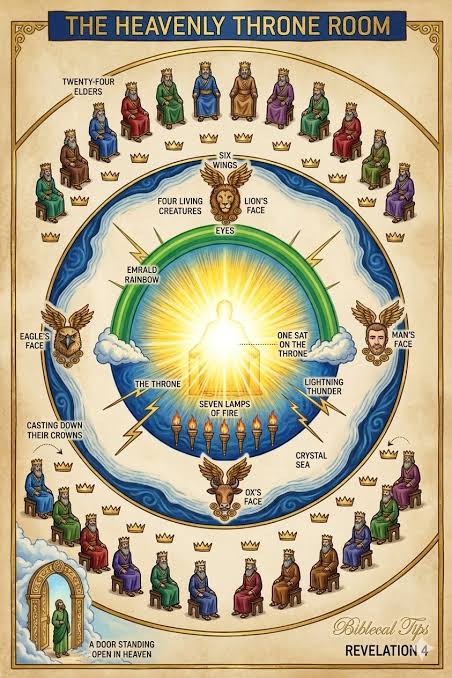
Why Revelation 4 is so Important
Revelation chapter 4 is one of the most magnificent descriptions of heaven found anywhere in Scripture. After addressing the seven churches in Revelation 2 and 3, the apostle John is invited to look beyond the struggles of the church on earth and behold the throne of God in heaven.
The significance of this chapter extends far beyond a description of heavenly glory. Revelation 4 introduces the heavenly throne-room setting for the visions that follow, particularly the revelation of Jesus Christ as the Lamb in chapter 5.
From a Adventist perspective, Revelation 4 establishes several foundational truths:
-
God is sovereign. Despite the apparent triumph of evil on earth, the throne of heaven remains occupied.
-
Heaven is the center of God’s redemptive government. The heavenly sanctuary reveals how God administers His kingdom and carries forward His plan of salvation.
-
Jesus Christ is central to heaven’s purposes. Although the Lamb becomes explicitly visible in Revelation 5, the vision of chapter 4 prepares us to understand His ministry and victory.
-
God is worthy of worship because He is the Creator. This becomes especially important in Revelation 14:6–7, where the final gospel proclamation calls humanity to worship the One who made heaven and earth.
-
The great controversy is being resolved. God’s character, His justice, His mercy, and His right to govern are central themes of Revelation.
-
The Sabbath is connected with the worship of the Creator. Revelation 4 does not explicitly mention the Sabbath, but its theology of creation provides an important foundation for understanding the fourth commandment and the three angels’ messages.
A central principle of Adventist interpretation is that Revelation should be understood through the life, death, resurrection, heavenly ministry, and ultimate triumph of Jesus Christ.
Revelation is not primarily a book about the Antichrist, persecution, or end-time catastrophes. It is, first and foremost, the revelation of Jesus Christ (Revelation 1:1).
This is the foundation upon which we will examine every verse of chapter 4.
I. The Literary and Prophetic Context of Revelation 4
Before examining the verses individually, we need to understand where Revelation 4 fits within the book.
Rev. 1
The risen Christ
Jesus appears among the seven golden lampstands, ministering to His church.
Rev. 2–3
The seven churches
Christ addresses the spiritual condition of His people across the Christian era.
Rev. 4
The throne of God
Heaven’s sovereignty, holiness, and worship of the Creator are revealed.
Rev. 5
The victorious Lamb
Jesus is revealed as the One worthy to open the sealed scroll.
Rev. 6–8
The seven seals
The unfolding history of the conflict between good and evil.
The first three chapters establish Christ’s intimate relationship with His church on earth. Chapters 4 and 5 then reveal the heavenly realities behind the earthly struggles.
This transition is theologically significant.
The church may experience persecution, compromise, suffering, apostasy, and spiritual weakness, but its future does not depend upon earthly circumstances.
Its future rests in the hands of the God who occupies the throne and the Lamb who has overcome.
The central message is that the history of the church must be understood in the light of heaven’s government, not merely the events occurring on earth.
II. Revelation 4:1 — The Open Door in Heaven
“After these things I looked, and behold, a door standing open in heaven.” — Revelation 4:1, NKJV
John sees an open door and hears a voice like a trumpet inviting him to come up and witness what must take place.
1. The meaning of the open door
The door represents access to a heavenly revelation that human beings could never discover through their own abilities.
John is not ascending into heaven through personal merit or mystical techniques. He is invited by divine revelation.
This distinction is important.
Biblical spirituality does not teach that human beings can enter God’s presence by achieving an altered state of consciousness. Rather, God reveals Himself through His Word and through the prophetic inspiration of the Holy Spirit.
Compare:
-
Ezekiel 1:1 — The heavens are opened, and Ezekiel sees visions of God.
-
Daniel 7:9–10 — Daniel witnesses the heavenly throne and court.
-
Acts 7:55–56 — Stephen sees Jesus standing at God’s right hand.
-
Hebrews 10:19–22 — Believers have access to God through the blood of Jesus.
2. Is this the door to the heavenly sanctuary?
Seventh-day Adventists recognize that Revelation contains important heavenly sanctuary imagery.
Hebrews 8:1–2 identifies Christ as our High Priest, ministering in the true tabernacle established by the Lord.
Revelation 11:19 explicitly describes the temple of God being opened in heaven and the ark of His covenant becoming visible.
However, we should distinguish between these passages.
Revelation 4:1 mentions a door in heaven but does not explicitly identify that door with either apartment of the heavenly sanctuary.
Consequently, it would be exegetically unwarranted to claim that Revelation 4:1, by itself, proves the opening of the Most Holy Place in 1844.
The heavenly sanctuary interpretation is supported by the broader biblical context, especially Daniel 7–8, Hebrews 8–9, and Revelation 11:19.
3. What does “things which must take place after this” mean?
This expression indicates that John will receive further prophetic revelation.
It does not necessarily mean that everything described in Revelation 4 takes place chronologically after the historical periods represented by the seven churches.
Revelation frequently introduces new visionary scenes that revisit history from different perspectives.
The chapter introduces the heavenly setting from which subsequent prophetic events will be understood.
Christ-centered application
Jesus is the One who provides access to the Father.
In John 14:6, Christ declares that no one comes to the Father except through Him.
The open door in Revelation 4 therefore harmonizes with the central gospel truth that access to God is a gift of grace.
We do not climb into heaven by our own righteousness. We come through Christ.
III. Revelation 4:2 — The Throne of God
“Immediately I was in the Spirit; and behold, a throne set in heaven, and One sat on the throne.” — Revelation 4:2, NKJV
The first object that captures John’s attention is not an angel, a building, or a prophetic beast.
It is a throne.
The word thronos denotes a royal seat of authority.
Throughout Revelation, the throne represents God’s sovereignty, His government, and His rightful authority over the universe.
1. The throne and the great controversy
The great controversy between Christ and Satan involves more than a conflict over territory or power.
It concerns the character of God and the principles of His government.
According to Isaiah 14:12–14, the figure traditionally understood in Adventist interpretation as representing Lucifer’s rebellion sought to exalt himself above his appointed position.
Ezekiel 28:12–17, understood typologically as describing the origin of Satan’s rebellion, depicts a glorious being corrupted by pride.
Revelation 12:7–9 reveals the heavenly conflict between Michael and the dragon.
Against this background, the throne in Revelation 4 is tremendously important.
Satan has challenged God’s government, but Satan has not displaced God.
The throne remains occupied.
God’s authority is not threatened by the temporary success of evil.
2. The Father and the Son
The One seated on the throne in Revelation 4 is generally identified by Adventist interpreters as God the Father.
Revelation 5 introduces Jesus Christ as the Lamb who approaches the throne and receives the scroll.
Yet this distinction must never be understood as separating Christ from divine sovereignty.
Revelation 3:21 records Jesus’ declaration that He has overcome and sat down with His Father on His throne.
Revelation 22:1 describes the throne of God and of the Lamb.
Thus, the Father and Son share divine authority.
Christ is not a secondary or lesser deity. In the Adventist understanding of the Trinity, He is eternally divine, equal with the Father in deity, glory, and majesty.
John 1:1–3, Colossians 1:15–17, and Hebrews 1:1–3 affirm His divine identity and creative activity.
3. The significance of “in the Spirit”
John’s experience is a prophetic vision under the inspiration of the Holy Spirit.
Compare Revelation 1:10; 17:3; and 21:10.
These passages show that John is receiving supernatural revelation, not merely expressing his imagination.
Ellen G. White and the heavenly throne
In The Great Controversy, particularly the chapter “The Origin of Evil,” Ellen White describes God’s government as founded upon love and the freedom of His intelligent creatures.
She presents Satan’s rebellion as a challenge to the principles of God’s rule.
This helps explain the theological importance of the throne in Revelation 4.
God’s authority is inseparable from His character.
The throne is not simply the symbol of irresistible power. It is the seat of a government whose foundation is righteousness and love.
Psalm 89:14 states that righteousness and justice are the foundation of God’s throne, while mercy and truth go before Him.
Christ-centered lesson: Jesus reveals the true character of the One seated upon the throne. According to John 14:9, to see Christ is to see the Father.
IV. Revelation 4:3 — The Jasper, Sardius, and Rainbow
John describes the appearance of the One seated upon the throne using precious stones and radiant light.
He mentions jasper, sardius, and a rainbow resembling an emerald.
These images communicate divine glory through symbols familiar to the biblical world.
1. Jasper and sardius
The jasper may suggest brilliance, purity, and overwhelming divine majesty.
Sardius, a reddish precious stone, contributes another dimension to the throne’s appearance.
Some Christian interpreters associate the red coloring with sacrifice and redemption, but Revelation 4 itself does not explicitly assign that meaning.
We should avoid making symbolic interpretations more certain than the biblical evidence permits.
The primary point is the extraordinary splendor of God’s presence.
2. The rainbow surrounding the throne
The rainbow is especially meaningful because of its earlier appearance in Genesis 9:12–17.
After the Flood, God established the rainbow as a sign of His covenant with Noah and every living creature.
It represented God’s promise that the earth would not again be destroyed by a universal flood.
In Revelation 4, the rainbow surrounds the divine throne.
This is a powerful theological picture.
The throne of the universe is surrounded by the symbol of covenant faithfulness.
God’s authority and His mercy are not competing attributes.
His justice is exercised in harmony with His promises.
3. Ellen White’s interpretation
In The Great Controversy, chapter “God’s People Delivered,” Ellen White describes the rainbow above the throne as a perpetual reminder that God’s mercy and justice are united.
Her treatment of this symbol emphasizes that divine justice cannot be separated from divine compassion.
This is especially significant in the Adventist understanding of the investigative judgment.
Judgment is not a process in which Christ must persuade an unwilling Father to show mercy.
Rather, the Father and Son are united in the plan of redemption.
John 3:16 identifies the Father as the One who loved the world and gave His Son.
Romans 8:31–34 presents God as acting for His people and Christ as interceding for them.
Christ-centered lesson
At Calvary, justice and mercy meet.
Romans 3:25–26 teaches that God demonstrates His righteousness through Christ’s atoning sacrifice.
The rainbow reminds us that the God who judges the world is the same God who has provided salvation through Jesus Christ.
The divine throne is therefore a place of both holiness and hope.
V. Revelation 4:4 — The Twenty-Four Elders
“Around the throne were twenty-four thrones, and on the thrones I saw twenty-four elders sitting, clothed in white robes; and they had crowns of gold on their heads.” — Revelation 4:4, NKJV
The identity of the twenty-four elders is one of the most discussed questions in Adventist interpretation of Revelation.
The text provides several details:
-
There are twenty-four elders.
-
They occupy thrones around God’s throne.
-
They wear white garments.
-
They possess golden crowns.
-
They participate in heavenly worship.
-
In Revelation 5:8, they are associated with golden bowls containing the prayers of the saints.
Three major interpretations
| Interpretation | Biblical reasoning | Important qualification |
|---|---|---|
| Representatives of redeemed humanity | White robes, crowns, and the presence of redeemed persons in heaven | Their exact identity is not explicitly stated |
| Representatives of heavenly beings or unfallen worlds | The heavenly council and cosmic scope of the scene | Revelation does not directly identify them as rulers of other worlds |
| A symbolic heavenly priestly council | Twenty-four priestly divisions in 1 Chronicles 24 | The passage does not explicitly identify the elders with those divisions |
1. The twenty-four priestly divisions
In 1 Chronicles 24, David organizes the descendants of Aaron into twenty-four divisions for priestly service.
This creates a compelling Old Testament parallel.
The twenty-four elders of Revelation may symbolize a complete priestly or representative body serving in God’s presence.
This is especially appropriate because Revelation 5:8 associates the elders with the prayers of the saints.
Nevertheless, the parallel should be treated as an interpretive possibility rather than a direct biblical identification.
2. Are the elders redeemed human beings?
Some Adventist interpreters understand the elders as representatives of humanity who have been redeemed and taken to heaven.
They point to Matthew 27:52–53, which describes saints who were raised at Christ’s resurrection, and Ephesians 4:8, which speaks of Christ leading captivity captive.
Ellen White also describes resurrected persons accompanying Christ at His ascension in The Desire of Ages, chapter “To My Father, and Your Father.”
However, she does not there explicitly identify those individuals as the twenty-four elders of Revelation 4.
That distinction is important.
We can recognize a possible connection without claiming that Scripture or Ellen White conclusively settles the question.
3. The elders as representatives of the heavenly council
Another interpretation views them as representatives of the heavenly universe, participating in God’s government and worship.
This interpretation draws support from the broader biblical picture of heavenly assemblies in Job 1:6; 2:1; and 1 Kings 22:19.
The crowns and thrones suggest delegated authority.
Yet the elders surrender their crowns before God, acknowledging that all authority is derived from Him.
4. What is their most important function?
Regardless of their exact identity, their role is unmistakable.
They worship God.
They acknowledge His worthiness.
They surrender their crowns.
They testify that all created authority is subordinate to the Creator.
This is the theological point John emphasizes.
Christ-centered application
In Revelation 3:21, Christ promises that those who overcome will share in His throne.
The elders provide a picture of what redeemed authority should look like.
Those who receive honor from God do not glorify themselves.
They return their honor to Him.
This is the opposite of Lucifer’s spirit of self-exaltation.
Heaven’s government is characterized by humility, worship, and recognition of God’s supremacy.
VI. Revelation 4:5 — Lightning, Thunder, and the Seven Spirits of God
John sees flashes of lightning and hears thunder proceeding from the throne.
He also sees seven burning lamps identified as the seven Spirits of God.
1. Lightning and thunder
These phenomena recall God’s manifestation at Mount Sinai.
Exodus 19:16–19 describes thunder, lightning, a thick cloud, and the sound of a trumpet as God descends upon the mountain.
The parallels are striking.
Both passages portray the awesome holiness of God.
Both involve manifestations of divine authority.
Both remind humanity that God’s presence is not ordinary or trivial.
The imagery also appears in other heavenly sanctuary and judgment scenes, including Revelation 8:5 and 11:19.
However, the appearance of lightning and thunder in Revelation 4 does not by itself prove that the investigative judgment has begun.
The symbols establish the holiness and majesty of God’s throne.
2. The seven Spirits of God
The expression appears in Revelation 1:4; 3:1; 4:5; and 5:6.
A common Adventist interpretation understands the seven Spirits as a symbolic description of the Holy Spirit in the fullness of His ministry.
The number seven repeatedly conveys completeness in Revelation.
Isaiah 11:2 describes the Spirit resting upon the Messiah, emphasizing wisdom, understanding, counsel, might, knowledge, and the fear of the Lord.
Zechariah 4 also provides important imagery involving lamps, oil, and divine activity through the Spirit.
The seven Spirits therefore need not represent seven separate divine beings.
Rather, the expression communicates the completeness and universal activity of the one Holy Spirit.
3. The Trinity in Revelation 4–5
These chapters present a profoundly Trinitarian theological picture.
The Father occupies the throne.
The Spirit is symbolically represented before the throne.
The Son appears in chapter 5 as the Lamb who has been slain.
Together, these chapters reveal the unified divine purpose of creation and redemption.
The Father is not opposed to the Son.
The Spirit is not independent of the Son.
All three participate in God’s saving work.
Christ-centered application
The Holy Spirit glorifies Christ (John 16:14).
The Spirit also makes the saving ministry of Jesus effective in the lives of believers.
The heavenly throne room is therefore not merely a place of distant authority.
It is the center of the divine mission to redeem humanity.
VII. Revelation 4:6 — The Sea of Glass
“Before the throne there was a sea of glass, like crystal.” — Revelation 4:6, NKJV
The sea of glass is one of Revelation’s most beautiful images.
John describes a vast, crystal-like expanse before God’s throne.
1. Old Testament background
Exodus 24:9–10 records that Moses, Aaron, Nadab, Abihu, and the elders of Israel saw beneath God’s feet something resembling a pavement of sapphire.
Ezekiel 1:22 describes an awesome crystalline expanse above the living creatures.
These passages provide the background for John’s vision.
The sea of glass communicates heavenly splendor, purity, and the transcendence of God’s dwelling.
2. The sea of glass and the redeemed
Revelation 15:2 describes those who have gained victory over the beast, its image, and the number of its name standing on a sea of glass mingled with fire.
This creates an important connection between Revelation 4 and the final victory of God’s people.
The sea of glass is first associated with God’s throne.
Later, the victorious saints are pictured standing upon it.
The movement is theologically meaningful.
Those who remain faithful to Christ during earth’s final conflict will ultimately participate in heaven’s worship.
3. Ellen White’s description
In The Great Controversy, chapter “God’s People Delivered,” Ellen White describes the redeemed assembled before God’s throne upon the sea of glass.
Her description emphasizes the fulfillment of Christ’s promise to bring His people into His presence.
John 14:1–3 records Jesus’ assurance that He will return to receive His followers.
The sea of glass therefore connects heavenly majesty with the believer’s future hope.
Christ-centered application
The ultimate goal of salvation is not merely escaping destruction.
It is restored fellowship with God.
Revelation 21:3 announces that God will dwell with His people.
The sea of glass anticipates the day when redeemed humanity will stand in the presence of the One who created and redeemed them.
VIII. Revelation 4:6–8 — The Four Living Creatures
John sees four living creatures around the throne.
They are described as resembling a lion, a calf or ox, a human being, and a flying eagle.
They have six wings and are full of eyes.
Their continual proclamation is:
“Holy, holy, holy, Lord God Almighty, Who was and is and is to come!” — Revelation 4:8, NKJV
1. The connection with Ezekiel
Ezekiel 1 describes four living creatures, each possessing faces associated with a human, lion, ox, and eagle.
Ezekiel 10 identifies the living creatures as cherubim.
Their close association with the divine throne suggests that John’s living creatures belong to the same category of heavenly throne attendants.
2. The connection with Isaiah
Isaiah 6:1–3 describes seraphim surrounding God’s throne.
They possess six wings and proclaim God’s holiness.
Revelation 4 combines imagery reminiscent of Ezekiel’s cherubim and Isaiah’s seraphim.
This suggests that John is drawing upon established biblical throne-room imagery rather than introducing an entirely unrelated class of beings.
3. What do the four faces represent?
Christian interpreters have proposed several symbolic meanings.
| Living creature | Common symbolic association |
|---|---|
| Lion | Majesty, kingship, strength |
| Ox or calf | Service, endurance, sacrifice |
| Human | Intelligence, moral responsibility |
| Eagle | Swiftness, vision, heavenly exaltation |
These associations are illustrative rather than explicitly defined in Revelation 4.
Some Christian traditions connect the four creatures with the four Gospels.
For example, the lion is sometimes associated with Christ’s kingship, the ox with His servanthood, the human face with His humanity, and the eagle with His divinity.
This can serve as a devotional illustration, but it is not a direct identification made by John.
A more cautious interpretation recognizes that the creatures represent exalted heavenly beings who continually worship and serve God.
4. The meaning of the eyes
The creatures are described as full of eyes.
This imagery suggests extraordinary perception, watchfulness, and awareness.
It should not be understood as implying that these creatures possess God’s omniscience.
Rather, they are heavenly attendants who observe and participate in the divine administration.
5. Why do they proclaim “Holy, holy, holy”?
The threefold repetition emphasizes God’s supreme holiness.
In Hebrew literary usage, repetition strengthens emphasis.
God is completely set apart from evil.
His character is perfectly pure.
His government is righteous.
His judgments are trustworthy.
The proclamation also identifies God as the One who was, is, and is to come.
God’s existence is not dependent upon creation or the passage of time.
He is eternal.
6. The holiness of God and the great controversy
Satan’s accusations call into question God’s character and the fairness of His government.
The heavenly beings respond by declaring God’s holiness.
Their worship is not blind submission.
It is a recognition of who God truly is.
The great controversy will ultimately end with the vindication of God’s character before the universe.
Philippians 2:10–11 describes every knee bowing and every tongue confessing that Jesus Christ is Lord.
Revelation 15:3–4 records the redeemed celebrating God’s righteous ways.
Christ-centered application
Jesus reveals divine holiness in human life.
He demonstrates that holiness is not the opposite of love.
His holiness expresses itself through compassion, self-sacrifice, truth, and obedience to the Father.
At Calvary, the holiness of God and the love of God are revealed together.
IX. Revelation 4:9–10 — The Elders Cast Their Crowns Before the Throne
John describes the four living creatures giving glory, honor, and thanks to God. The twenty-four elders respond by falling down in worship and casting their crowns before the throne.
This is one of the most significant acts of worship in Revelation.
1. Why do the elders surrender their crowns?
Crowns symbolize victory, authority, and honor.
The Greek word used here, stephanos, frequently denotes a victor’s crown.
The elders possess crowns, but they do not regard their positions as grounds for self-glorification.
They voluntarily surrender their crowns before God.
Their actions communicate that every privilege, every victory, and every position of authority ultimately belongs to the Creator.
2. The contrast between Lucifer and the redeemed
This scene presents a profound contrast with the spirit of Satan’s rebellion.
Lucifer sought exaltation.
The elders surrender their exaltation.
Lucifer desired a throne.
The elders bow before God’s throne.
Lucifer sought glory for himself.
The elders give glory to God.
This contrast illustrates two fundamentally different principles of government.
The kingdom of Satan is founded upon self-exaltation, domination, and independence from God.
The kingdom of Christ is characterized by love, humility, obedience, and voluntary service.
Philippians 2:5–11 provides the supreme example.
Although Christ possessed divine glory, He humbled Himself, took the form of a servant, and became obedient unto death.
God then highly exalted Him.
The way of Christ is the way of self-sacrificing love, not self-exaltation.
3. Ellen White on the principles of God’s government
In The Desire of Ages, chapter 1, “God With Us,” Ellen White presents self-giving love as the fundamental principle of heaven.
She contrasts this principle with Satan’s self-seeking ambition.
Her theological emphasis is especially relevant to Revelation 4.
The worship of heaven is not motivated by coercion.
It is the willing response of intelligent beings who recognize the goodness, holiness, and worthiness of God.
The elders cast their crowns before the throne because they understand that God alone is the source of their existence and honor.
Practical application
The Christian life is not about achieving spiritual superiority.
It is about surrendering everything to Jesus Christ.
The more fully we understand His character, the less interested we become in our own glory.
Heaven’s worship teaches us that genuine greatness is inseparable from humility.
X. Revelation 4:11 — Why God is Worthy of Worship
THE THEOLOGICAL CLIMAX OF CHAPTER 4
“You are worthy, O Lord, To receive glory and honor and power; For You created all things, And by Your will they exist and were created.”
Revelation 4:11, NKJV
This verse provides the principal reason heaven worships God.
God is worthy of worship because He is the Creator of all things.
The verse establishes a direct relationship between creation and worship.
God is not worthy of worship simply because He possesses superior power.
He is worthy because every created being owes its existence to Him.
Creation is an expression of His will, wisdom, goodness, and love.
1. Christ as Creator
A Christ-centered interpretation must recognize the New Testament’s consistent teaching that Jesus Christ participated fully in creation.
John 1:1–3 declares that all things were made through the Word.
Colossians 1:16–17 identifies Christ as the One through whom and for whom all things were created.
Hebrews 1:2 identifies the Son as the One through whom God made the worlds.
Thus, the worship of the Creator in Revelation 4 cannot be separated from the deity of Jesus Christ.
The Father and Son are united in the work of creation.
This becomes particularly important in Revelation 5, where the Lamb receives divine worship.
2. Creation and redemption
Revelation 4 celebrates creation.
Revelation 5 celebrates redemption.
These two chapters belong together.
Revelation 4
The Creator
God is worthy because He created all things.
Central emphasis: Divine sovereignty and creation
Revelation 5
The Redeemer
The Lamb is worthy because He was slain and redeemed humanity.
Central emphasis: Christ’s sacrifice and victory
This relationship is central to the writings of Adventist theologians Ranko Stefanović and Ekkehardt Mueller. Mueller particularly emphasizes the hymns of Revelation 4–5 and their importance for understanding true worship.
Creation establishes God’s rightful authority over His creatures.
Redemption demonstrates His willingness to sacrifice Himself for those creatures.
The same divine love is revealed in both.
3. Revelation 4:11 and the seventh-day Sabbath
This is one of the most important connections for Seventh-day Adventist theology.
Revelation 4:11 declares that God is worthy of worship because He created all things.
Exodus 20:8–11 establishes the seventh-day Sabbath as the memorial of creation.
Genesis 2:1–3 explains that God rested on the seventh day, blessed it, and sanctified it.
The Sabbath therefore directs human attention to the very truth celebrated in Revelation 4.
Compare these passages:
| Scripture | Central teaching |
|---|---|
| Genesis 2:1–3 | God blessed and sanctified the seventh day |
| Exodus 20:8–11 | The Sabbath memorializes God’s creation |
| Psalm 95:6 | Humanity is invited to worship its Maker |
| Revelation 4:11 | Heaven worships God because He created all things |
| Revelation 14:7 | Earth’s final gospel proclamation calls humanity to worship the Creator |
| Revelation 14:12 | God’s end-time people are characterized by faith in Jesus and obedience to God’s commandments |
4. The connection with the first angel’s message
Revelation 14:7 calls humanity to worship the One who made heaven, earth, sea, and the springs of water.
The wording recalls the creation language of Exodus 20:11.
From an Adventist historicist perspective, this is a significant connection between creation, the Sabbath, and the final proclamation of the everlasting gospel.
The message of Revelation 14 is not merely a warning against false worship.
It is a positive invitation to worship the Creator through faith in Jesus Christ.
The Sabbath serves as a divinely appointed memorial of the Creator’s work.
However, Revelation 4:11 itself does not command Sabbath observance or explicitly identify the seventh day. The Sabbath connection arises through comparison with Genesis, Exodus, and Revelation 14.
This distinction strengthens rather than weakens responsible biblical interpretation.
5. The Sabbath as a Christ-centered institution
Jesus declares in Mark 2:27–28 that the Sabbath was made for humanity and that the Son of Man is Lord of the Sabbath.
The Sabbath is therefore not simply a Jewish ceremonial institution.
Its origin precedes Israel’s national existence.
It belongs to the creation order and points to the Creator.
According to the New Testament, that Creator is Jesus Christ.
The seventh-day Sabbath can consequently be understood as a weekly memorial of Christ’s creative power, His lordship, and His sanctifying grace.
Hebrews 4:9–11 further connects God’s rest with the spiritual experience of His people, although Christians differ on how that passage relates to weekly Sabbath observance.
The Christ-centered meaning of the Sabbath is not salvation through obedience, but worship of the Creator and Redeemer who saves by grace.
XI. Does Revelation 4 Describe the Investigative Judgment Beginning in 1844?
This question deserves special attention because it has been debated among Seventh-day Adventist theologians.
Two principal interpretations have emerged.
Interpretation A: Revelation 4–5 portrays Christ’s heavenly inauguration after His ascension
Ranko Stefanović, Jon Paulien, and Richard M. Davidson have been associated with interpretations emphasizing the inauguration or enthronement of Christ following His ascension.
The biblical arguments include:
-
Revelation 4 presents the ongoing worship of heaven.
-
Revelation 5 introduces the victorious Lamb, who has been slain.
-
The Lamb’s victory points naturally to Christ’s death, resurrection, and ascension.
-
Acts 2:32–36 describes Christ’s exaltation at God’s right hand.
-
Hebrews 1:3 and 8:1 describe Christ seated at the right hand of the Father.
Stefanović’s doctoral research argues that the scene of Revelation 5 is best understood against the background of the enthronement of the resurrected Messiah and the presentation of royal authority.
It distinguishes the inauguration of Christ’s heavenly ministry after His ascension from the later judgment phase understood through Daniel 7–8.
Interpretation B: Revelation 4–5 portrays the heavenly pre-Advent judgment
Other Adventist interpreters, including Alberto R. Treiyer, Mario Veloso, and R. Dean Davis, have been associated with readings that place greater emphasis on the judgment setting.
Their arguments emphasize similarities between Revelation 4–5 and Daniel 7.
These include the heavenly throne, divine majesty, heavenly attendants, multiple thrones, the presentation of a scroll, and the Son’s reception of authority.
This approach connects the scene more directly with the judgment associated in Adventist historicism with 1844.
The existence of these two approaches is acknowledged in Adventist scholarship, including discussions published by the Biblical Research Institute.
Comparing Revelation 4 with Daniel 7
| Feature | Revelation 4 | Daniel 7:9–14 |
|---|---|---|
| Heavenly throne | Explicit | Explicit |
| God seated in majesty | Yes | Yes |
| Heavenly attendants | Yes | Yes |
| Multiple thrones | Yes | Yes |
| Books opened for judgment | Not stated | Explicit |
| Court convenes | Not explicitly stated | Explicit |
| Son of Man receives dominion | Developed in Revelation 5 | Explicit |
| Worship and divine authority | Central | Present |
My assessment of the biblical evidence
The strongest direct reading of Revelation 4 is that John is describing the heavenly throne room and its continuing worship.
The chapter does not explicitly describe the opening of books, the examination of human records, or the beginning of an investigative judgment.
Daniel 7 does explicitly describe a court sitting and books being opened.
Therefore, I would not identify Revelation 4:1–11 as a definitive depiction of the judgment beginning in 1844.
The chapter establishes the heavenly throne-room context within which God’s government, Christ’s ministry, and divine judgment can be understood.
This interpretation preserves the Adventist sanctuary framework without requiring Revelation 4 to communicate more than the text explicitly states.
The Adventist doctrine of the pre-Advent judgment is principally developed from Daniel 7:9–14, Daniel 8:14, the sanctuary typology of Leviticus 16, Hebrews 8–9, and the judgment proclamation of Revelation 14:6–7.
XII. The Relationship Between Revelation 4 and the Heavenly Sanctuary
The earthly sanctuary was constructed according to a divinely revealed pattern (Exodus 25:8–9, 40).
Hebrews 8:1–5 and 9:23–24 connect the earthly sanctuary with the heavenly reality.
Revelation repeatedly employs sanctuary imagery.
Sanctuary imagery throughout Revelation
-
Revelation 1:12–13 — Seven lampstands
Christ ministers among the lampstands, representing His presence with the churches.
-
Revelation 4:5 — Seven lamps of fire
The imagery recalls sanctuary lighting, while John identifies the lamps with the seven Spirits of God.
-
Revelation 5:8 — Golden bowls of incense
Incense is associated with the prayers of God’s people.
-
Revelation 8:3–4 — Golden altar
An angel presents incense with the prayers of the saints before God.
-
Revelation 11:19 — Ark of the covenant
The heavenly temple opens and the ark becomes visible.
-
Revelation 15:5–8 — Temple of the tabernacle
The heavenly sanctuary is associated with the concluding acts of divine judgment.
These passages demonstrate that the heavenly sanctuary is a major theological setting throughout Revelation.
But the symbols should be interpreted according to their individual contexts.
The seven lamps of Revelation 4:5, for example, are explicitly identified with the seven Spirits of God. We should not ignore that identification by assigning the lamps an unrelated meaning.
Likewise, the heavenly sanctuary is not simply a larger replica of an earthly building.
The earthly sanctuary served as a teaching model of the realities of Christ’s priestly ministry.
The center of the heavenly sanctuary is not its furnishings.
The center is Jesus Christ, our High Priest.
Hebrews 7:25 teaches that He is able to save completely those who come to God through Him because He continually intercedes for them.
That is the great assurance underlying the Adventist sanctuary message.
XIII. Ellen G. White’s writings and Revelation 4
Ellen White’s writings provide valuable theological reflections that harmonize with Revelation 4, although not every statement is a direct verse-by-verse commentary on the chapter.
The following passages are especially useful.
| Ellen White source | Theological connection |
|---|---|
| The Desire of Ages, chapter 1, “God With Us” | God’s character, self-sacrificing love, and the contrast between Christ and Satan |
| Patriarchs and Prophets, chapter 1, “Why Was Sin Permitted?” | The origin of rebellion and the principles of divine government |
| The Great Controversy, chapter “The Origin of Evil” | God’s law, love, justice, and the great controversy |
| The Desire of Ages, chapter “To My Father, and Your Father” | Christ’s ascension and reception in heaven |
| The Great Controversy, chapter “What Is the Sanctuary?” | Christ’s ministry in the heavenly sanctuary |
| The Great Controversy, chapter “Facing Life’s Record” | The pre-Advent judgment and Christ’s mediatorial work |
| The Great Controversy, chapter “God’s People Delivered” | The redeemed, heavenly worship, and the sea of glass |
A particularly important theological principle
In The Desire of Ages, chapter 1, Ellen White writes:
“The law of love being the foundation of the government of God…”
This principle illuminates the entire throne-room vision.
God’s throne is not founded upon arbitrary power.
His government is founded upon love.
The angels worship because they know His character.
The elders cast their crowns before Him because they recognize His goodness.
The living creatures proclaim His holiness because His nature is perfectly righteous.
And Christ, the Lamb who was slain, reveals that the supreme expression of divine power is self-sacrificing love.
XIV. Adventist Theologians and Recommended Studies
For a serious, academically grounded Seventh-day Adventist study of Revelation 4–5, I recommend consulting the following authors.
Revelation of Jesus Christ: Commentary on the Book of Revelation
Particularly valuable for the literary structure of Revelation, the throne-room vision, the identity of the Lamb, and the inauguration of Christ’s heavenly ministry.
Adventist New Testament scholar and specialist in Revelation.
Especially helpful for understanding Revelation’s Old Testament allusions, its literary organization, and the distinction between Christ’s heavenly inauguration and later judgment scenes.
Ekkehardt Mueller
Reflections on Worship in Revelation 4 and 5
An especially relevant study of the heavenly hymns, creation, redemption, and the centrality of worship in Revelation.
Adventist theologian known for his work on the sanctuary, Daniel, Revelation, and the pre-Advent judgment.
His approach is useful for comparing the throne-room imagery with the heavenly judgment of Daniel 7 and the sanctuary theology of Daniel 8.
For additional primary study, the Biblical Research Institute’s study on Creation and the Three Angels’ Messages connects Revelation’s Creator-worship theme with its final gospel proclamation.
XV. Ten Great Theological Truths from Revelation 4
1. God remains sovereign. The rebellion of Satan and the suffering of humanity have not displaced the Creator from His throne.
2. The throne of God is founded upon righteousness and love. Divine authority cannot be separated from God’s character.
3. Jesus Christ reveals the Father. The character of the One seated upon the throne is perfectly revealed in the life and sacrifice of Christ.
4. The Holy Spirit participates in God’s redemptive work. The seven Spirits symbolize the fullness of the Spirit’s ministry.
5. Heavenly worship is voluntary and Christlike. The elders surrender their crowns rather than seeking their own glory.
6. God is worthy of worship because He created all things. Creation establishes the foundation of humanity’s responsibility to worship the Creator.
7. The Sabbath memorializes God’s creative work. The seventh-day Sabbath connects the creation account with the final call to worship the Creator.
8. The heavenly sanctuary reveals the reality of Christ’s ministry. Our Savior ministers for humanity in heaven.
9. The great controversy centers on God’s character and rightful authority. Heaven’s worship affirms the holiness and justice that Satan has challenged.
10. The destiny of the redeemed is fellowship with God. The heavenly throne scene anticipates the ultimate restoration of God’s people to His presence.
XVI. The Deepest Christ-centered Meaning of Revelation 4
One final question deserves consideration.
Why does Revelation 4 focus on the throne of God before Revelation 5 introduces the Lamb who was slain?
The literary arrangement communicates something profound.
Before John sees the Lamb, he sees the throne.
Before he witnesses redemption celebrated, he hears creation celebrated.
Before the history of the seals unfolds, he sees that heaven is governed by a holy and sovereign God.
But the throne-room revelation is incomplete until chapter 5.
There, the Lamb appears.
The One who possesses divine authority is revealed as the One who has given His life for humanity.
The Creator is also the Redeemer.
The One worthy of universal worship is the One who has borne the sins of the world.
This brings us to the very heart of the everlasting gospel.
The God who created us has not abandoned us.
The God whose law we have transgressed has provided the sacrifice for our redemption.
The God who will judge the world has given us His Son as our Savior and Advocate.
The God who calls humanity to worship Him as Creator also invites us to rest in the righteousness of Jesus Christ.
In this light, the Sabbath, the sanctuary, the judgment, and the three angels’ messages must never become isolated doctrines.
They are interconnected revelations of the character and saving ministry of Jesus.
Conclusion: The throne is occupied, and the Lamb has overcome
Revelation 4 begins with an open door in heaven and ends with the worship of the Creator.
Between these two scenes, John witnesses the glory of God’s throne, the worship of heavenly beings, the surrender of crowns, and the acknowledgment that all existence depends upon God.
For the Seventh-day Adventist Christian, this vision provides a foundation for understanding the heavenly sanctuary, the great controversy, the seventh-day Sabbath, the pre-Advent judgment, and the final proclamation of the everlasting gospel.
But its greatest message is personal.
The One who occupies the throne is the Father who gave His Son for our salvation.
The Lamb who appears in Revelation 5 is the Savior who died for us, rose again, and now ministers in heaven on our behalf.
And the Holy Spirit is working to prepare a people who will worship God in spirit and in truth.
Revelation 4 teaches us why God is worthy of worship. Revelation 5 reveals the extraordinary lengths to which God has gone to redeem those who worship Him.
Together, these chapters proclaim that the government of the universe is founded upon divine love, revealed supremely through Jesus Christ.
A natural continuation of this study is Revelation 5: The Lamb, the Seven-Sealed Scroll, the Heavenly Council, and the Enthronement of Christ, including a detailed comparison of the interpretations of Ranko Stefanović, Jon Paulien, Alberto Treiyer, and Ellen G. White.

Article
THE Seventh-Day Sabbath — Answering Common Questions with Scripture
THE Seventh-Day Sabbath — Answering Common Questions with Scripture Welcome back, friends. In our last episode, we talked about God’s call to stop — to...
THE Seventh-Day Sabbath — Answering Common Questions with Scripture
Welcome back, friends.
In our last episode, we talked...