



THE COMPROMISING CHURCH
4th to 6th centuries and beyond.
Mix of paganism and Christianity.
AD 313–538
Now we enter a dramatically different period.
The church moves from persecution to political acceptance.
This is one of the great turning points in Christian history. In the sixth century the papacy had become firmly established, and the bishop of Rome was declared to be the head over the entire church. Paganism had given place to the papacy. The dragon had given the beast “his power, and his seat, and great authority.” Revelation 13:2. A union was formed between Christianity and paganism.
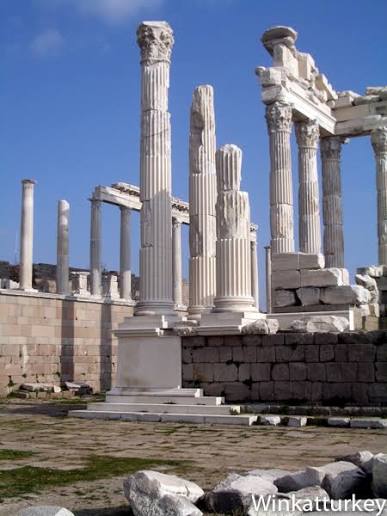
Pergamum was the center of various pagan cults, including the cult of Asclepius, the Greek god of healing, who was called “the Savior” and was represented by a serpent. People came from all over to the shrine of Asclepius to be healed. Pergamum had a leading role in promoting the cult of emperor worship, which, as in Smyrna, was compulsory. No wonder Jesus said that the Christians in Pergamum lived in the city where Satan’s seat is and where his throne was located.
The Christians in Pergamum faced temptations from both outside and inside the church. While most of them remained faithful, some, the “Nicolaitans,” advocated compromise with paganism in order to avoid persecution. Like Balaam, who apostatized and enticed the Israelites to sin against God on the way to the Promised Land (Num. 31:16), these members found it more convenient, and even rewarding, to compromise their faith. Though the Jerusalem Council had forbidden “things offered to idols” and “sexual immorality” (Acts 15:29, NKJV), the doctrine of Balaam taught church members to reject this decision. The only solution Jesus can offer to Pergamum is: “ ‘ “Repent” ’ ” (Rev. 2:16, NKJV).
THE SALUTATION
Revelation 2:12:
“And to the angel of the church in Pergamos write…”
THE DESCRIPTION OF CHRIST
Jesus identifies Himself as:
“He who has the sharp two-edged sword.”
The sword represents the Word of God.
Hebrews 4:12 describes the Word of God as:
“living and powerful, and sharper than any two-edged sword…”
Why is the sword appropriate for Pergamos?
Because Pergamos represents an era when the church would need the Word of God to distinguish:
truth from compromise.
“I KNOW WHERE YOU DWELL”
Revelation 2:13:
“I know your works, and where you dwell, where Satan’s throne is.”
Again:
Jesus knows.
But now notice the language.
The church is dwelling in a difficult spiritual environment.
Jesus calls it:
“Satan’s throne.”
The traditional Adventist interpretation sees this period as involving the increasing influence of pagan Rome and the transformation of Christianity after the conversion and political patronage associated with Constantine.
THE GREAT TRANSITION
Under Constantine, Christianity went from being persecuted to being increasingly favored by the Roman state.
The Edict of Milan in AD 313 is a major historical marker.
Christianity was no longer simply a persecuted minority.
The church began to experience:
- political recognition,
- wealth,
- social influence,
- imperial support.
At first this appeared to be a great victory.
But something dangerous happened.
The church began to gain the world.
And eventually:
The world began to gain the church.
This is the danger of Pergamos.
THE COMMENDATION
Jesus says:
“And you hold fast to My name, and did not deny My faith…”
Even during this period of compromise, faithful Christians remained.
Jesus specifically mentions:
“Antipas, My faithful martyr…”
Whether Antipas represents a specific historical individual or is symbolic of faithful opposition, the central lesson remains:
Christ always has faithful people even in dark periods of history.
THE REPROOF — THE DOCTRINE OF BALAAM
Revelation 2:14:
“But I have a few things against you…”
Some in Pergamos were holding:
“the doctrine of Balaam.”
Why Balaam?
The story is found in Numbers 22–25.
Balaam could not curse Israel directly.
So Israel was enticed into compromise.
The danger was not merely persecution from outside.
It was corruption from within.
This is exactly the danger of Pergamos.
THE DANGER OF COMPROMISE
Pergamos teaches a profound principle:
Satan does not always destroy the church through persecution.
Sometimes he attempts to destroy it through prosperity.
The Smyrna church was attacked from outside.
Pergamos was increasingly compromised from within.
The temptation changed.
Instead of:
“Deny Christ or die.”
The temptation became:
“Keep Christ, but compromise enough to fit comfortably into the culture.”
This is often more subtle and therefore more dangerous.
THE NICOLAITANS
Jesus again mentions the Nicolaitans:
“So you also have those who hold the doctrine of the Nicolaitans…”
The issue involves compromise between Christian faith and practices contrary to God’s revealed will.
The prophetic principle is clear:
Christ will not accept a church that knowingly blends and compromises Biblical truth with error.
THE ADMONITION
Revelation 2:16:
“Repent, or else I will come to you quickly and will fight against them with the sword of My mouth.”
Notice the contrast.
Jesus has the sword.
The church must be governed by the Word.
When the church compromises Scripture, Christ Himself becomes the judge.
THE PROMISE TO PERGAMOS
Revelation 2:17:
“To him who overcomes I will give some of the hidden manna to eat.”
Manna points us back to Israel in the wilderness.
Jesus Himself is the Bread of Life.
John 6:32–35 points beyond physical bread to Christ.
The overcomer receives:
Hidden manna
Christ provides spiritual nourishment that the world cannot provide.
Then:
“I will give him a white stone, and on the stone a new name written…”
The new name represents a transformed identity and intimate relationship with Christ.
The world may label God’s people.
Christ gives them a new identity.
PERGAMOS IN THE HISTORICIST ADVENTIST INTERPRETATION
AD 313–538
Characteristic: Compromising church
Strengths:
- held Christ’s name
- maintained faith despite opposition
- faithful witnesses remained
Problem:
- compromise with paganism
- false doctrines
- spiritual accommodation
Historical transition:
- Christianity gains imperial favor
- pagan Roman persecution declines
- church and state become increasingly intertwined
Admonition:
- repent
- return to the Word
Promise:
- hidden manna
- white stone
- new name
THE LESSON
Pergamos asks us:
What happens when the church stops confronting the culture and begins accommodating it?
There were some in the church in Pergamum who did as Balaam did. It is wrong to commit adultery, but it is worse to seduce people to fall into sin. The doctrine of Balaam was promulgated where the sins of the flesh are permitted or tolerated.
The doctrine of the Bible considers immorality a sin in every circumstance. God condemns idolatry and sexual depravation everywhere and in every context. Jer. 3:2; 13:27; Ezek. 16; 23; 43:7; Hos 5:4; 6:10.
In the New Testament at no time is the cross of Christ and excuse to live in sin. Rom 1:23-25; 1 Thess 1:9.
To him that overcomes is promised a new name, linked to the city of God, linked to the name of our Father God.
“Under the fiercest persecution these [postapostolic] witnesses for Jesus kept their faith unsullied. Though deprived of every comfort, shut away from the light of the sun, making their home in the dark but friendly bosom of the earth, they uttered no complaint. With words of faith, patience, and hope they encouraged one another to endure privation and distress. The loss of every earthly blessing could not force them to renounce their belief in Christ. Trials and persecution were but steps bringing them nearer their rest and their reward. . . .
. . . They rejoiced that they were accounted worthy to suffer for the truth, and songs of triumph ascended from the midst of crackling flames. Looking upward by faith, they saw Christ and angels leaning over the battlements of heaven, gazing upon them with the deepest interest and regarding their steadfastness with approval. A voice came down to them from the throne of God: “Be thou faithful unto death, and I will give thee a crown of life.” Revelation 2:10.—The Great Controversy, p. 41.
The gospel of Christ is a blessing that all may possess. The poorest are as well able as the richest to purchase salvation; for no amount of worldly wealth can secure it. It is obtained by willing obedience, by giving ourselves to Christ as His own purchased possession. Education, even of the highest class, cannot of itself bring a man nearer to God.—Christ’s Object Lessons, p. 117.
Desponding soul, take courage, even though you have done wickedly. . . .While you were in rebellion against Him, He went forth to seek you. With the tender heart of the shepherd He left the ninety and nine and went out into the wilderness to find that which was lost. The soul, bruised and wounded and ready to perish, He encircles in His arms of love and joyfully bears it to the fold of safety.
It was taught by the Jews that before God’s love is extended to the sinner, he must first repent. In their view, repentance is a work by which men earn the favor of Heaven. . . . But in the parable of the lost sheep, Christ teaches that salvation does not come through our seeking after God but through God’s seeking after us. “There is none that understands, there is none that seeks after God. They are all gone out of the way.” Romans 3:11, 12. We do not repent in order that God may love us, but He reveals to us His love in order that we may repent.—Christ’s Object Lessons, pp. 188, 189.
Appeal:
“Father, help us not merely to understand Revelation, but to hear what Your Spirit is saying to us. If we have lost our first love, bring us back. If we are suffering, give us courage. If we are compromising, give us conviction. If we have tolerated error, give us discernment. Help us hold fast to Jesus and to His Word. Give us the faith of Smyrna, the discernment of Ephesus, the courage to reject Pergamum’s compromise, and the faithfulness of Thyatira’s remnant. And above all, help us to overcome through the blood of the Lamb, so that when Jesus comes, we may receive the crown of life and live with Him forever. In Jesus’ name, Amen.”