

I. Introduction: Who shall be able to stand?
Revelation 7 is one of the most significant chapters in the entire book of Revelation. It reveals God’s preparation of His people for the final crisis of earth’s history and provides a magnificent picture of the ultimate triumph of Christ and His redeemed people.
Revelation 6 concludes with the second coming of Jesus Christ and a penetrating question:
“For the great day of his wrath is come; and who shall be able to stand?” — Revelation 6:17, KJV
Revelation 7 answers that question.
Those who will be able to stand are not individuals who have achieved salvation through their own righteousness, religious accomplishments, denominational membership, or human strength. They are those who have been redeemed by the blood of Jesus Christ, received the seal of God, and remained faithful to Him.
Revelation 7 is an interlude between the sixth and seventh seals. Rather than immediately opening the seventh seal, God reveals what He is accomplishing among His people before the final consummation of human history.
The chapter moves from the threats and uncertainties of earth to the security and celebrations of heaven.
| Scripture | Central theme |
|---|---|
| Revelation 7:1–3 | The four angels and the sealing of God’s people |
| Revelation 7:4–8 | The identity of the 144,000 |
| Revelation 7:9–10 | The victorious great multitude |
| Revelation 7:11–12 | Heavenly worship around God’s throne |
| Revelation 7:13–14 | The white robes and the great tribulation |
| Revelation 7:15–17 | Eternal security under the care of the Lamb |
The central message of Revelation 7 is not the destructive power of the final crisis but the saving, preserving, cleansing and shepherding power of Jesus Christ.
II. The historical and prophetic setting of Revelation 7
Revelation presents the unfolding of the great controversy between Christ and Satan throughout Christian history, culminating in the second coming of Christ, the destruction of sin and the restoration of all things.
Revelation 7 must therefore be studied in connection with several other prophetic passages.
Revelation 7 in the prophetic timeline
-
Revelation 6:1–11 — The first five seals
The unfolding history of Christianity, including gospel proclamation, apostasy, persecution and martyrdom.
-
Revelation 6:12–17 — The sixth seal
Prophetic signs culminating in the second coming of Jesus.
-
Revelation 7:1–8 — The sealing
God’s restraining power and the preparation of His end-time people.
-
Revelation 13–14 — The final conflict
The conflict over worship, commandments, allegiance and the mark of the beast.
-
Daniel 12:1; Revelation 15–16 — The time of trouble
The close of probation and the final judgments.
-
Revelation 7:9–17 — The redeemed victorious
A prophetic preview of God’s people standing before His throne.
-
Revelation 21–22 — Eternal restoration
God dwells with His redeemed people forever.
Conceptual historicist sequence, rather than a strictly chronological reading of every chapter.
The sanctuary-centered approach to Revelation emphasizes the relationship between the heavenly sanctuary, Christ’s priestly ministry, divine judgment and the ultimate vindication of God’s government. This framework is especially valuable in understanding Revelation 7 because the chapter begins with the preparation of God’s servants on earth and concludes with their service in His heavenly temple.
III. Revelation 7:1 — The four angels and the four winds
“And after these things I saw four angels standing on the four corners of the earth, holding the four winds of the earth, that the wind should not blow on the earth, nor on the sea, nor on any tree.”
1. Who are the four angels?
The four angels are heavenly messengers entrusted with the responsibility of restraining destructive forces until God’s appointed time.
They demonstrate that God has not abandoned this world to Satan.
Although Satan is described as the prince of this world (John 12:31; 14:30), his activities remain subject to divine limitations.
This principle is clearly revealed in Job 1:10–12 and Job 2:6, where Satan could not proceed beyond the boundaries established by God.
Other passages explain the ministry of angels:
-
Psalm 103:20: Angels execute God’s commands.
-
Psalm 34:7: The angel of the Lord protects those who fear Him.
-
Hebrews 1:14: Angels minister to the heirs of salvation.
-
Daniel 10:12–21: Heavenly beings participate in the unseen controversy affecting earthly kingdoms.
-
2 Kings 6:15–17: Heavenly forces surround and protect God’s servants.
The four angels are not necessarily four specific named angels. Scripture does not identify them as Michael, Gabriel or other individual heavenly beings.
Their importance lies in their divine commission.
2. What are the four corners of the earth?
The four corners represent the four directions of the compass: north, south, east and west.
The expression symbolizes worldwide geographical scope.
Compare Isaiah 11:12, Ezekiel 7:2 and Matthew 24:31.
The crisis described in Revelation 7 is therefore not merely a regional conflict. Its implications extend throughout the world.
3. What do the four winds represent?
Throughout Scripture, winds frequently symbolize destructive forces, political upheaval, warfare and divine judgments.
| Biblical passage | Meaning of the winds |
|---|---|
| Daniel 7:2–3 | Turmoil associated with the rise of earthly empires |
| Jeremiah 25:32–33 | Worldwide calamity and judgment |
| Jeremiah 49:36 | Scattering and destruction |
| Ezekiel 13:13 | Judgment against false security |
| Revelation 7:1 | Destructive forces temporarily restrained |
The traditional Biblical understanding includes political strife, military conflict, social disintegration and the final destructive activities associated with the great controversy.
Uriah Smith particularly associated these winds with worldwide political conflict and warfare.
4. Ellen White on the restraining angels
Ellen White writes:
“Angels are now restraining the winds of strife, that they may not blow until the world shall be warned of its coming doom.”
— Early Writings, p. 38.
The purpose of the restraint is redemptive. God is giving humanity an opportunity to hear the everlasting gospel, repent, receive Christ and become established in His truth.
Second Peter 3:9 confirms this divine purpose: God’s apparent delay is an expression of His patience and desire that people should come to repentance.
Every additional opportunity to proclaim the gospel is evidence of God’s mercy.
IV. Revelation 7:2 — The angel ascending from the east
“And I saw another angel ascending from the east, having the seal of the living God.”
1. Why does the angel come from the east?
The Greek expression apo anatolēs hēliou means from the rising of the sun.
The east is repeatedly associated with divine glory, deliverance and the coming of God.
Consider the following passages:
-
Ezekiel 43:1–4 — God’s glory enters the temple from the east.
-
Malachi 4:2 — The Sun of righteousness arises with healing.
-
Matthew 24:27 — Christ’s coming is compared with lightning appearing from the east.
-
Luke 1:78–79 — Divine salvation is associated with the dawning light.
-
Revelation 16:12 — The kings from the rising of the sun appear in the context of final deliverance.
The direction emphasizes the divine origin of the sealing work.
This is not a political movement, a human organization or a self-generated religious experience. It is a work initiated by heaven.
2. What is the seal of the living God?
The Greek word sphragis means a seal, signet or identifying mark.
In Scripture, sealing conveys several related concepts:
| Function | Scripture |
|---|---|
| Ownership | 2 Timothy 2:19 |
| Authenticity | Romans 4:11 |
| Divine authority | Esther 8:8 |
| Spiritual security | Ephesians 1:13–14 |
| Protection in judgment | Ezekiel 9:4–6 |
| Identification with God | Revelation 14:1 |
Revelation 14:1 further explains Revelation 7 by identifying the sealed company as having the divine name upon their foreheads.
In biblical thought, God’s name represents His identity, authority and character (Exodus 34:5–7).
The seal is therefore fundamentally a sign that a person belongs to God.
3. The relationship between the seal of God and the Holy Spirit
Ephesians 4:30 states:
“And grieve not the holy Spirit of God, whereby ye are sealed unto the day of redemption.”
The Holy Spirit is the divine agent of spiritual sealing.
It is important not to separate the Sabbath from the transforming work of the Holy Spirit or from faith in Jesus Christ.
The seal is not merely intellectual acceptance of a doctrine. It involves the entire person’s allegiance to God.
4. Why Adventists associate the seal with the seventh-day Sabbath
The fourth commandment occupies a distinctive place within the Ten Commandments because it explicitly identifies God as the Creator.
The Creator’s authority in the fourth commandment
The traditional Adventist seal analogy, illustrating the three identifying elements of divine authority.
Two Old Testament passages are particularly important:
Exodus 31:13: The Sabbath is a sign between God and His people, identifying Him as the One who sanctifies them.
Ezekiel 20:12, 20: The Sabbath is a sign through which God’s people acknowledge Him as their Lord.
The relationship becomes especially significant in Revelation 14:7, where the first angel calls humanity to worship the Creator, using language reminiscent of Exodus 20:11.
The final controversy in Revelation is a controversy over worship:
-
Revelation 13:4 — Worship of the dragon and beast.
-
Revelation 13:15 — Compulsory worship of the image.
-
Revelation 14:7 — Worship of the Creator.
-
Revelation 14:9 — Warning against worshiping the beast.
-
Revelation 14:12 — Faithfulness to God’s commandments and the faith of Jesus.
Sabbath observance is to become a distinguishing expression of loyalty when the final conflict over worship reaches its climax.
5. Is everyone who keeps the Sabbath already sealed?
No.
A person may observe the seventh-day Sabbath outwardly while lacking the character, faith and love of Jesus.
Similarly, Adventist historicism does not teach that every sincere Sunday-observing Christian presently possesses the mark of the beast.
Ellen White’s discussion in The Great Controversy, pp. 449–450, places the decisive test in the context of informed choice and enforced worship.
The distinction concerns conscious allegiance to God when His requirements become clearly understood.
The Sabbath is a sign of divine authority and sanctification, not a substitute for salvation through Christ.
V. Revelation 7:3 — The sealing of the forehead
“Hurt not the earth, neither the sea, nor the trees, till we have sealed the servants of our God in their foreheads.”
1. Why are God’s people sealed in their foreheads?
The forehead is associated symbolically with the mind, understanding, decision-making and conscious allegiance.
Deuteronomy 6:6–8 describes God’s commandments as being upon the heart and symbolically between the eyes.
Revelation contrasts two systems of allegiance:
| Seal of God | Mark of the beast |
|---|---|
| Revelation 7:3 | Revelation 13:16 |
| Forehead | Forehead or hand |
| God’s authority | Beast’s authority |
| Loyalty to the Creator | Submission to counterfeit worship |
| God’s name | Beast’s name or number |
| Faithful obedience | Compromise or rebellion |
The forehead represents conviction and acceptance. The hand can symbolize outward action or compliance.
God seeks willing, intelligent allegiance rather than merely external conformity.
2. Ellen White’s definition of sealing
One of Ellen White’s most important explanations is:
“A settling into the truth, both intellectually and spiritually, so they cannot be moved.”
— Seventh-day Adventist Bible Commentary, vol. 4, p. 1161; Manuscript 173, 1902.
The seal involves:
-
An understanding of biblical truth.
-
An experiential relationship with Christ.
-
A transformed character.
-
Unwavering commitment to God’s authority.
-
Dependence upon divine grace.
-
Faithfulness under pressure.
3. The sealing and Ezekiel 9
Ezekiel 9 provides an important Old Testament background for Revelation 7.
Before judgment falls upon Jerusalem, a heavenly messenger marks those who mourn over the abominations committed in the city.
The marked individuals are distinguished not merely by religious affiliation but by their spiritual response to sin.
They are grieved by evil, corruption, idolatry and rebellion against God.
This has profound implications for the church. Membership in a religious organization does not automatically guarantee divine approval.
God searches the heart.
4. The sealing and the close of probation
Adventist theology connects the completion of the final sealing work with Revelation 22:11–12 and Daniel 12:1.
Christ completes His heavenly mediation, human destinies become fixed, and the final judgments follow.
The sealing does not earn salvation. It confirms the allegiance of those who have accepted Christ and remained in Him.
The preparation for this experience must occur now, rather than during the final crisis.
VI. Revelation 7:4 — Who are the 144,000?
“And I heard the number of them which were sealed.”
John identifies the number as 144,000, drawn from the twelve tribes of Israel.
This company has generated extensive discussion throughout Adventist history.
1. The prophetic significance of 144,000
The number twelve has considerable biblical significance.
There were twelve tribes of Israel, twelve apostles of Christ, twelve gates of the New Jerusalem and twelve foundations bearing the apostles’ names.
Revelation 21:17 also describes the wall of the New Jerusalem as measuring 144 cubits.
These numerical correspondences suggest completeness, covenant identity and divine organization.
The Old Testament military censuses in Numbers 1 and 26 also provide a possible background. The numbered company may represent God’s spiritually organized army, whose victory is gained through faithfulness to the Lamb rather than physical warfare.
2. Is the number literal or symbolic?
There are three principal interpretations within the Adventist tradition.
| Interpretation | Explanation |
|---|---|
| Literal number | Exactly 144,000 individuals constitute a special end-time company. |
| Symbolic number | The number represents the complete company of God’s last-generation faithful people. |
| Representative company | The 144,000 represent or constitute a distinctive company within the larger redeemed population. |
Uriah Smith often defended a literal numerical interpretation.
Contemporary Adventist theologians, including Ekkehardt Mueller, have examined the symbolic nature of the number and its relationship to the great multitude.
The evidence for a symbolic interpretation is substantial, especially considering the unusual tribal list and Revelation’s broader numerical symbolism.
Nevertheless, the precise number should not become a test of fellowship or a source of speculation about who will be saved.
3. Ellen White’s warning against speculation
Ellen White counsels:
“It is not His will that they shall get into controversy over questions which will not help them spiritually.”
— Selected Messages, book 1, p. 174.
In the same passage, she specifically addresses speculative controversies concerning the identity of the 144,000.
The essential question is not how many will belong to the group but what spiritual experience they possess.
4. Who are the 144,000 according to Revelation 14?
Revelation 14:1–5 provides the essential characteristics of the company.
| Characteristic | Spiritual significance |
|---|---|
| Stand with the Lamb on Mount Zion | Victory through Christ |
| Bear the divine name | Belong to God and reflect His character |
| Sing a new song | Possess a distinctive experience of redemption |
| Redeemed from the earth | Saved through Christ’s sacrifice |
| Spiritually undefiled | Faithful to Christ rather than Babylon |
| Follow the Lamb wherever He goes | Unconditional discipleship |
| First fruits unto God | Special consecration |
| No deceit in their mouths | Integrity and truthfulness |
| Without fault | Stand approved through redeeming and transforming grace |
Their spiritual purity is not necessarily a reference to literal celibacy. Revelation uses women as symbols of religious communities, notably the faithful woman in Revelation 12 and Babylon in Revelation 17.
Their virginity is therefore commonly understood as spiritual fidelity to Christ.
Compare 2 Corinthians 11:2 and Jeremiah 2:2.
5. Are the 144,000 the last generation?
The traditional understanding strongly associates the 144,000 with those who are alive during the final crisis and are delivered at the second coming.
Ellen White describes this company in The Great Controversy, pp. 648–649, as those who have experienced the final time of trouble, endured extreme distress and been delivered.
This gives them a distinctive testimony concerning the sustaining power of Christ.
They do not constitute the entirety of the saved throughout history.
Abraham, Moses, David, the apostles, the martyrs and faithful believers throughout the centuries are not excluded from salvation.
6. Will they demonstrate the vindication of God’s character?
Within the great controversy framework, the faithful lives of God’s final people testify that Christ’s grace is powerful enough to sustain loyalty even during the greatest spiritual conflict.
However, it is essential to maintain the supremacy of Calvary.
Christ decisively demonstrated God’s righteousness, love and justice through His life, death and resurrection.
The 144,000 do not complete an inadequate atonement. Their victory is a testimony to the sufficiency of Christ’s victory.
Revelation 12:11 establishes the basis of their triumph: the blood of the Lamb.
VII. Revelation 7:5 — Judah, Reuben and Gad
“Of the tribe of Juda were sealed twelve thousand. Of the tribe of Reuben were sealed twelve thousand. Of the tribe of Gad were sealed twelve thousand.”
The listing of the twelve tribes contains important theological implications. This is not a conventional Old Testament tribal census.
Judah — The royal tribe
Judah appears first, although Reuben was Jacob’s firstborn son.
The reason is most likely Christological.
Genesis 49:10 identifies Judah as the tribe from which the royal ruler would come. Revelation 5:5 identifies Jesus as the Lion of the tribe of Judah.
Judah’s placement at the head of the list emphasizes the supremacy of Jesus Christ over the redeemed community.
Interestingly, Judah’s personal history was far from perfect. Genesis 38 records serious moral failures, while Genesis 44:33–34 reveals his willingness to sacrifice himself for Benjamin.
His life illustrates the transforming power of divine grace.
Reuben — The restoration of the fallen
Reuben lost his birthright because of his sin (Genesis 35:22; 49:3–4; 1 Chronicles 5:1).
Nevertheless, his tribe appears among the sealed.
This provides a powerful illustration that past failures need not determine eternal destiny.
Through repentance and faith, sinners can experience forgiveness and restoration.
Gad — Victory following conflict
Genesis 49:19 portrays Gad as experiencing conflict but ultimately overcoming.
This provides an appropriate spiritual application to God’s final people, who experience opposition but overcome through the power of Christ.
VIII. Revelation 7:6 — Asher, Naphtali and Manasseh
“Of the tribe of Aser were sealed twelve thousand. Of the tribe of Nephthalim were sealed twelve thousand. Of the tribe of Manasses were sealed twelve thousand.”
Asher — The blessings of God
Genesis 49:20 associates Asher with abundance and prosperity.
Deuteronomy 33:24–25 speaks of divine blessing and enduring strength.
Spiritually, this recalls God’s ability to sustain His people through every circumstance.
Naphtali — Liberty and divine favor
Genesis 49:21 describes Naphtali through the imagery of a deer released into freedom.
Deuteronomy 33:23 describes the tribe as satisfied with favor and filled with the blessing of the Lord.
The territory of Naphtali also appears in Isaiah 9:1–2, a messianic prophecy fulfilled in the ministry of Jesus in Galilee, according to Matthew 4:13–16.
Manasseh — Deliverance from past affliction
Joseph named his firstborn son Manasseh in connection with God’s healing of the wounds of his past (Genesis 41:51).
Manasseh’s inclusion appropriately illustrates the redemptive experience of those whose painful histories have been overcome through divine grace.
In Revelation 21:4, God’s redeemed people ultimately experience complete deliverance from sorrow and pain.
IX. Revelation 7:7 — Simeon, Levi and Issachar
“Of the tribe of Simeon were sealed twelve thousand. Of the tribe of Levi were sealed twelve thousand. Of the tribe of Issachar were sealed twelve thousand.”
Simeon — Grace overcoming destructive character
Simeon and Levi were associated with violence in Genesis 34 and were rebuked by Jacob in Genesis 49:5–7.
Yet both tribes appear among the sealed.
This reminds us that salvation involves the transformation of fallen human character.
Levi — The priestly tribe
Levi’s inclusion is particularly significant within a sanctuary-centered interpretation of Revelation.
The Levites were set apart for sacred service (Numbers 3:5–13).
Their inclusion in the numbered company is unusual because Levi was excluded from certain Old Testament military and territorial censuses.
The presence of Levi may reinforce the priestly character of God’s redeemed people.
Revelation 1:6 and 5:10 describe the redeemed as kings and priests, while Revelation 7:15 portrays them serving God in His temple.
This is consistent with the wider biblical theology of a redeemed priesthood:
“But ye are a chosen generation, a royal priesthood, an holy nation, a peculiar people.” — 1 Peter 2:9
Issachar — Understanding the times
First Chronicles 12:32 describes men of Issachar as possessing an understanding of the times and knowing what Israel ought to do.
This provides an appropriate spiritual application to God’s final people, who must understand the prophetic times in which they live.
Prophetic understanding, however, must always produce humility, faithfulness and missionary responsibility rather than spiritual pride.
X. Revelation 7:8 — Zebulun, Joseph and Benjamin
“Of the tribe of Zabulon were sealed twelve thousand. Of the tribe of Joseph were sealed twelve thousand. Of the tribe of Benjamin were sealed twelve thousand.”
Zebulun — Light to the nations
Zebulun, alongside Naphtali, appears in Isaiah 9:1–2 and Matthew 4:13–16 in connection with the messianic light shining upon those living in darkness.
This fits the worldwide mission of Revelation 14:6, where the everlasting gospel is proclaimed to every nation.
Joseph — Faithfulness under temptation
Joseph provides one of Scripture’s greatest examples of faithfulness under difficult circumstances.
He experienced betrayal, slavery, temptation, false accusations and imprisonment, yet remained faithful to God.
His response to temptation in Genesis 39:9 illustrates the attitude of the sealed:
“How then can I do this great wickedness, and sin against God?”
Joseph’s loyalty was not dependent upon favorable circumstances.
Benjamin — God’s beloved
Deuteronomy 33:12 describes Benjamin as beloved of the Lord and dwelling in safety under His protection.
This provides a fitting conclusion to the tribal list.
The ultimate security of God’s people is found in their relationship with Him.
Why are Dan and Ephraim missing?
The arrangement of the tribes in Revelation 7 is unusual.
| Tribe | Significance |
|---|---|
| Judah | Listed first instead of Reuben |
| Levi | Included despite exclusion from certain territorial and military lists |
| Joseph | Included by his own name |
| Manasseh | Included separately from Joseph |
| Ephraim | Not explicitly named |
| Dan | Entirely omitted |
Several biblical passages may provide insight into these omissions.
Dan became associated with idolatry in Judges 18:27–31. Jeroboam later established one of his golden calves in Dan (1 Kings 12:28–30).
Ephraim became closely associated with the apostasy of the northern kingdom.
Hosea 4:17 declares that Ephraim was joined to idols.
Revelation repeatedly warns against idolatry and false worship, understand these omissions of Dan and Ephraim as warnings against spiritual apostasy.
Is Revelation 7 referring to literal ethnic Israel?
The Bible understands the twelve tribes as representing God’s covenant people in Christ, including believers of Jewish and Gentile ancestry.
The New Testament provides the foundation for this understanding.
-
Romans 2:28–29 — The importance of inward spiritual circumcision.
-
Romans 9:6–8 — Physical ancestry alone does not establish covenant faithfulness.
-
Galatians 3:7 — Those who exercise faith are children of Abraham.
-
Galatians 3:29 — Those belonging to Christ are Abraham’s seed.
-
Ephesians 2:11–22 — Jewish and Gentile believers are united in Christ.
-
James 1:1 — The twelve tribes are addressed in a New Testament Christian context.
-
Romans 11:17–24 — Gentile believers are grafted into the covenant community and warned against arrogance.
The prophetic emphasis is covenant faithfulness through Jesus Christ.
XI. Revelation 7:9 — The great multitude, white robes and palm branches
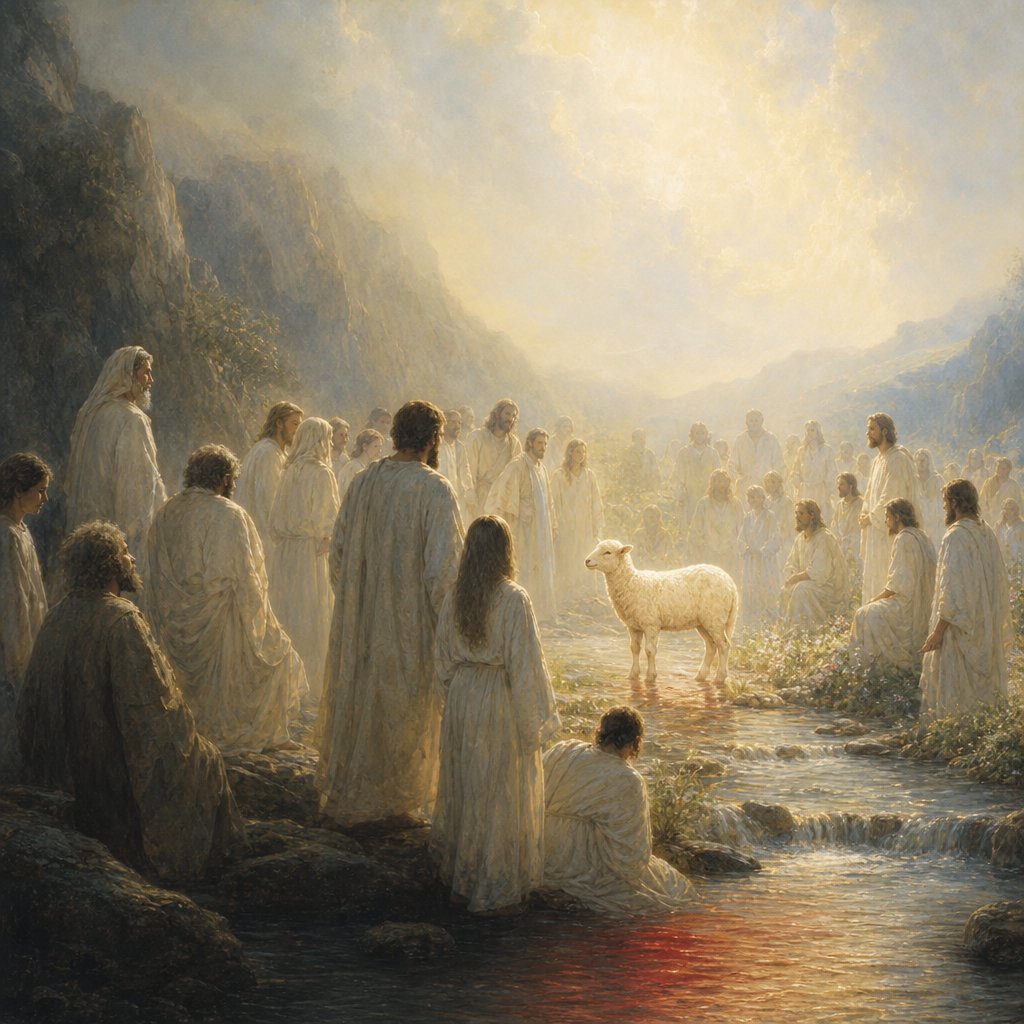
“After this I beheld, and, lo, a great multitude, which no man could number, of all nations, and kindreds, and people, and tongues, stood before the throne, and before the Lamb, clothed with white robes, and palms in their hands.”
This is one of the most magnificent scenes in Revelation.
John moves from a numbered company preparing for the final conflict to an innumerable multitude celebrating the victory of redemption.
1. What is the relationship between the 144,000 and the great multitude?
There are three major possibilities within Adventist interpretation.
| Feature | 144,000 | Great multitude |
|---|---|---|
| Revelation passage | 7:1–8 | 7:9–17 |
| Number | 144,000 | Innumerable |
| Location in vision | Earth | Before God’s throne |
| Condition | Preparing for conflict | Victorious after tribulation |
| Identification | Twelve tribes | Every nation and people |
| Distinguishing symbol | Seal of God | White robes and palms |
| Relationship to Christ | Servants of God | Redeemed worshipers |
Interpretation A: Two distinct companies
The 144,000 constitute a special end-time company that experiences the final time of trouble.
The great multitude represents the larger redeemed population throughout human history, including those raised at Christ’s return.
Ellen White’s description in The Great Controversy, pp. 648–649, emphasizes the distinctive experience of the 144,000.
Her description on p. 665 applies the imagery of Revelation 7:9 to the broader assembly of the redeemed.
Interpretation B: The same company seen from two perspectives
John hears the number of the sealed but subsequently sees a great multitude.
This follows a literary pattern already established in Revelation 5:5–6.
Revelation 5
John hears
The Lion of Judah
John sees
The slain Lamb
Two descriptions of Jesus Christ.
Revelation 7
John hears
The 144,000
John sees
The great multitude
Possibly there are two descriptions of God’s victorious people.
Ekkehardt Mueller explicitly presents this interpretation in his scholarly article Ecclesiology in the Book of Revelation. He understands the numbered company and the multitude as two complementary portrayals of God’s end-time people.
Interpretation C: A special company within the greater redeemed population
The 144,000 constitute a distinctive end-time company within the larger multitude of all the redeemed.
They share the salvation experienced by all believers but possess a unique experience associated with the final crisis.
The principal conclusion: Regardless of whether the two visions describe identical companies or a special company within a larger assembly, Revelation does not teach that only 144,000 human beings will be saved.
The gospel invitation is universal.
2. Every nation, kindred, people and tongue
The fourfold expression emphasizes the worldwide success of the everlasting gospel.
Revelation 5:9, 7:9 and 14:6 should be read together.
Revelation 5 describes the price of redemption. Revelation 14 describes the worldwide proclamation of redemption. Revelation 7 describes its victorious result.
The promise given to Abraham in Genesis 12:3 reaches fulfillment: through his seed, all families of the earth would be blessed.
The redeemed transcend national, racial, linguistic, cultural and economic divisions.
Grace accomplishes what human political systems have never been able to accomplish: a united human family centered upon God.
3. What do the white robes represent?
White garments are a recurring symbol throughout Revelation.
| Scripture | Meaning |
|---|---|
| Revelation 3:4–5 | Purity and victory |
| Revelation 3:18 | Christ’s righteousness offered to Laodicea |
| Revelation 6:11 | Divine recognition of the faithful martyrs |
| Revelation 7:14 | Cleansing through the blood of Christ |
| Revelation 19:8 | Righteous deeds of the saints, symbolized by granted garments |
| Isaiah 61:10 | Garments of salvation and righteousness |
| Zechariah 3:3–5 | Removal of guilt and restoration |
The most important Old Testament parallel is Zechariah 3.
Joshua the high priest stands before the angel of the Lord wearing filthy garments while Satan accuses him.
God removes his filthy garments and clothes him with clean clothing.
This is a picture of both forgiveness and restoration.
The white robes of Revelation 7 represent the righteousness of Christ bestowed upon the believer, accompanied by the transforming experience of sanctification.
Ellen White on the robe of Christ’s righteousness
“This robe, woven in the loom of heaven, has in it not one thread of human devising.”
— Christ’s Object Lessons, p. 311.
The white robe is not manufactured through human religious achievements.
It is received through Christ.
4. What do the palm branches represent?
Palm branches have several important biblical associations.
A. The Feast of Tabernacles
Leviticus 23:39–43 instructs Israel to celebrate the Feast of Tabernacles with palm branches and rejoicing before the Lord.
This feast commemorated God’s protection during Israel’s wilderness journey and celebrated the completion of the agricultural harvest.
The parallels with Revelation 7 are profound.
| Feast of Tabernacles | Revelation 7 |
|---|---|
| Wilderness journey completed | Earthly trials completed |
| Harvest celebration | Redeemed humanity gathered |
| Palm branches | Palm branches of victory |
| Rejoicing before God | Worship before the throne |
| Temporary dwelling with God | Permanent dwelling with God |
Ellen White explains the ultimate significance of this feast in Patriarchs and Prophets, p. 541, connecting it with the final gathering of God’s redeemed people.
B. The triumphal entry of Jesus
John 12:12–13 records the people welcoming Jesus into Jerusalem with palm branches.
At that time, many expected a political deliverer.
In Revelation 7, the redeemed celebrate the far greater victory of Christ over Satan, sin and death.
C. Victory through divine righteousness
Ellen White writes:
“The palm branch in their hands is a symbol of their triumph, the white robe an emblem of the spotless righteousness of Christ.”
— The Great Controversy, p. 665.
Adventist Publishing
The redeemed possess two complementary symbols: the robe declares how they were saved, and the palm declares that Christ has brought them to victory.
XII. Revelation 7:10 — Salvation belongs to God and the Lamb
“And cried with a loud voice, saying, Salvation to our God which sitteth upon the throne, and unto the Lamb.”
1. Salvation is entirely attributed to God
The Greek word sōtēria means salvation, deliverance or preservation.
The redeemed do not attribute their salvation to themselves.
Their praise is directed toward God and the Lamb.
This agrees with the entire biblical testimony:
Ephesians 2:8–9 teaches that salvation is by grace through faith. Jonah 2:9 declares that salvation belongs to the Lord. Titus 3:5 teaches that God saves us according to His mercy rather than our works.
The redeemed never claim that their obedience purchased their salvation.
Their obedience is the fruit of redemption.
2. The Father and Son united in redemption
Revelation 7 presents God upon the throne and the Lamb receiving the praise of the redeemed.
This illustrates the unity of the Father and the Son in the plan of salvation.
John 3:16 reveals the Father’s love in giving His Son.
Romans 5:8 reveals divine love through the sacrificial death of Christ.
Second Corinthians 5:19 declares that God was in Christ reconciling the world to Himself.
Calvary was not the action of a loving Jesus persuading an unwilling Father to forgive humanity.
Calvary was the revelation of the united love of God for fallen humanity.
3. The vindication of God’s character
The great controversy began with rebellion against God’s authority and accusations against His character.
Revelation 7 reveals the ultimate answer to those accusations.
The redeemed freely acknowledge that God is worthy of their trust, love and worship.
The kingdom of God triumphs not because God compels love, but because His character has been revealed through Jesus Christ. God triumphs because God is love.
XIII. Revelation 7:11 — The angels, twenty-four elders and four living creatures
“And all the angels stood round about the throne, and about the elders and the four beasts, and fell before the throne on their faces, and worshipped God.”
This verse returns us to the heavenly throne room of Revelation 4 and 5.
1. Who are the four living creatures?
The King James Version calls them four beasts. However, the Greek word zōa means living beings or living creatures.
This is different from thērion, the term used for the predatory prophetic beasts in Revelation 13.
The four living creatures are holy beings associated with God’s throne.
Their descriptions are given in Revelation 4:6–8.
Like a lion
Majesty, courage and royal strength.
Like a flying eagle
Swiftness and heavenly vision.
These individual symbolic associations are possible devotional interpretations. Revelation itself does not assign a specific meaning to each creature’s appearance.
Their Old Testament background
The creatures combine characteristics found in Ezekiel’s vision of the cherubim and Isaiah’s vision of the seraphim.
| Characteristic | Ezekiel 1 and 10 | Isaiah 6 | Revelation 4 |
|---|---|---|---|
| Heavenly throne | Yes | Yes | Yes |
| Living creatures | Yes | — | Yes |
| Lion, ox, man and eagle | Yes | — | Yes |
| Six wings | — | Yes | Yes |
| Eyes associated with heavenly beings | Yes | — | Yes |
| Threefold declaration of holiness | — | Yes | Yes |
Ezekiel 10:20 explicitly identifies the living creatures in his vision as cherubim.
Isaiah 6 describes seraphim proclaiming God’s holiness.
John’s vision brings together aspects of these two heavenly throne-room scenes.
Their ministry in Revelation
The four living creatures are involved in several important activities.
In Revelation 4:8–9 they proclaim God’s holiness. In Revelation 5:8–14 they participate in worship of the Lamb. In Revelation 6:1–7 they announce the opening of the first four seals. In Revelation 7:11 they participate in heaven’s celebration of redemption. In Revelation 15:7 one of them distributes the bowls of divine judgment.
They are therefore closely associated with heavenly worship, divine government and the administration of God’s purposes.
The eyes surrounding them may symbolize awareness and vigilance in the service of God.
Their presence emphasizes that heaven is actively involved in the great controversy.
Are they the same as the four angels holding the winds?
No identification of this kind is made in Revelation.
The four angels of Revelation 7:1 exercise a restraining and judicial function involving the earth.
The four living creatures of Revelation 7:11 occupy a distinctive position around God’s throne.
The two groups perform different functions.
2. Who are the twenty-four elders?
One traditional interpretation identifies them as representatives of redeemed humanity, possibly associated with those resurrected at Christ’s resurrection in Matthew 27:52–53.
Another interpretation understands them as members of the heavenly divine council.
A sanctuary-centered interpretation emphasizes their priestly and liturgical functions, with possible connections to the twenty-four divisions of priests described in 1 Chronicles 24.
Their characteristics include:
-
Occupying thrones — Revelation 4:4.
-
Wearing white garments and golden crowns — Revelation 4:4.
-
Participating in heavenly worship — Revelation 4:10.
-
Presenting incense associated with the prayers of the saints — Revelation 5:8.
-
Explaining prophetic events to John — Revelation 5:5; 7:13–14.
Their priestly activities are particularly important in relation to the heavenly sanctuary and its worship.
3. The significance of the entire heavenly assembly
Revelation 7 portrays the redeemed, angels, elders and living creatures participating together in heavenly worship.
The salvation of humanity is not merely an earthly event.
It has cosmic significance.
Ephesians 3:10 connects the church with the revelation of God’s wisdom to heavenly principalities and powers.
First Peter 1:12 describes angels as desiring to understand the mysteries of salvation.
What happened at Calvary concerns the entire universe.
XIV. Revelation 7:12 — The sevenfold praise of God
“Saying, Amen: Blessing, and glory, and wisdom, and thanksgiving, and honour, and power, and might, be unto our God for ever and ever. Amen.”
The angels respond to the testimony of the redeemed with seven expressions of praise.
| Attribute | Greek | Theological significance |
|---|---|---|
| Blessing | Eulogia | God is worthy of praise |
| Glory | Doxa | His character is magnificent |
| Wisdom | Sophia | His purposes are righteous and wise |
| Thanksgiving | Eucharistia | His creatures recognize His goodness |
| Honor | Timē | His authority deserves reverence |
| Power | Dynamis | He possesses the ability to accomplish His purposes |
| Might | Ischys | His strength sustains His government |
The number seven frequently symbolizes completeness in Revelation.
This sevenfold praise represents comprehensive worship of God.
It also parallels the sevenfold worship of the Lamb in Revelation 5:12.
The Father and the Son receive heavenly adoration.
The worship begins and ends with Amen, an expression of affirmation and agreement.
In the context of the great controversy, this worship represents the heavenly universe’s recognition of God’s righteousness and goodness.
XV. Revelation 7:13 — Who are these people in white robes?
“And one of the elders answered, saying unto me, What are these which are arrayed in white robes? and whence came they?”
The elder asks John two fundamental questions:
-
Who are these people?
-
Where have they come from?
The questions concern identity and experience.
They are not answered by the earthly occupations, nationalities, social positions or institutional memberships of the redeemed.
Their identity is found in their relationship with Jesus.
Their experience is characterized by suffering, faithfulness, cleansing and deliverance.
The elder’s question also functions as a literary device to direct the reader’s attention toward the central explanation of the vision.
John is about to learn that the victorious multitude consists not of people who escaped every difficulty, but of those whom Christ redeemed through their difficulties.
This is particularly important for Christians living under persecution.
Revelation does not promise an easy journey. It promises a victorious destination.
XVI. Revelation 7:14 — The great tribulation and the blood of the Lamb
“And I said unto him, Sir, thou knowest. And he said to me, These are they which came out of great tribulation, and have washed their robes, and made them white in the blood of the Lamb.”
This is the theological heart of Revelation 7.
1. What is the great tribulation?
The Greek expression is tēs thlipseōs tēs megalēs — the great tribulation.
The noun thlipsis conveys affliction, distress, pressure or oppression.
The definite articles give the expression a particular emphasis.
Tribulation may be understood in three related historical and prophetic dimensions.
A. Tribulation throughout Christian history
Jesus repeatedly warned His disciples that they would experience persecution.
John 16:33, Acts 14:22, 2 Timothy 3:12 and Revelation 2:10 establish that suffering is a recurring experience of Christian discipleship.
Faithful Christians have experienced opposition under pagan governments, religious establishments and secular political systems.
No generation of believers has been promised complete immunity from suffering.
B. The prophetic period of persecution
Matthew 24:21 speaks of a period of great tribulation.
This connects a major historical fulfillment with the 1,260 prophetic days of Daniel and Revelation, understood through the year-day principle, 538 AD- 1798 AD.
Relevant passages include Daniel 7:25, Revelation 11:2–3, Revelation 12:6, 14 and Revelation 13:5.
This prophetic period from AD 538 to 1798 is associated with the ascendancy of medieval papal political-religious authority, the Inquisition, the murder of millions of Christian martyrs, and its interruption at the end of the eighteenth century.
This is a historicist theological interpretation rather than a universally accepted historical periodization. The historical critique concerns coercive religious systems and practices, not the personal faith or sincerity of individual Roman Catholics.
C. The final time of trouble
Daniel 12:1 predicts an unprecedented time of trouble associated with the deliverance of God’s people.
Adventists understand this to have its ultimate fulfillment shortly before the return of Jesus.
Revelation 13–16 expands upon the nature of this final controversy.
The final tribulation in Adventist historicism
-
The final gospel proclamation
Revelation 14:6–12 — The everlasting gospel and the call to worship the Creator.
-
The crisis over worship
Revelation 13:11–17 — Religious coercion, economic restrictions and demands for allegiance.
-
The completion of sealing
Revelation 7:1–3 — God’s servants become established in their allegiance to Him.
-
The close of probation
Daniel 12:1; Revelation 22:11 — Human decisions reach their finality in the traditional Adventist framework.
-
The seven last plagues
Revelation 15–16 — Divine judgments fall upon the rebellious world.
-
The deliverance of God’s people
Daniel 12:1; Revelation 19:11–21 — Christ intervenes to rescue His faithful people.
-
The triumphant assembly
Revelation 7:9–17 — The redeemed stand before the throne of God.
Ellen White’s The Great Controversy, chapter 39, “The Time of Trouble,” provides an extensive exposition of this final period.
2. The time of Jacob’s trouble
Jeremiah 30:7 describes a time of trouble for Jacob, from which he will ultimately be saved.
Genesis 32 records Jacob wrestling through the night while facing the consequences of his former sins.
His experience illustrates intense spiritual struggle, confession, helplessness and dependence upon God’s mercy.
In Adventist eschatology, God’s final people experience a comparable struggle.
Their security rests not upon confidence in their personal achievements but upon confidence in God’s promises.
Ellen White connects Jacob’s experience with the final crisis in The Great Controversy, pp. 616–623.
The decisive issue is faith in God when outward circumstances appear hopeless.
3. Will the 144,000 pass through the great tribulation?
According to the Biblical understanding, yes.
Ellen White’s description in The Great Controversy, pp. 648–649, connects this company with the final time of trouble, the seven last plagues, hunger, thirst and eventual divine deliverance.
Their experience is distinctive because they witness the final manifestation of the great controversy while remaining faithful to Christ.
However, divine protection does not mean exemption from every hardship.
God may preserve His people spiritually while permitting them to experience severe physical and emotional distress.
4. Does Revelation teach a secret pretribulation rapture?
No.
Adventist historicism rejects the idea that the church will be secretly removed from the earth before the final tribulation.
Revelation 7:14 portrays believers emerging from tribulation.
Matthew 24:29–31 places the gathering of the elect after the tribulation described there.
First Thessalonians 4:16–17 describes Christ’s descent, the resurrection of the righteous dead and the gathering of the living righteous.
Revelation 1:7 describes the worldwide visibility of Christ’s return.
How can blood make robes white?
This is one of the greatest paradoxes in Scripture.
Ordinary blood stains clothing. The sacrificial blood of Jesus cleanses the sinner.
The imagery has its foundation in the Old Testament sanctuary.
Leviticus 17:11 establishes the relationship between blood, life and atonement.
The New Testament reveals its ultimate fulfillment in Christ.
| Biblical passage | The cleansing power of Christ |
|---|---|
| Isaiah 1:18 | Scarlet sins become white as snow |
| Isaiah 53:5–6 | Christ bears humanity’s iniquities |
| John 1:29 | The Lamb takes away the world’s sin |
| Romans 3:24–26 | Justification through Christ’s redemption |
| Ephesians 1:7 | Redemption and forgiveness through His blood |
| Hebrews 9:14 | Cleansing of the conscience |
| Hebrews 10:14 | The sufficiency of Christ’s sacrifice |
| 1 John 1:7–9 | Cleansing from sin |
| Revelation 12:11 | Victory through the Lamb’s blood |
The washing of the robes does not mean that believers cleanse themselves independently.
The Greek verbs indicate their participation in receiving and appropriating the cleansing provided by Christ.
They respond through repentance, faith and surrender.
The relationship between justification and sanctification
Revelation 7 brings together two inseparable aspects of the Christian experience.
Justification is God’s gracious declaration of forgiveness and righteousness through faith in Christ.
Sanctification is the continuing transformation of the believer through the Holy Spirit.
The white robes represent a righteousness that originates in Christ rather than humanity.
Ellen White explains:
“Christ was treated as we deserve, that we might be treated as He deserves.”
— The Desire of Ages, p. 25.
This is the foundation of the redeemed multitude’s victory.
They have not been saved because they endured the tribulation successfully by themselves. They have been saved through the Lamb whose grace enabled them to endure.
XVII. Revelation 7:15 — Serving God in His heavenly temple
“Therefore are they before the throne of God, and serve him day and night in his temple: and he that sits on the throne shall dwell among them.”
This verse is particularly significant in light of sanctuary theology.
1. The importance of the word “therefore”
The redeemed stand before God’s throne because they have been cleansed by the blood of the Lamb.
The word therefore connects their access to God directly with Christ’s sacrifice in verse 14.
Their entrance into God’s presence is not based upon personal merit.
Hebrews 10:19–22 explains that believers have access to God’s presence through the blood of Jesus.
2. The heavenly sanctuary
The Greek word translated temple is naos.
It frequently denotes the sanctuary itself, rather than the entire temple precinct.
In Revelation, the heavenly sanctuary occupies a central position.
| Passage | Sanctuary activity |
|---|---|
| Revelation 1:12–13 | Christ among the lampstands |
| Revelation 4–5 | Heavenly throne-room worship |
| Revelation 8:3–4 | Incense and the prayers of the saints |
| Revelation 11:19 | The heavenly temple and ark of the covenant |
| Revelation 14:15–17 | Angels emerging from the temple |
| Revelation 15:5–8 | The temple in connection with final judgments |
| Revelation 7:15 | The redeemed serving in God’s temple |
This theological framework emphasizes that the sanctuary provides a unifying structure for understanding Revelation and the unfolding ministry of Christ.
Through the sanctuary, the reader understands the relationship between sacrifice, priestly mediation, judgment and restoration.
3. The sanctuary and the Day of Atonement
Three major sanctuary themes converge in Revelation 7:
Sacrifice — Calvary
The Lamb provides the blood of redemption.
Hebrews 9:12–14; Revelation 7:14
Judgment — The heavenly sanctuary
God’s people are identified and vindicated in relation to Christ’s righteousness.
Daniel 7:9–14; 8:14; Revelation 7:3
Restoration — Dwelling with God
The redeemed enter the presence and service of God.
Revelation 7:15; 21:3
Within Adventist theology, Daniel 8:14 marks the commencement of the final phase of Christ’s heavenly ministry in 1844.
The investigative judgment, the final sealing and the vindication of God’s people belong within this broader eschatological framework, although Revelation 7 itself does not specify the date 1844.
The sanctuary reveals God’s purpose not merely to pardon sinners but to restore the broken relationship between humanity and its Creator.
4. What does it mean to serve God day and night?
The Greek verb latreuō refers to sacred service or worship.
The expression day and night emphasizes continual service and devotion.
It need not imply an endless physical work schedule or the continued existence of ordinary nighttime in the New Jerusalem.
Revelation 22:5 explicitly declares that there will be no night there.
The redeemed find their greatest fulfillment in the presence and service of God.
5. God will dwell among them
The Greek verb skēnoō means to dwell, tabernacle or spread one’s tent over someone.
This connects Revelation 7 with the entire biblical story of God’s desire to dwell with humanity.
| Scripture | God’s dwelling with humanity |
|---|---|
| Genesis 3:8 | God seeks fellowship with humanity in Eden |
| Exodus 25:8 | God commands Israel to construct a sanctuary |
| John 1:14 | The Word becomes flesh and dwells among us |
| 1 Corinthians 3:16 | God dwells in His people through the Spirit |
| Revelation 7:15 | God shelters the redeemed |
| Revelation 21:3 | God dwells permanently with humanity |
Here again, the Feast of Tabernacles provides a profound background.
The wilderness journey is over. The harvest is gathered. God’s people are home.
XVIII. Revelation 7:16 — No more hunger, thirst or suffering
“They shall hunger no more, neither thirst any more; neither shall the sun light on them, nor any heat.”
This verse portrays the reversal of the sufferings experienced by the redeemed.
1. No more hunger
Revelation 13:17 describes economic restrictions imposed upon those who refuse allegiance to the beast.
Within Adventist historicism, the faithful may experience deprivation as a consequence of refusing religious coercion.
Isaiah 33:16 promises divine provision for the righteous.
Ellen White discusses God’s provision for His people during the final crisis in The Great Controversy, pp. 629–630.
God’s promise of ultimate provision, however, does not mean that Christians will never experience temporary hunger.
Revelation 7 looks forward to the permanent abolition of such suffering.
2. No more thirst
Physical thirst is one of humanity’s most basic experiences of dependence.
Water is also a biblical symbol of spiritual life.
Jesus declares in John 4:14 that the water He provides produces everlasting life.
John 7:37–39 connects living water with the Holy Spirit.
The redeemed will experience complete satisfaction in the presence of God.
3. No more scorching heat
Revelation 16:8–9 describes the fourth plague, involving scorching heat.
The imagery of Revelation 7:16 may therefore reflect the hardships associated with the final judgments.
Its most direct Old Testament parallel, however, is Isaiah 49:10:
“They shall not hunger nor thirst; neither shall the heat nor sun smite them.”
Isaiah describes the restoration and deliverance of God’s people.
Revelation applies this promise to their final and eternal restoration.
4. The end of the curse
Genesis 3 describes suffering entering human existence through sin.
Revelation 7, 21 and 22 describe the removal of that suffering.
The redeemed will no longer experience starvation, thirst, persecution, insecurity, exposure or the destructive consequences of rebellion.
God’s plan of salvation culminates in the restoration of the whole person.
Christian salvation is not merely escape from condemnation. It is the restoration of life as God intended it to be.
XIX. Revelation 7:17 — The Lamb who becomes the Shepherd
“For the Lamb which is in the midst of the throne shall feed them, and shall lead them unto living fountains of waters: and God shall wipe away all tears from their eyes.”
This may be one of the most beautiful and profound verses in the entire Bible.
The Lamb who was sacrificed for humanity becomes the Shepherd who cares for humanity throughout eternity.
1. The Lamb in the midst of the throne
In Revelation 5:6, John sees a Lamb standing as though slain.
In Revelation 7:17, that same Lamb occupies the central position of divine authority and shepherds the redeemed.
The crucified Christ is the reigning Christ.
The sacrifice of Calvary is not forgotten in heaven.
It remains central to the identity of the Redeemer and to the gratitude of the redeemed.
Ellen White writes:
“The cross of Christ will be the science and the song of the redeemed through all eternity.”
— The Great Controversy, p. 651.
The universe will never cease to contemplate the love revealed at Calvary.
2. The Lamb shall shepherd them
The Greek word translated feed in the King James Version is poimainō.
It means to shepherd, tend, care for and guide a flock.
The imagery is remarkable.
Ordinarily, the lamb needs a shepherd. Here the Lamb Himself becomes the Shepherd.
Jesus’ qualifications as Shepherd arise from His willingness to become the sacrificial Lamb.
The shepherd theme throughout Scripture
| Scripture | Revelation of Christ as Shepherd |
|---|---|
| Genesis 48:15 | God shepherds Jacob throughout his life |
| Psalm 23 | The Lord provides, guides and protects |
| Isaiah 40:11 | God tenderly gathers His flock |
| Ezekiel 34:11–16 | God personally searches for His lost sheep |
| Ezekiel 34:23 | God appoints the promised Davidic Shepherd |
| Micah 5:4 | The Messiah shepherds in the strength of the Lord |
| John 10:11 | The Good Shepherd gives His life for the sheep |
| Hebrews 13:20 | Jesus is the great Shepherd of the sheep |
| 1 Peter 5:4 | Jesus is the Chief Shepherd |
| Revelation 7:17 | The Lamb shepherds the redeemed eternally |
These passages reveal the continuity of Christ’s ministry.
He is not merely the Savior who rescued His people in the past. He is the Shepherd who continues to care for them forever.
3. Psalm 23 and Revelation 7
Psalm 23 provides a remarkable theological parallel to the closing verses of Revelation 7.
| Psalm 23 | Revelation 7:15–17 |
|---|---|
| The Lord is my shepherd | The Lamb shepherds the redeemed |
| I shall not want | No more hunger or thirst |
| He leads me beside still waters | He leads them to living fountains |
| Though I walk through the valley of death | They have come out of great tribulation |
| Thou art with me | God dwells among them |
| Thou preparest a table before me | Complete divine provision |
| I will dwell in the house of the Lord forever | The redeemed serve before God’s throne |
Revelation 7 can be understood as an eschatological fulfillment of Psalm 23.
The Shepherd who accompanied His sheep through their earthly valley brings them safely into the eternal home.
4. Living fountains of waters
The fountain of living water is an important biblical image of God’s life-giving presence.
Jeremiah 2:13 identifies God as the fountain of living waters.
Isaiah 55:1 invites the thirsty to come freely to the waters.
John 4:14 describes the water Christ provides as springing up into everlasting life.
Revelation 22:1–2 describes the river of life proceeding from the throne of God and the Lamb.
Revelation 22:17 extends the final invitation to all who are thirsty.
Eternal life is not independent existence apart from God. It is life continually sustained through fellowship with Him.
5. God shall wipe away every tear
This is far more than a promise that crying will eventually cease.
It is a revelation of God’s personal tenderness.
The great Sovereign of the universe stoops to remove the tears from the eyes of His children.
Compare Isaiah 25:8 and Revelation 21:4.
Every tear shed through persecution, loneliness, bereavement, injustice, illness, betrayal and suffering will ultimately be answered by divine restoration.
Revelation does not portray God as indifferent to human suffering.
Psalm 56:8 describes God as remembering the tears of His people.
The God who sees every tear ultimately promises to remove the conditions that produce those tears.
Ellen White on God’s ultimate purpose
Throughout The Great Controversy, especially its concluding chapter, Ellen White emphasizes the complete removal of sin and suffering and the restoration of harmony throughout creation.
The end of the great controversy is not simply the defeat of Satan.
It is the restoration of a universe in which love, righteousness, freedom and peace coexist permanently.
XX. Revelation 7 through the sanctuary theology
Treiyer’s broader theological work provides an important framework for connecting Revelation 7 with the heavenly sanctuary, the Day of Atonement and the great controversy.
Several features of the chapter deserve particular attention within that framework.
| Revelation 7 | Sanctuary and covenant significance |
|---|---|
| Four restraining angels | Divine government directs the timing of judgment |
| Sealing angel | God’s ownership and identification of His servants |
| Seal upon the forehead | Covenant allegiance and consecration |
| Twelve tribes | Organization of the covenant people |
| White robes | Cleansing, righteousness and priestly imagery |
| Blood of the Lamb | Sacrificial atonement |
| Palm branches | Feast of Tabernacles and the final harvest |
| Twenty-four elders | Heavenly council and priestly worship |
| Four living creatures | Administration and worship around God’s throne |
| Service in the temple | Restored access to God’s presence |
| Living fountains | Life proceeding from God |
| God dwelling with humanity | The ultimate purpose of the sanctuary |
The great sanctuary theme begins with God seeking to dwell among fallen humanity in Exodus 25:8 and reaches its consummation in Revelation 21:3.
Between those two passages stands the entire plan of redemption.
Treiyer’s sanctuary-centered approach is especially helpful in demonstrating that the judgment is not an isolated divine activity. It belongs to the larger purpose of resolving the great controversy and restoring harmony between God and His creation.
XXI. Ten major theological conclusions from Revelation 7
| No. | Biblical truth | Application |
|---|---|---|
| 1 | God remains sovereign | The world is not beyond His control. |
| 2 | Divine judgments are restrained | Humanity is being given opportunity to repent. |
| 3 | God seals His people | Believers must become established in Christ and His truth. |
| 4 | Worship is the decisive issue | Loyalty to the Creator cannot be surrendered. |
| 5 | The Sabbath signifies divine authority | True obedience arises from faith and love. |
| 6 | The 144,000 embody end-time faithfulness | Christ can sustain His people under severe pressure. |
| 7 | The redeemed come from every nation | Salvation is not restricted to one ethnicity or denomination. |
| 8 | The white robes are cleansed by Christ’s blood | Human merit cannot purchase salvation. |
| 9 | God’s people overcome through tribulation | Suffering does not indicate divine abandonment. |
| 10 | The Lamb shepherds His people eternally | The ultimate destiny of the redeemed is fellowship with God. |
XXII. How can we prepare to receive the seal of God?
Revelation 7 is not intended merely to satisfy prophetic curiosity.
It calls believers to a profound spiritual preparation.
1. Surrender completely to Jesus Christ
Romans 12:1–2 calls believers to present themselves to God and experience the transformation of their minds.
The sealing begins with belonging to Christ.
2. Study and internalize God’s Word
John 17:17 connects sanctification with divine truth.
Biblical convictions must become part of the believer’s spiritual character.
3. Invite the transforming ministry of the Holy Spirit
Ephesians 1:13 and 4:30 connect sealing with the Holy Spirit.
External religion cannot substitute for inward renewal.
4. Honor God through loving obedience
John 14:15 connects love for Jesus with obedience to His commandments.
The final remnant is described in Revelation 14:12 as keeping God’s commandments and possessing the faith of Jesus.
5. Restore the biblical Sabbath as an expression of loyalty
Isaiah 58:12–14 connects restoration, Sabbath observance and delight in the Lord.
The seventh-day Sabbath is a weekly reminder that God is our Creator, Redeemer and Sanctifier.
6. Reject spiritual compromise
Revelation 18:4 calls God’s people to come out of Babylon and separate themselves from its sins.
This requires fidelity to biblical truth rather than uncritical submission to human religious authority.
7. Participate in the proclamation of the everlasting gospel
Revelation 14:6–12 presents a worldwide missionary responsibility.
God’s restraining angels provide an opportunity for His people to share the message of salvation.
8. Develop an unwavering faith in Christ
The final crisis will expose the inadequacy of superficial Christianity.
Believers must learn to trust God in daily life before facing extraordinary trials.
Ellen White makes this appeal:
“Let us strive with all the power that God has given us to be among the hundred and forty-four thousand.”
— Review and Herald, March 9, 1905.
This is not an invitation to compete for a limited number of heavenly positions. It is an appeal to seek the spiritual experience of unreserved faithfulness to Christ.
XXIII. Selected theological references
Ellen G. White
The following references use the customary English-edition pagination and provide additional material for a comprehensive study.
| Publication | Pages | Subject |
|---|---|---|
| Early Writings | 36–38 | Restrained winds and the sealing |
| Early Writings | 14–20 | The redeemed and the 144,000 |
| Early Writings | 279–282 | Completion of the third angel’s message |
| Testimonies for the Church, vol. 5 | 207–216 | The seal of God |
| SDA Bible Commentary, vol. 4 | 1161 | Intellectual and spiritual sealing |
| Selected Messages, book 1 | 174–175 | Warning against speculation |
| The Great Controversy | 433–450 | God’s law and the Sabbath controversy |
| The Great Controversy | 613–634 | The final time of trouble |
| The Great Controversy | 635–652 | Deliverance and the 144,000 |
| The Great Controversy | 665–678 | Final triumph and restoration |
| Christ’s Object Lessons | 307–319 | The garment of Christ’s righteousness |
| The Desire of Ages | 476–484 | The Good Shepherd |
| Patriarchs and Prophets | 537–542 | The Feast of Tabernacles |
| Review and Herald | March 9, 1905 | Counsel concerning the 144,000 |
Ellen White’s writings can be accessed through EGW Writings.
Alberto R. Treiyer
Recommended related theological works:
-
The Day of Atonement and the Heavenly Judgment: From the Pentateuch to Revelation.
-
The Apocalyptic Times of the Sanctuary: Biblical, Historical, and Theological Studies.
These works provide relevant background for the sanctuary, heavenly judgment, covenant theology and apocalyptic worship. Specific chapter and page references should be checked against the original publications before academic publication.
Additional Adventist scholars
-
Ekkehardt Mueller: The 144,000 and the Great Multitude, Biblical Research Institute.
-
Ekkehardt Mueller: Ecclesiology in the Book of Revelation, Journal of the Adventist Theological Society.
-
Ranko Stefanovic: Revelation of Jesus Christ: Commentary on the Book of Revelation.
-
Jon Paulien: The Deep Things of God: An Insider’s Guide to the Book of Revelation.
-
Roy Gane: Altar Call.
-
Uriah Smith: Daniel and the Revelation — The Sealing.
Not all Adventist scholars agree concerning the numerical identity of the 144,000, their precise relationship to the great multitude or the identity of the twenty-four elders. These differences should be acknowledged rather than presented as settled denominational doctrine.
XXIV. Conclusion — From the winds of destruction to the fountains of life
Revelation 7 begins with four angels restraining the winds of destruction.
It ends with the Lamb leading His redeemed people beside the fountains of everlasting life.
It begins with a threatened earth.
It ends with a secure heaven.
It begins with God’s servants receiving His seal.
It ends with those servants standing before His throne.
It begins with the anticipation of tribulation.
It ends with the permanent removal of suffering.
Between these two scenes stands the cross of Jesus Christ.
Without the Lamb, there would be no sealing, no white robes, no palm branches, no victorious multitude and no eternal fellowship with God.
The central question of Revelation 7 is therefore not simply, Who are the 144,000?
The more important questions are:
-
Do I belong completely to Jesus Christ?
-
Have I received the cleansing available through His blood?
-
Am I becoming established in His truth?
-
Will I remain faithful to Him regardless of the cost?
-
Am I following the Lamb wherever He leads?
Revelation 7 provides one of Scripture’s greatest messages of assurance.
The God who restrains the winds is the God who seals His people.
The Christ who shed His blood is the Christ who clothes His people in righteousness.
The Lamb who died for His sheep is the Shepherd who leads them into eternity.
Our destiny is not the great tribulation. Our destiny is the throne of God.
Our ultimate hope is not that we will possess sufficient strength to overcome the final crisis alone, but that Jesus Christ, the sacrificial Lamb and eternal Shepherd, is able to bring us safely home.
“Now unto him that is able to keep you from falling, and to present you faultless before the presence of his glory with exceeding joy.”
— Jude 24