




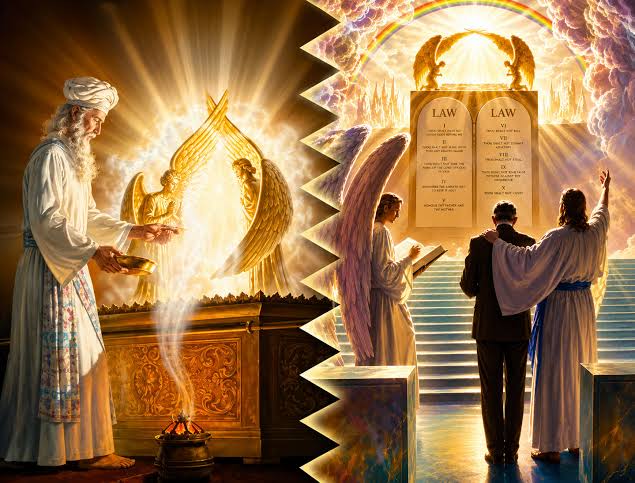
Treiyer’s work is particularly valuable for understanding Revelation 6 within the larger theological structure of Revelation 4–8.
An important qualification: Treiyer’s published discussions of Revelation 4–5, the heavenly sanctuary, the Day of Atonement, and historicist interpretation, but not a verified, complete, seal-by-seal commentary establishing his precise position on all six seals. Therefore, the following is a sanctuary-centered synthesis informed by his documented theological approach, not a claim that every conclusion below is his explicit interpretation.
1. The heavenly throne and the sanctuary
Treiyer’s work emphasizes the importance of locating the visions of Revelation within the heavenly sanctuary and interpreting them through Old Testament sanctuary typology.
His published materials include:
-
The Day of Atonement as Related to the Contamination and Purification of the Sanctuary (1986).
-
The Priest-King Role of the Messiah (1996).
-
A Summary of the Heavenly Ministry of Jesus and Its Relation to Revelation 4–5 (2006).
-
Dialogues on the Heavenly Temple in the Book of Revelation (2022).
-
His 2023 critique of the Andrews Bible Commentary treatment of Revelation 4–5.
These works and their bibliographic descriptions are available through his ministry’s publication catalog.
Treiyer’s discussion of Revelation 4–5 is particularly important because he challenges interpretations that overlook the sanctuary setting and the distinction between different phases of Christ’s heavenly ministry.
His 2023 article discusses the understanding of the throne vision in relation to the Most Holy Place and the Day of Atonement. This does not mean that all scholars agree on the timing or sanctuary location of every throne-room scene.
2. The Lamb as priest, king, and judge
Revelation 5 portrays the Lamb as worthy to open the scroll because He was slain and redeemed people through His blood.
This provides three important connections:
Christ as sacrifice: Revelation 5:9 and Hebrews 9:12 establish that His redemptive work rests upon His own blood.
Christ as heavenly priest: Hebrews 7:25 and 8:1–2 describe His continuing ministry on behalf of believers.
Christ as king and judge: Daniel 7:13–14 describes the Son of Man receiving dominion, while John 5:22 declares that the Father has committed judgment to the Son.
Treiyer’s sanctuary-centered theological approach encourages readers to consider these functions together without collapsing them into a single event.
Christ’s sacrificial death, heavenly intercession, judgment ministry, and ultimate royal victory are related, but they are not identical.
3. The seals as evidence in the Great Controversy
One fruitful theological synthesis is to view the six seals as revealing the evidence of the conflict between Christ and Satan.
The first seal displays the victorious proclamation of the gospel.
The second through fourth seals reveal the destructive consequences of violence, spiritual compromise, and death.
The fifth seal presents the appeal of the faithful for justice.
The sixth seal anticipates the public manifestation of divine judgment.
In this reading, history is not merely a sequence of political events. It becomes the arena in which the character of God’s government and the consequences of rebellion are revealed.
This is consistent with Treiyer’s larger concern for divine vindication, but it should be presented as an interpretive synthesis rather than a documented quotation from him.
4. The relationship between the fifth seal and Daniel 7
Daniel 7
The little horn persecutes the saints.
The heavenly court convenes.
Judgment is given in favor of the saints.
Revelation 6
The martyrs have been slain.
They appeal to God for justice.
They receive white robes and await final vindication.
The relationship is substantial.
Both passages concern the persecution of God’s people and the certainty of divine justice.
The distinction is that Daniel 7 explicitly depicts the heavenly court and the opening of books, while Revelation 6:9–11 presents the martyrs’ appeal without describing the entire judicial procedure.
The passages illuminate one another, but their details should not be made interchangeable.
5. The relationship between the fifth and sixth seals
The fifth seal asks: How long will the suffering of God’s people remain unanswered?
The sixth seal reveals the approaching day when God will intervene openly.
The fifth seal emphasizes divine patience and the assurance of vindication.
The sixth emphasizes the certainty and universality of judgment.
Together, they move from the question of justice to the manifestation of justice.
6. The relationship to the investigative judgment
Daniel 8:14 and the seventy-weeks prophecy of Daniel 9 form the basis for the 1844 interpretation.
Treiyer’s research defends the importance of sanctuary typology and the heavenly Day of Atonement for understanding the judgment.
A sanctuary-centered reading of Revelation 6 can therefore connect the martyrs’ vindication with Christ’s heavenly judgment ministry.
7. A question requiring further examination
A particularly important research question is whether Treiyer’s understanding of the heavenly throne scene in Revelation 4–5 changes how the opening of the seals should be understood chronologically.
For example, does the opening of the scroll primarily concern Christ’s authority over history following His ascension, the unfolding of covenantal judgment, or a particular phase of the heavenly judicial process?
These possibilities have major implications for the relationship between Revelation 5, the fifth seal, and Daniel 7.
His exact answer should be established from his Revelation 4–5 and seven-seals lectures before being attributed to him.
For further research, his Adventist Distinctive Messages website includes articles, books, and Daniel and Revelation teaching series.
Comparison of Scripture, Ellen White, and Treiyer’s Theological Framework
| Seal | Biblical emphasis | Ellen White’s relevant writings | Treiyer-related sanctuary perspective |
|---|---|---|---|
| First | Conquest and victory | Acts of the Apostles; Great Controversy, ch. 2 | Christ’s victory and the gospel’s historical witness |
| Second | War and bloodshed | Great Controversy, ch. 2 | The conflict between the kingdom of Christ and coercive power |
| Third | Scarcity and famine | Great Controversy, ch. 3 | Covenant faithfulness, apostasy, and the displacement of biblical truth |
| Fourth | Death and destruction | Great Controversy, chs. 4–6 | Persecution, religious-political authority, and historicist prophecy |
| Fifth | Martyrdom and vindication | Great Controversy, chs. 39–42 | Heavenly justice, sanctuary judgment, and vindication of the saints |
| Sixth | Cosmic signs and final judgment | Great Controversy, chs. 17 and 40 | Final manifestation of judgment and the triumph of the Lamb |
The Treiyer column identifies theological connections to his published research, not verified individual interpretations of each seal.
Seven Major Theological Conclusions
1. Jesus Christ is the central figure of Revelation 6
Although the chapter contains violence, famine, death, and judgment, the Lamb remains sovereign.
He opens every seal.
The story is ultimately about His victory, not Satan’s power.
2. The church’s history reveals the consequences of faithfulness and compromise
This traces a movement from apostolic purity through persecution, compromise, and religious oppression.
This should encourage believers to evaluate every religious institution, including their own, by the teachings and character of Jesus.
3. The heavenly sanctuary is essential to the chapter’s theology
The altar, the martyrs’ appeal, the throne, and the Lamb all belong to a larger biblical pattern involving sacrifice, mediation, and judgment.
The sanctuary reveals how God’s mercy and justice work together.
4. God has not forgotten the martyrs
The fifth seal assures believers that suffering is neither meaningless nor invisible to heaven.
The blood of the faithful calls for justice, and God promises a final answer.
5. Prophecy is not intended merely to satisfy curiosity
The signs of the sixth seal call humanity to recognize the seriousness of divine judgment.
Jesus’ own emphasis in Matthew 24:42–44 is watchfulness and readiness.
6. The judgment vindicates God’s character
The Great Controversy concerns more than the salvation of individual human beings.
It also concerns the public demonstration that God’s government is righteous, His law is good, and His redemptive work is just.
Romans 3:25–26 describes God as both just and the justifier of those who believe in Jesus.
7. The answer to Revelation 6 is found in Revelation 7
The sixth seal asks who can stand.
Revelation 7 portrays the redeemed standing before the throne.
Their robes have been washed in the blood of the Lamb.
The final answer is not human accomplishment.
It is Jesus Christ.
References
These are the principal sources I recommend identifying in the episode notes.
Biblical references: Revelation 4–8; Daniel 7–9 and 12; Ezekiel 14:21; Zechariah 1 and 6; Leviticus 4 and 16–17; Matthew 24; Mark 13; Luke 21; Hebrews 8–10; Revelation 12–14 and 20.
Ellen G. White:
-
The Great Controversy — Heralds of the Morning — the Lisbon earthquake and heavenly signs.
-
The Great Controversy — 1833 falling stars — direct application of Revelation 6:13.
-
The Great Controversy, chapters 2–6 — persecution, apostasy, and the preservation of biblical truth.
-
The Great Controversy, chapters 39–42 — final trouble, deliverance, and the conclusion of the Great Controversy.
-
The Acts of the Apostles — the mission and witness of the apostolic church.
Alberto R. Treiyer:
-
Published articles and bibliographic catalog — includes his studies on Revelation 4–5, the heavenly temple, sanctuary typology, and the Day of Atonement.
-
Adventist Distinctive Messages — books and recorded prophetic teaching series.
Additional historicist commentary: Uriah Smith, Daniel and the Revelation — The Seven Seals.