



Theme: The unfathomable love of God, the sacrifice of Jesus Christ at Calvary, and the bleeding Lamb who alone is worthy to open the seven-sealed scroll.
Central Scripture: Revelation 5:1–14
Key message: Jesus Christ is worthy not simply because He possesses all power, but because He revealed the heart of God through His sacrificial death. The Lion of Judah conquered as the Lamb who was slain.
WORTHY IS THE LAMB
The Love That Conquered the Universe
Revelation 5 — A Gospel Message from the Throne Room of Heaven
Imagine, for a moment, that you could look through an open door into heaven.
Imagine seeing the throne of the Almighty, surrounded by brilliant light, by countless angels, by the heavenly beings who worship the Creator of the universe.
Imagine hearing the thunder of heavenly praise.
And then, suddenly, something happens.
A great silence seems to settle over the scene.
In the right hand of God is a mysterious scroll, written on both sides and sealed with seven seals.
The scroll contains something of unimaginable importance. It concerns the purposes of God, the destiny of His creation, and the ultimate triumph of His kingdom.
But there is a problem.
No one can open it.
No one in heaven.
No one on earth.
No one beneath the earth.
And the apostle John begins to weep.
Why would John weep in heaven?
What could possibly bring tears in the presence of the Almighty?
And then comes an announcement that changes everything:
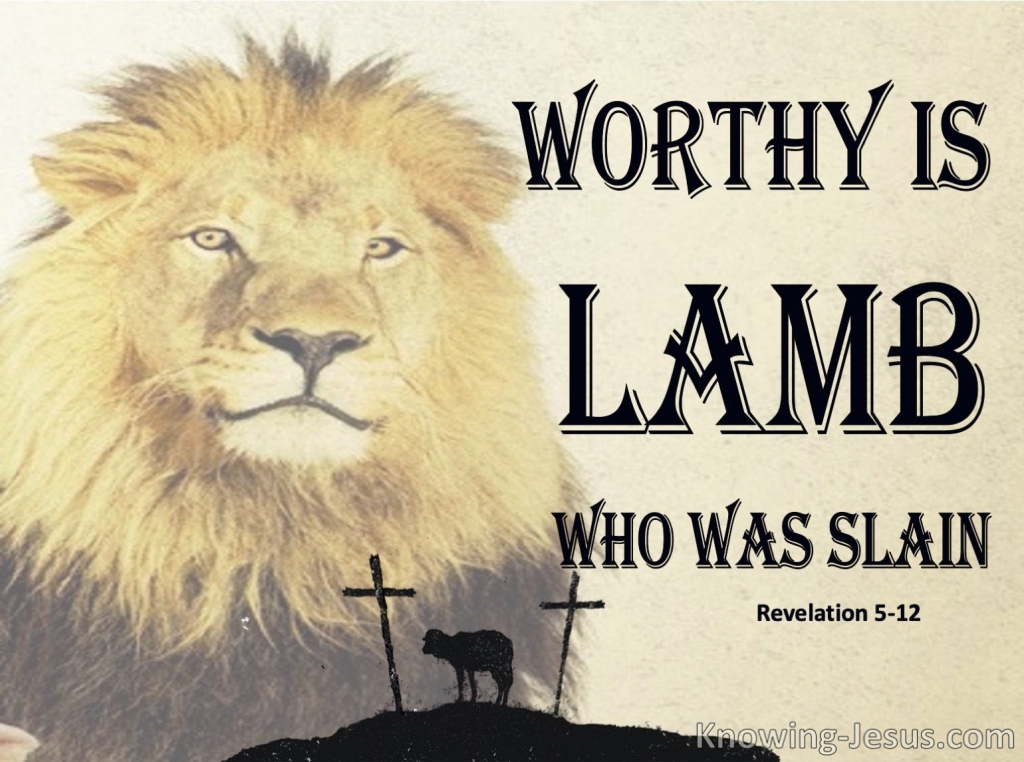
“Do not weep. Behold, the Lion of the tribe of Judah, the Root of David, has conquered!”
John turns to see the conquering Lion.
But what he sees is astonishing.
Not a lion with blood upon its teeth.
Not a mighty warrior carrying the weapons of battle.
Not a king displaying the trophies of defeated enemies.
John sees a Lamb.
A Lamb standing, yet bearing the marks of slaughter.
A Lamb who has been sacrificed.
A Lamb who has shed His blood.
And suddenly the mystery of heaven begins to unfold.
The greatest power in the universe is revealed through the greatest sacrifice in history.
The King of kings has conquered through love.
And the One who was crucified on Calvary is the only One worthy to open the scroll.
Today, I invite you to enter the throne room of heaven through the fifth chapter of Revelation.
We are going to discover why Jesus is worthy.
Why His blood matters.
Why His sacrifice reveals the character of God.
And why the Lamb who was slain is the greatest assurance that you and I can ever possess.
PART ONE — THE TEARS OF JOHN: WHEN NO ONE IS WORTHY
Listen to Revelation 5:1–4:
“And I saw in the right hand of him that sat on the throne a book written within and on the backside, sealed with seven seals.”
Then a mighty angel cries out:
“Who is worthy to open the book, and to loose the seals thereof?”
And the answer comes:
No one.
No created being is found worthy.
And John says:
“And I wept much.”
Think about those words.
John does not merely shed a tear.
He weeps deeply.
Why?
Because the opening of the scroll is connected with the fulfillment of God’s redemptive purposes.
The precise contents of the scroll are not fully explained in Revelation 5. But the chapter makes unmistakably clear that the authority to open it belongs to the One who has conquered through His sacrificial death.
The great promises of God stand before us.
The promise made in Eden that the serpent’s head would be crushed.
The promise made to Abraham that all the families of the earth would be blessed.
The promise given to David that his kingdom would endure.
The promise through Isaiah that a suffering Servant would bear our sins.
The promise through Daniel that the Son of Man would receive an everlasting kingdom.
And the promise that one day death, sorrow, crying, and pain would be no more.
But who can bring God’s purposes to completion?
Who can overcome the rebellion that has devastated creation?
Who can answer the accusations of Satan against the government of God?
Who can rescue a fallen race without compromising the righteousness of heaven?
John searches.
But no created being is worthy.
Not Abraham.
Not Moses.
Not Elijah.
Not Daniel.
Not the apostle Paul.
Not even the mightiest angel.
And certainly not you or me.
The problem of sin is greater than human intelligence, human morality, or human achievement can solve.
We cannot educate ourselves out of guilt.
We cannot purchase forgiveness.
We cannot erase our past by promising to be better tomorrow.
We cannot manufacture eternal life.
Humanity needs more than instruction.
We need redemption.
We need Someone who can stand between the holy God and a fallen world.
Someone who knows the heart of the Father.
Someone who can bear the consequences of sin.
Someone who can reveal that God’s justice and God’s love are not enemies.
Someone who can conquer evil without becoming evil.
And there is only One.
Perhaps John is weeping for more than he fully understands.
Perhaps his tears echo the tears of every mother who has buried a child.
Every father who has watched his family suffer.
Every person who has cried out, “God, why?”
Every broken marriage.
Every hospital room.
Every cemetery.
Every injustice.
Every unanswered prayer.
Every life devastated by the terrible reality of sin.
If the scroll remains sealed forever, how will God’s purposes be fulfilled?
If no one is worthy, where is our hope?
But the story does not end with John’s tears.
Because the answer to humanity’s deepest need has already been given.
And that answer is Jesus Christ.
PART TWO — THE LION WHO CONQUERED AS A LAMB
Revelation 5:5 announces:
“Behold, the Lion of the tribe of Judah, the Root of David, has prevailed to open the book.”
The Lion of Judah!
What a magnificent title.
It takes us back to Genesis 49, where Jacob foretells the coming ruler from the tribe of Judah.
It takes us to Isaiah 11, where the promised descendant of David establishes righteousness and peace.
It takes us to the great messianic hope of Israel.
The King is coming.
The Deliverer is coming.
The Conqueror is coming.
And John turns to see Him.
But in verse 6 he says:
“And I beheld, and, lo, in the midst of the throne … stood a Lamb as it had been slain.”
A Lamb.
Can you imagine John’s astonishment?
He hears about a Lion.
He sees a Lamb.
He hears about conquest.
He sees sacrifice.
He expects overwhelming power.
He sees the marks of suffering.
This is one of the most profound revelations in all of Scripture.
The Lion conquers by becoming the Lamb.
The victory of Christ is not the victory of brute force.
It is the victory of holy love.
The victory of righteousness over evil.
The victory of truth over deception.
The victory of self-sacrifice over selfishness.
The victory of the cross over the kingdom of darkness.
The kingdoms of this world conquer by taking life.
Jesus conquers by giving His life.
Earthly rulers establish their authority by demanding that others die for them.
Jesus establishes His kingdom by dying for His enemies.
The powers of darkness seek to control through fear.
Jesus wins the hearts of His people through love.
And this is why Revelation 5 is so important.
It tells us what God is really like.
If you want to understand the character of God, look at Jesus.
If you want to know how God responds to rebellion, look at Calvary.
If you want to know whether God loves sinners, look at the Lamb who was slain.
Jesus said in John 14:9:
“He that hath seen me hath seen the Father.”
And in John 3:16:
“For God so loved the world, that he gave his only begotten Son.”
Notice those words.
God so loved.
The cross did not persuade an unwilling Father to begin loving humanity.
The cross happened because the Father already loved us.
The Father was not standing against us while Jesus stood for us.
According to 2 Corinthians 5:19, God was in Christ reconciling the world unto Himself.
The Father and the Son were united in the great work of redemption.
God’s love is the source of Calvary.
And Calvary is the supreme revelation of God’s love.
Dear listener, do not miss this.
The God who created the stars is the God who loved you enough to enter the suffering of this world.
The God who formed the galaxies is the God who permitted His own Son to be rejected by the people He came to save.
The God whose glory fills heaven is the God whose love was revealed through a crown of thorns.
The Lamb is worthy because the Lamb was slain.
PART THREE — FROM EDEN TO CALVARY: THE BLOOD OF THE LAMB
To understand the Lamb in Revelation 5, we must travel backward through the Bible.
All the way to Eden.
Genesis 3 tells us that Adam and Eve rebelled against God.
They distrusted His goodness.
They believed the serpent’s suggestion that God was withholding something desirable.
And immediately, sin produced what it always produces.
Shame.
Fear.
Separation.
Blame.
Death.
But notice something extraordinary.
When Adam and Eve sinned, God came looking for them.
He called:
“Where art thou?”
The first great question after the fall was not humanity asking where God had gone.
It was God seeking fallen humanity.
What a picture of divine love!
Even before Adam and Eve fully understood the tragedy of their rebellion, God announced the promise of a Deliverer.
Genesis 3:15 declared that the offspring of the woman would crush the serpent’s head.
The promise of Calvary was already present in Eden.
Then Genesis 3:21 tells us that God clothed Adam and Eve with garments of skin.
The text does not explicitly describe the sacrifice that produced those garments, but within the larger biblical story, the image points toward God’s gracious provision for guilty humanity.
Then we come to Genesis 22.
Abraham and Isaac are climbing Mount Moriah.
Isaac asks his father:
“Behold the fire and the wood: but where is the lamb for a burnt offering?”
And Abraham answers:
“My son, God will provide himself a lamb.”
What a prophetic statement!
God will provide.
Not humanity.
Not human religion.
Not human achievement.
God Himself will provide the sacrifice.
And then we come to Exodus 12.
Israel is enslaved in Egypt.
The final plague is approaching.
God commands each household to take a lamb without blemish.
The lamb is slain.
Its blood is placed upon the doorposts.
And God promises that when He sees the blood, He will pass over the household.
The blood becomes the sign of deliverance.
Centuries later, Isaiah 53 declares:
“He is brought as a lamb to the slaughter.”
And:
“All we like sheep have gone astray; we have turned every one to his own way; and the LORD hath laid on him the iniquity of us all.”
Then one day, beside the Jordan River, John the Baptist sees Jesus approaching.
And he announces:
“Behold the Lamb of God, which taketh away the sin of the world.”
John 1:29.
There He is.
The Lamb promised in Eden.
The Lamb anticipated by Abraham.
The Lamb foreshadowed in the Passover.
The Lamb described by Isaiah.
The Lamb who would carry the sins of the world.
And finally, on a hill outside Jerusalem, the Lamb is sacrificed.
Calvary.
The cross is not an isolated tragedy in the life of Jesus.
It is the fulfillment of the great redemptive promise woven throughout Scripture.
The sacrificial system did not save people through the intrinsic power of animal blood.
Hebrews 10:4 makes clear that the blood of bulls and goats could not take away sins.
Those sacrifices pointed forward to Jesus.
Every innocent victim upon the altar reminded Israel that sin brings death and that God Himself would provide redemption.
And now, in Revelation 5, John sees the fulfillment.
The Lamb stands in heaven.
Alive.
Victorious.
Yet still identified as the One who was slain.
The cross is not forgotten in heaven.
It remains the eternal testimony of God’s love.
PART FOUR — CALVARY: WHERE THE HEART OF GOD WAS REVEALED
Now I want us to leave the throne room of heaven for a few moments.
And travel to a garden outside Jerusalem.
Gethsemane.
It is night.
Jesus is alone in prayer.
The disciples are sleeping.
The shadow of the cross is falling upon Him.
And Matthew 26:38 records His words:
“My soul is exceeding sorrowful, even unto death.”
Luke tells us that His anguish was so intense that His sweat became like great drops of blood falling to the ground.
Here is the eternal Son of God, who spoke the universe into existence.
And He is suffering.
Why?
Not because He has sinned.
Not because He has rebelled.
Not because He deserves condemnation.
But because He has chosen to bear the burden of fallen humanity.
Isaiah 53:5 says:
“He was wounded for our transgressions, he was bruised for our iniquities.”
And verse 6 declares:
“The LORD hath laid on him the iniquity of us all.”
Think of that.
Our transgressions.
Our iniquities.
Our guilt.
Our rebellion.
Jesus willingly takes upon Himself the burden of our sin.
The innocent One stands in the place of the guilty.
The Holy One identifies Himself with the unholy.
The obedient Son bears the consequences of human disobedience.
And He does it voluntarily.
Jesus said in John 10:18:
“No man taketh it from me, but I lay it down of myself.”
The cross was not an accident.
It was not merely the unfortunate outcome of political and religious hostility.
It was the voluntary self-offering of the Son of God.
And what does that tell us?
It tells us that the love of God is not sentimental language.
It is not a religious slogan.
It is not merely a beautiful thought.
God’s love acts.
God’s love gives.
God’s love sacrifices.
God’s love enters our suffering.
God’s love bears the cost of our redemption.
Now follow Jesus to Calvary.
He has been betrayed.
Abandoned.
Falsely accused.
Mocked.
Scourged.
Crowned with thorns.
His hands and feet are pierced.
He hangs between heaven and earth.
The Creator is rejected by His creation.
The Giver of life is dying.
The One who made the tree hangs upon a cross of wood.
And as He suffers, what words come from His lips?
“Father, forgive them; for they know not what they do.”
Luke 23:34.
Forgive them.
Not destroy them.
Not condemn them.
Not summon the armies of heaven to avenge Him.
Forgive them.
Here is the character of God revealed in human history.
Love that refuses to become hatred.
Mercy extended to enemies.
Grace offered to those who have done nothing to deserve it.
And then, in the darkness, comes the terrible cry:
“My God, my God, why hast thou forsaken me?”
Matthew 27:46.
These words echo Psalm 22.
They reveal the profound anguish of the suffering Messiah.
We must not pretend that we can fully comprehend what Jesus experienced in those hours.
But Scripture tells us that He bore our sins.
That He became a curse for us.
That He tasted death for everyone.
That He endured the cross for the joy set before Him.
The weight of sin was terrible.
Yet His love was greater.
And finally, He cries:
“It is finished.”
John 19:30.
What was finished?
Not His love.
Not His concern for humanity.
Not His future heavenly ministry.
But the decisive sacrificial work by which redemption was secured.
The Lamb had been offered.
The price of redemption had been paid.
The decisive victory over Satan had been won.
The perfect sacrifice had been made.
Hebrews 10:14 declares that by one offering Christ has perfected forever those who are being sanctified.
The sacrifice does not need to be repeated.
The blood of Christ is sufficient.
And because of that sacrifice, a sinner can approach the throne of grace with confidence.
Not confidence in personal goodness.
Not confidence in religious accomplishments.
Not confidence in a record of obedience.
But confidence in Jesus.
The Lamb who was slain.
E.G. White writes extensively about this great sacrifice in The Desire of Ages, particularly in the chapters “Gethsemane,” “Calvary,” and “It Is Finished.”
She emphasizes that the cross reveals the principles of God’s government and exposes the character of Satan.
The great controversy is not ultimately settled by a demonstration of who possesses greater physical power.
It is settled by the revelation of truth.
By the revelation of righteousness.
By the revelation of self-sacrificing love.
Satan claimed that God’s government was unjust.
Calvary revealed the opposite.
The Son of God willingly gave Himself for those who had rebelled against Him.
What greater evidence of love could heaven provide?
What greater demonstration of the character of God could the universe witness?
And this brings us back to Revelation 5.
Because the Lamb standing in heaven bears the marks of Calvary.
He is alive.
But He is still the Lamb who was slain.
PART FIVE — THE BLEEDING LAMB IN THE THRONE ROOM OF HEAVEN
Revelation 5:6 says:
“I beheld … a Lamb as it had been slain.”
Notice the remarkable description.
The Lamb is standing.
Yet He appears as one who has been slaughtered.
The Greek imagery recalls a sacrificial victim.
This is not a picture of Jesus continuing to suffer physically or bleed in heaven.
His sacrifice was completed once for all.
But John sees Him under the symbolism of a sacrificial Lamb, bearing the unmistakable evidence of His death.
He is the slain yet living Lamb.
The crucified yet resurrected Redeemer.
The sacrificed yet victorious King.
And this is the central mystery of the gospel.
The wounds of Christ are not signs of defeat.
They are the evidence of His victory.
The blood of Jesus is not evidence that love failed.
It is the demonstration that love conquered.
When Thomas doubted the resurrection, Jesus invited him to see His hands and His side.
The risen Christ did not conceal the marks of His sacrifice.
And in Revelation 5, heaven worships Him precisely because He was slain.
Imagine the angels.
They had witnessed the rebellion of Lucifer.
They had seen the devastation of sin.
They had watched humanity turn away from its Creator.
They had observed the long history of suffering, cruelty, idolatry, and death.
And then they witnessed the incarnation.
The eternal Son became human.
He entered a fallen world.
He lived among the poor.
He touched lepers.
He welcomed children.
He forgave sinners.
He healed the sick.
He fed the hungry.
He revealed the Father.
And then He was crucified.
How could heaven remain silent?
How could the angels comprehend such love?
The Creator dying for His creatures.
The innocent suffering for the guilty.
The King giving His life for rebels.
And now the Lamb stands alive before the throne.
The victory is complete.
The sacrifice is accepted.
The Redeemer has returned.
Ellen White describes this heavenly reception of Christ in The Desire of Ages, pages 833–835.
She portrays the risen Savior entering the heavenly courts, presenting His completed sacrifice, and receiving the Father’s acknowledgment.
The redeemed are accepted in their Representative.
And heaven erupts in worship.
Listen carefully.
The Lamb is not worthy because He avoided suffering.
He is worthy because He entered suffering and conquered through love.
He is not worthy because He refused the cross.
He is worthy because He embraced it.
He is not worthy because He saved Himself.
He is worthy because He gave Himself to save others.
And now, standing in the presence of the Father, the Lamb approaches the throne.
PART SIX — THE LAMB TAKES THE SCROLL
Revelation 5:7:
“And he came and took the book out of the right hand of him that sat upon the throne.”
This is a breathtaking moment.
The Lamb approaches the Father.
And takes the scroll.
No angel could do it.
No created being could do it.
But Jesus can.
Why?
Because He is the victorious Redeemer.
Because He is the promised Son of David.
Because He is the One who has conquered.
Because His blood has purchased people for God.
And because He has demonstrated the righteousness and love of the Father’s government.
The scroll is transferred into His hands.
The hands that touched the leper.
The hands that blessed little children.
The hands that broke bread for the hungry.
The hands that washed the feet of the disciples.
The hands that were nailed to the cross.
Those same hands receive the scroll.
What a magnificent picture!
The destiny of God’s redemptive purposes is entrusted to the crucified and risen Christ.
The One who holds the scroll is the One who died for us.
The One who directs the unfolding of history is the One who loved us enough to surrender His life.
The One who will ultimately judge the world is the One who first came to save the world.
Does that not give you hope?
Does that not give you assurance?
We live in a world of uncertainty.
Nations rise and fall.
Governments change.
Wars threaten.
Disease strikes.
Families suffer.
Death interrupts our plans.
And sometimes it seems that history is moving toward chaos.
But Revelation 5 tells us that history is not ultimately in the hands of Satan.
It is not ultimately in the hands of earthly rulers.
It is not controlled by blind chance.
The scroll is in the hands of Jesus Christ.
The Lamb who was slain.
And that means the One who governs the fulfillment of God’s purposes is the One whose character has been revealed at Calvary.
Ranko Stefanović and Jon Paulien have emphasized the heavenly inauguration and enthronement dimensions of Revelation 5.
This interpretation beautifully connects the cross with the exaltation of Christ.
The Lamb who humbled Himself unto death is now exalted.
Philippians 2 declares that because of His obedience unto death, God has highly exalted Him.
Hebrews 1 describes Him seated at the right hand of Majesty.
And Revelation 5 shows the Lamb receiving the scroll.
Christ’s royal authority and His priestly ministry are inseparable from His sacrifice.
He is the King who gave His life.
He is the Priest who offered Himself.
He is the Redeemer who intercedes for us.
And He is the Judge who knows the full cost of redemption.
This scene also provides the foundation for understanding Christ’s continuing heavenly ministry.
The inauguration of His heavenly rule is not identical with the later pre-Advent judgment described in Daniel 7 and 8.
But both rest upon the same unrepeatable sacrifice.
The blood of the Lamb.
The merits of Christ.
The victory of Calvary.
The investigative judgment does not create a new sacrifice or make the cross sufficient only at some later date.
The cross is already sufficient.
And the heavenly ministry of Jesus applies and vindicates the saving work He has accomplished.
The great assurance of the believer is therefore not that we can somehow become worthy enough to stand before God.
It is that Jesus is worthy.
And we belong to Him.
PART SEVEN — THE NEW SONG: YOU WERE SLAIN AND REDEEMED US
Now listen to Revelation 5:8–9.
The four living creatures and the twenty-four elders fall before the Lamb.
They hold golden bowls filled with incense, representing the prayers of the saints.
And they sing a new song.
A song never before heard in precisely this way.
A song that celebrates the accomplished redemption of humanity.
“Worthy art thou to take the book, and to open the seals thereof: for thou wast slain.”
Why is He worthy?
Because He was slain.
And because by His blood He purchased people for God from every tribe, language, people, and nation.
This is the song of redemption.
Not the song of human accomplishment.
Not the song of religious superiority.
Not the song of denominational pride.
Not the song of personal righteousness.
It is the song of the Lamb.
The Lamb who was slain.
The Lamb whose blood redeems.
The Lamb whose grace saves.
And notice who is included in His redeeming purpose.
Every tribe.
Every language.
Every people.
Every nation.
The gospel is not the private possession of one nation, one culture, or one race.
Jesus died for the world.
The rich and the poor.
The educated and the uneducated.
The respected and the forgotten.
The religious and the irreligious.
The person who has lived a relatively moral life.
And the person whose life has been shattered by terrible choices.
The invitation of the gospel reaches them all.
The Lamb’s sacrifice is sufficient for all who come to Him in faith.
First John 2:2 declares that Christ is the propitiation for our sins, and not for ours only, but also for the sins of the whole world.
And Romans 5:8 tells us:
“God commends His love toward us, in that, while we were yet sinners, Christ died for us.”
While we were yet sinners.
Not after we had corrected every defect.
Not after we had overcome every temptation.
Not after we had achieved some extraordinary spiritual standard.
While we were yet sinners.
Christ died for us.
That is grace.
That is love.
That is the gospel.
And the golden bowls of Revelation 5 remind us that our prayers are precious in heaven.
Perhaps you are listening today with a burden upon your heart.
Perhaps you have prayed for years for a son or daughter.
Perhaps you are facing illness.
Perhaps you are grieving someone you love.
Perhaps you are struggling with guilt over a sin you cannot seem to forget.
Perhaps you have wondered whether God hears you.
Revelation 5 says that the prayers of the saints are represented before the throne.
Your prayers are not meaningless.
Your tears are not invisible.
Your suffering is not forgotten.
And your Savior is not indifferent.
The One who receives those prayers is the Lamb who suffered for you.
He understands sorrow.
He understands rejection.
He understands betrayal.
He understands physical pain.
He understands the anguish of the human heart.
Hebrews 4:15 reminds us that we do not have a High Priest who cannot sympathize with our weaknesses.
And Hebrews 7:25 assures us that He lives to intercede for those who come to God through Him.
The Lamb who was slain is the Savior who intercedes.
PART EIGHT — THE GREAT CONTROVERSY: LOVE HAS CONQUERED
Now we come to one of the deepest theological meanings of Revelation 5.
Why does all heaven celebrate the Lamb?
Why do countless angels join in worship?
Why does the chapter move from the grief of John to the universal praise of heaven?
Because the cross is not only about the forgiveness of individual sinners.
It is also about the character of God.
The great controversy began with rebellion against God’s government.
Lucifer questioned the justice of God.
He sought independence from divine authority.
He introduced suspicion concerning the character of the Creator.
And that same suspicion appeared in Eden.
The serpent suggested that God could not be trusted.
That His commandments were restrictive.
That His motives were selfish.
That disobedience would bring greater freedom.
But Calvary answered those accusations.
At the cross, God demonstrated that His government is founded upon self-giving love.
Jesus did not use His divine power to escape suffering.
He did not compel humanity to love Him.
He did not destroy His enemies.
He gave Himself.
The contrast between Christ and Satan could not be greater.
Satan’s kingdom is built upon selfishness.
Christ’s kingdom is built upon love.
Satan seeks to exalt himself.
Christ humbled Himself.
Satan deceives.
Christ reveals truth.
Satan brings death.
Christ gives life.
And this is why the cross is the decisive revelation of God’s character.
White develops this theme in The Desire of Ages, chapter 79, “It Is Finished,” and in The Great Controversy, chapter 42, “The Controversy Ended.”
The sacrifice of Jesus reveals both the justice and the mercy of God.
God does not excuse evil as though it does not matter.
But neither does He abandon sinners to their fate.
He confronts sin through the self-offering of His Son.
And the universe beholds a love beyond comprehension.
In Revelation 5:11, John hears the voices of countless angels.
Ten thousand times ten thousand.
And thousands of thousands.
Their praise fills heaven.
Then verse 12 declares:
“Worthy is the Lamb that was slain to receive power, and riches, and wisdom, and strength, and honour, and glory, and blessing.”
Seven expressions of praise.
A complete acknowledgment of the worthiness of Christ.
Notice that heaven does not sing, “Worthy is the Lamb because He possesses overwhelming force.”
It sings, “Worthy is the Lamb that was slain.”
The sacrifice is central.
The cross is central.
The love of God is central.
And then the worship expands.
Revelation 5:13 describes every creature in heaven, on earth, beneath the earth, and in the sea joining the universal acknowledgment of God and the Lamb.
This anticipates the final vindication of God’s character.
The day is coming when every question about God’s justice will be answered.
Every accusation against His government will be exposed.
Every injustice will be judged.
Every tear of the redeemed will be wiped away.
Every grave will surrender those who belong to Christ.
And the universe will recognize that God’s ways are righteous and true.
Not because He has forced every heart to love Him.
But because His character has been fully revealed.
God is love.
And the Lamb is worthy.
PART NINE — WHAT DOES THE LAMB MEAN FOR YOU TODAY?
Now, dear listener, I want to bring this magnificent heavenly vision down to the place where you live.
To your home.
Your family.
Your worries.
Your regrets.
Your hopes.
Your relationship with God.
Because Revelation 5 is not merely a chapter to be analyzed.
It is a revelation to be believed.
It is a Savior to be trusted.
It is a love to be received.
Perhaps you have spent years trying to make yourself acceptable to God.
You have tried to be good enough.
Religious enough.
Obedient enough.
Faithful enough.
And yet, deep within, you know your failures.
You remember your mistakes.
You know the thoughts you have entertained.
You know the opportunities you have neglected.
You know the people you have hurt.
And perhaps you wonder:
Could God really love someone like me?
Listen to the answer of Revelation 5.
The Lamb was slain.
For sinners.
For the guilty.
For the lost.
For those who could never redeem themselves.
Jesus did not come to save people who had already made themselves worthy.
He came to save the unworthy.
And by His grace, to make them His own.
That is why salvation is such good news.
We do not begin with our worthiness.
We begin with His.
We do not begin with our perfection.
We begin with His righteousness.
We do not begin with our achievements.
We begin with His sacrifice.
And when we receive Him by faith, His grace begins to transform our lives.
We love because He first loved us.
We forgive because He forgave us.
We obey because we trust the One who gave Himself for us.
We keep God’s commandments not to purchase His favor, but because His love has captured our hearts.
Jesus said in John 14:15:
“If you love me, keep my commandments.”
Obedience is not the price of redemption.
It is the fruit of a living relationship with the Redeemer.
This is essential for those of us who cherish the biblical Sabbath, the heavenly sanctuary, the three angels’ messages, and the prophetic message of Revelation.
Every doctrine must lead us to Jesus.
The Sabbath points to the Creator who became our Redeemer.
The sanctuary points to the Lamb who was slain and the High Priest who intercedes.
The judgment points us to the righteous God whose saving purpose is fulfilled through Christ.
The three angels’ messages call the world to worship the Creator and receive the everlasting gospel.
And the everlasting gospel is the good news of Jesus Christ.
A message without the Lamb at its center has lost the heart of Revelation.
We may understand prophetic symbols.
We may explain historical timelines.
We may identify kingdoms and empires.
We may discuss the seven seals and the seven trumpets.
But if we fail to see the love of God revealed in the Lamb, we have missed the very heart of the book.
The central question is not simply, “Do you understand the scroll?”
The deeper question is:
Do you know the Lamb who is worthy to open it?
PART TEN — THE INVITATION: BEHOLD THE LAMB
As we come to the close of our study, I want to invite you to return once more to the throne room of heaven.
See John standing there.
See the scroll in the hand of God.
Hear the mighty angel asking:
“Who is worthy?”
Feel the silence.
See John’s tears.
And then hear the announcement:
“Do not weep.”
The Lion of Judah has conquered.
And there, in the midst of the throne, stands the Lamb.
The Lamb who was born in Bethlehem.
The Lamb who walked the dusty roads of Galilee.
The Lamb who touched the untouchable.
The Lamb who forgave the guilty.
The Lamb who welcomed the rejected.
The Lamb who prayed in Gethsemane.
The Lamb who was scourged.
The Lamb who wore the crown of thorns.
The Lamb whose hands were pierced.
The Lamb who cried out from the cross.
The Lamb who bowed His head and died.
And the Lamb who rose again.
He is standing.
Alive forevermore.
And He is worthy.
Worthy to open the scroll.
Worthy to receive the worship of heaven.
Worthy to reign over creation.
Worthy to complete the work of redemption.
Worthy to be trusted with your life.
What does God want from you today?
He wants your heart.
Not because He needs something you possess.
But because He loves you.
He created you.
He knows you.
He understands you.
And He gave His Son for you.
You may have wandered far from Him.
You may have become discouraged.
You may have lost your first love.
You may have spent years in religious activity without experiencing the joy of knowing Jesus personally.
Today, look again at the Lamb.
Look at the wounds.
Look at the sacrifice.
Look at the love.
The same Jesus who died on Calvary is alive in heaven.
The same Jesus who forgave the thief on the cross can forgive you.
The same Jesus who restored Peter can restore you.
The same Jesus who called Matthew from the tax collector’s table can call you into a new life.
The same Jesus who welcomed the woman caught in adultery can offer you forgiveness and transformation.
He has not changed.
Hebrews 13:8 says:
“Jesus Christ the same yesterday, and to day, and for ever.”
And He is calling you.
Not merely to a system of beliefs.
Not merely to a religious institution.
Not merely to a set of prophetic interpretations.
But to Himself.
To the Lamb.
To the Savior.
To the One who loves you with an everlasting love.
Would you surrender your heart to Him today?
Would you stop trying to save yourself?
Would you trust the sufficiency of His sacrifice?
Would you accept His forgiveness?
Would you allow His Spirit to transform your life?
Would you make Jesus Christ the center of your faith, your home, your worship, and your future?
Let us pray.
PRAYER
Our loving Heavenly Father,
We come before You with gratitude that words cannot adequately express.
We have looked into the throne room of heaven.
We have seen the sealed scroll.
We have heard the question of worthiness.
And we have seen the Lamb.
Father, we thank You for loving this world so much that You gave Your only begotten Son.
We thank You that Jesus willingly entered our suffering.
That He carried our sins.
That He endured the cross.
That He revealed Your character of righteousness, mercy, and self-sacrificing love.
Lord Jesus, we worship You.
You are the Lion of Judah.
You are the Root of David.
You are the Lamb who was slain.
You are our Redeemer.
Our High Priest.
Our King.
Our righteousness.
And our hope.
Forgive our sins.
Heal our broken hearts.
Remove our pride and self-righteousness.
Deliver us from the fear that we must somehow earn Your love.
Teach us to rest in the assurance of Your completed sacrifice.
And by Your Holy Spirit, transform us into people who reflect Your character.
May our homes reveal Your love.
May our churches reveal Your compassion.
May our proclamation of truth always reveal Your grace.
May the Sabbath remind us of Your creative and redeeming love.
May the sanctuary direct our attention to Your saving ministry.
And may the everlasting gospel be the center of everything we believe and proclaim.
Father, prepare us for the day when the great controversy will be ended.
When sin and death will be no more.
When the redeemed will stand before Your throne.
And when all creation will acknowledge the worthiness of the Lamb.
Until that day, keep our eyes fixed upon Jesus.
For He alone is worthy.
In His precious and holy name we pray.
Amen.
DECLARATION
Dear listener, never forget the message of Revelation 5.
The future is not in the hands of the powers of darkness.
The destiny of God’s redemptive plan is in the hands of Jesus Christ.
And those hands bear the marks of Calvary.
The Lion has conquered.
The Lamb has been slain.
The Savior has risen.
And heaven declares:
WORTHY IS THE LAMB!
“The Lion conquered by becoming the Lamb.”
The theological foundation is Revelation 5, Isaiah 53, John 3:16, Romans 5:8, Hebrews 9–10, and Ellen White’s The Desire of Ages, especially chapters 74, 78, 79, and 87.
Trust Christ’s completed sacrifice, receive His grace, and respond with loving obedience—not to earn salvation, but because salvation has been freely provided through the Lamb.
May God bless you and keep you, until we meet again as we study Revelation 6.

Article
ONE VOICE 2027: A Prophetic Opportunity or a Spiritual Challenge for the Seventh-day Adventist Church?
A biblical and theological examination of OneVoice27: Mission for All Liderazgo mundial fortalece la misión de la Iglesia Adventista impulsando la...
A biblical and theological examination of OneVoice27: Mission for All
Liderazgo mundial fortalece la misión de la Iglesia Adventista impulsando...