



The Message of Encouragement and the Foundation for Everything That Follows
“The Revelation of Jesus Christ, which God gave Him to show His servants—things which must shortly take place.”
— Revelation 1:1, NKJV
The book of Revelation has fascinated and challenged Christians for nearly two thousand years.
It contains seemingly mysterious symbols, seven churches, seven seals, seven trumpets, beasts, dragons, heavenly judgments, Babylon, Armageddon, the second coming, the millennium, the lake of fire, and finally the New Jerusalem.
But before we attempt to understand any of those things, we must answer a much more fundamental question:
What is Revelation about?
The answer is found in its very first words:
“The Revelation of Jesus Christ.”
He is the Servant of the Eternal who dies for His people, fulfilling the will of God (Isa 53). While being in the same condition as God, He humbled Himself to take the “form of a servant” Philippians 2:6-8.
He declared “I did not come to be served, but to serve, and to give my life a ransom for many” Matt 20:28.
He demonstrated His servant disposition by washing His disciples feet John 13:1-17.
Revelation is not first and foremost a revelation about beasts.
It is not primarily a revelation about political powers.
It is not primarily a revelation about catastrophes.
It is not even primarily a revelation about the end of the world.
It is a revelation of Jesus Christ.
Everything else in the book must be understood in relationship to Him and the combined expression “the Word of God and the Testimony of Jesus”.
Importantly understanding the expression “Testimony of Jesus Christ” being connected to the commandments of God, the faith of Jesus and the martyrs of Jesus.
Chapter 1 is so important as it establishes the Christ whom we will encounter throughout the remainder of Revelation.
Revelation Means an Unveiling
The word translated “revelation” comes from the Greek apokalypsis, meaning an unveiling, disclosure, or uncovering.
Something that was hidden is being made visible.
God is pulling back the curtain.
He is showing His servants what they need to know.
This is important because Revelation is not intended to conceal truth permanently. It is intended to reveal truth.
God wants His people to see.
Revelation 1:1 says:
“which God gave Him to show His servants.”
The book is therefore a divine communication.
It begins in heaven and comes to humanity.
The basic chain is:
God → Jesus Christ → His angel → John → God’s servants
The revelation originates with God.
God gives it to Christ.
Christ communicates it through His angel.
The angel communicates it to John.
John bears witness to what he has seen and heard.
And the message ultimately reaches God’s people.
This means that Revelation is not John’s speculation about the future.
John is a prophet receiving a message from heaven to be given to mankind.
The book of Revelation begins with a special blessing to everyone who reads, hears and obeys what is written in it. The exhortation is clear to hear and obey the Word of God.
“Blessed are those who keep the testimonies and seek Him with all their heart” Ps 119:2
“Blessed are those who listen to me” Prov 8: 34
“Blessed are those who hear the Word of God and obey it” Luke 11:28
“Everyone who hears these words of mine and acts on them is like a wise man” Matt 7:24
“Time is near” Rev 1:3 follows the prophecies of Daniel for the “time of the end” Daniel 8:17,19; 11:40 ; 12:40
John—the Apostle Who Knew Jesus
The human instrument chosen to receive this revelation is John.
Revelation 1:4 begins:
“John, to the seven churches which are in Asia…from Him who is and was and is to come.”
And Revelation 1:9 identifies him:
“I, John, your brother and companion in the tribulation and kingdom and patience of Jesus Christ…”
John is not a detached academic studying Jesus from a distance.
He had walked with Jesus.
The Gospel of John repeatedly identifies him through the expression “the disciple whom Jesus loved.”
See John 13:23; 19:26; 20:2; 21:7; and 21:20.
John had sat beside Jesus.
He had heard Him teach.
He had watched Him heal.
He had witnessed His crucifixion.
He had seen the empty tomb.
He had encountered the resurrected Christ.
And now, years later, John is shown another dimension of the same Jesus:
the glorified Christ.
There is something profoundly beautiful about this.
John knew Jesus during His earthly ministry.
Now John is shown Jesus in His heavenly glory.
The Jesus of Revelation is therefore not a different Jesus.
He is the same Jesus John knew.
But now John sees Him as He is in His glorified, victorious state.
“In the Revelation all the books of the Bible meet and end. Here is the complement of the book of Daniel. One is a prophecy; the other a revelation. The book that was sealed is not the Revelation, but that portion of the prophecy of Daniel relating to the last days. The angel commanded, “But thou, O Daniel, shut up the words, and seal the book, even to the time of the end.” Daniel 12:4.
It was Christ who bade the apostle record that which was to be opened before him. “What you see, write in a book,” He commanded, “and send it unto the seven churches which are in Asia; unto Ephesus, and unto Smyrna, and unto Pergamos, and unto Thyatira, and unto Sardis, and unto Philadelphia, and unto Laodicea.” “I am He that lives, and was dead; and, behold, I am alive for evermore. . . . Write the things which thou hast seen, and the things which are, and the things which shall be hereafter; the mystery of the seven stars which you have seen in My right hand, and the seven golden candlesticks. The seven stars are the angels of the seven churches: and the seven candlesticks which you have seen are the seven churches.” Revelation 1:11, 18-20.
The names of the seven churches are symbolic of the church in different periods of the Christian Era. The number 7 indicates completeness, and is symbolic of the fact that the messages extend to the end of time, while the symbols used reveal the condition of the church at different periods in the history of the world.” AA 585-585
The Spirit of God is the divine agent by which the harmony and communication between the angels, the churches, and Christ is made possible.
The seven angels are possessed by the Spirit of God.
We have the three “P’s” of Christianity in Revelation 1:5-6.
2,000 years ago, Jesus saved us from the “Penalty” of sin. “Greater love has no one than this, that he lay down his life for his Friends” John 15:13. “The Son of Man came… to give His life as ransom for many” Matt 20:28 “He purchased us with His own blood” Acts 20:28.
Today He saves us from the “Power” of sin through His priestly ministry which makes effective His death at the cross. “In Him we Him we have redemption through His blood, the forgiveness of our trespasses, according to the riches of His grace” Eph 1:7. ” Hegave Himself for us to redeem us from all lawlessness and to purify for Himself a people for His own possession, zealous for good deeds” Titus 2:14.
Tomorrow He will deliver us from the “Presence” of sin. “We do have such a high priest, who sat down at the right hand of the throne of the Majesty in heaven, and who serves in the sanctuary, the true tabernacle set up by the Lord, not by a mere human being. Every high priest is appointed to offer both gifts and sacrifices, and so it was necessary for this one also to have something to offer.” Heb 8:1-3 “But when Christ came as High Priest of the good things that are now already here, He went through the greater and more perfect tabernacle that is not made with human hands, that is to say, is not a part of this creation. He did not enter by means of the blood of goats and calves; but he entered the Most Holy Place once for all by his own blood, thus obtaining eternal redemption. ” Heb 9:11-12
“The cross of Christ will be the science and the song of the redeemed through all eternity. In Christ glorified they will behold Christ crucified. Never will it be forgotten that He whose power created and upheld the unnumbered worlds through the vast realms of space, the Beloved of God, the Majesty of heaven, He whom cherub and shining seraph delighted to adore—humbled Himself to uplift fallen man; that He bore the guilt and shame of sin, and the hiding of His Father’s face, till the woes of a lost world broke His heart and crushed out His life on Calvary’s cross. That the Maker of all worlds, the Arbiter of all destinies, should lay aside His glory and humiliate Himself from love to man will ever excite the wonder and adoration of the universe. As the nations of the saved look upon their Redeemer and behold the eternal glory of the Father shining in His countenance; as they behold His throne, which is from everlasting to everlasting, and know that His kingdom is to have no end, they break forth in rapturous song: “Worthy, worthy is the Lamb that was slain, and hath redeemed us to God by His own most precious blood!” GC 651-652
“The theme of redemption is one that the angels desire to look into; it will be the science and the song of the redeemed throughout the ceaseless ages of eternity…. As we meditate upon the perfections of the Savior, we shall desire to be wholly transformed and renewed in the image of His purity. There will be a hungering and thirsting of soul to become like Him whom we adore. The more our thoughts are upon Christ, the more we shall speak of Him to others and represent Him to the world.” SC 88-89
John on Patmos
John tells us:
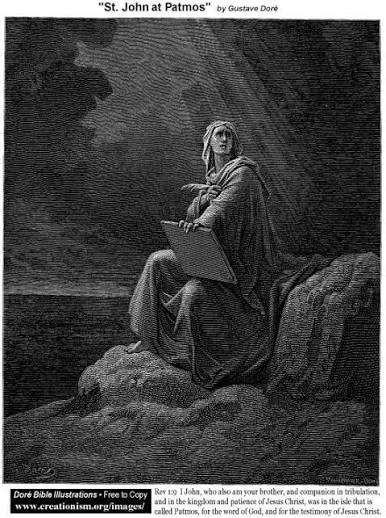
“I was on the island that is called Patmos for the word of God and for the testimony of Jesus Christ.”
— Revelation 1:9
John was separated from the churches he loved, incarcerated on Patmos, a small island in the Aegean Sea.
From a human perspective, his circumstances were restrictive.
But God was not restricted.
John was separated from his fellow believers, but he was not separated from heaven.
In fact, it was on Patmos that heaven opened to him.
That gives us an important spiritual lesson:
Our physical circumstances do not determine our access to God.
John was on Patmos.
But heaven came near.
A Special Blessing
Revelation contains a remarkable promise:
“Blessed is he who reads and those who hear the words of this prophecy, and keep those things which are written in it.”
— Revelation 1:3
Notice that the blessing involves three actions:
- reads
- hears
- keeps
The purpose of Revelation is therefore not merely intellectual.
God does not say:
“Blessed are those who can explain every symbol.”
He says:
“Blessed… [are those who] keep those things which are written in it.”
Understanding matters.
But obedience matters more.
Revelation is intended to change the way God’s people live.
It calls us to faithfulness, perseverance, worship, obedience, courage, and readiness for Christ’s return.
The study of prophecy is therefore not an end in itself.
Prophecy is designed to lead us to Jesus.
Revelation 1:7 — The Christ Who Is Coming
Only a few verses into the book we encounter one of its great themes:
“Behold, He is coming with clouds, and every eye will see Him…”
— Revelation 1:7
Notice who is coming:
He.
Jesus.
The central figure of Revelation is not an event.
It is a Person.
Jesus is coming.
That gives Revelation its ultimate direction.
The book begins with:
The revelation of Jesus Christ.
And it ends with:
“Even so, come, Lord Jesus!”
— Revelation 22:20
The whole prophetic journey lies between those two realities:
Christ revealed.
Christ returning.
When “every eye” sees the Lord there will be no time for repentance. Those who have repented before, when there was time for repentance, will rejoice at His coming 1 Cor 15;54; 2 Tim 4:8; Heb 10:36.
“When Christ comes the second time, not as a prisoner surrounded by a rabble will they see Him. They will see Him as heaven’s King…. Then the priests and rulers will remember distinctly the scene in the judgment hall. Every circumstance will appear before them as if written in letters of fire.” Mar 282
Revelation 1:4–5 gives us a remarkable introduction to Christ:
“Grace to you and peace from Him who is and who was and who is to come…”
And then:
“and from Jesus Christ, the faithful witness, the firstborn from the dead, and the ruler over the kings of the earth.”
Before Revelation introduces its symbols, it introduces its Savior.
Who is Jesus?
He is the Faithful Witness
Jesus reveals God.
He is the perfect witness to the character of His Father.
The Gospel of John says:
“No one has seen God at any time. The only begotten Son… He has declared Him.”
— John 1:18
Jesus doesn’t merely give us information about God.
Jesus reveals what God is like.
If we want to understand the character of God while studying Revelation, we must keep looking at Jesus.
He Is the Firstborn from the Dead
Revelation calls Jesus:
“the firstborn from the dead.”
The emphasis is upon Christ’s victory over death.
Jesus died.
Jesus entered the grave.
Jesus rose again.
And because He lives, death does not have the final word.
This becomes foundational to the remainder of Revelation.
The book will ultimately speak about resurrection, judgment, the second death, the destruction of evil, and the restoration of God’s creation.
But behind all of these themes stands the risen Christ.
The One who conquered death is the One who controls the future.
He Is Ruler Over the Kings of the Earth
Revelation 1:5 calls Jesus:
“the ruler over the kings of the earth.”
Think about John’s situation.
Rome appeared to control the world.
Caesars ruled.
Governors ruled.
Armies ruled.
John was a prisoner on Patmos.
But heaven says something radically different:
Jesus is the true ruler.
This theme will become increasingly important as Revelation unfolds.
Earthly kingdoms appear powerful.
Political systems rise and fall.
Empires come and go.
But Christ remains sovereign.
That is why Revelation ultimately calls humanity to worship—not earthly powers, but God and His Christ.
“Who Loved Us”
Then comes one of the most beautiful statements in the chapter:
“To Him who loved us and washed us from our sins in His own blood.”
— Revelation 1:5
Before we encounter the judgments of Revelation, we encounter the love of Christ.
Before the trumpets.
Before the plagues.
Before Babylon.
Before the beasts.
Before the final conflict.
We meet the Savior who loves us.
The Jesus of Revelation is the Jesus of Calvary.
He is not merely the coming King.
He is the crucified Lamb.
He is the One who shed His blood.
And John’s first epistle gives us the parallel:
“The blood of Jesus Christ His Son cleanses us from all sin.”
— 1 John 1:7
Revelation 1:5 says Christ:
“washed us from our sins in His own blood.”
The theology is the same.
The Jesus who is revealed in glory is the Jesus who saves sinners.
That must never be forgotten as we move through the difficult portions of Revelation.
“In the Spirit on the Lord’s Day”
John writes:
“I was in the Spirit on the Lord’s Day…”
— Revelation 1:10
John is describing the beginning of a prophetic vision.
The expression “in the Spirit” appears repeatedly in Revelation and introduces John to supernatural visions of heavenly realities.
But what does John mean by “the Lord’s Day”?
The Bible explicitly identifies the seventh day as belonging to the Lord:
“The seventh day is the Sabbath of the LORD your God.”
— Exodus 20:10
Isaiah refers to the Sabbath as God’s holy day (Isaiah 58:13), and Jesus declared:
“The Son of Man is also Lord of the Sabbath.”
— Mark 2:28Revelation 1:10 therefore fits naturally within the broader biblical teaching that identifies the seventh-day Sabbath as the Lord’s day.
This becomes particularly significant later in Revelation when the final gospel calls humanity to:
“Worship Him who made heaven and earth, the sea and springs of water.”
— Revelation 14:7
Creation, worship, the Sabbath, and the authority of the Creator will become important themes as the series progresses.
John Contemplates Eternity
Then John hears a voice behind him.
He turns.
And what he sees overwhelms him.
Revelation 1:12–16 describes the glorified Christ.
John sees:
- seven golden lampstands,
- one like the Son of Man,
- a garment reaching to His feet,
- a golden band around His chest,
- hair like white wool,
- eyes like a flame of fire,
- feet like fine brass,
- a voice like the sound of many waters,
- seven stars in His right hand,
- and a sharp two-edged sword proceeding from His mouth.
This is not the ordinary appearance of Jesus during His earthly ministry.
John is seeing the glorified Christ.
And his response is overwhelming:
“And when I saw Him, I fell at His feet as dead.”
— Revelation 1:17
John and Daniel—A Prophetic Parallel
This experience strongly resembles Daniel 10.
Daniel says:
“I lifted my eyes and looked…”
— Daniel 10:5
He then describes a heavenly figure.
And Daniel writes:
“And when I saw this great vision, no strength remained in me.”
— Daniel 10:8
Daniel ultimately falls with his face toward the ground.
Now compare John.
John sees the glorified Christ and:
“fell at His feet as dead.”
The similarity is striking.
Both prophets:
see heavenly glory → lose human strength → fall before the heavenly revelation.
This teaches us something important about prophetic revelation.
John is not simply receiving information.
He is encountering heavenly reality.
The prophets’ visions were so overwhelming that their physical bodies could scarcely withstand the experience.
“Do Not Be Afraid”
Now comes one of the most tender moments in Revelation.
John falls at Jesus’ feet.
And Jesus says:
“Do not be afraid.”
Why should John not be afraid?
Because the glorious One standing before him is the One who loves him.
Jesus continues:
“I am the First and the Last.”
Then:
“I am He who lives, and was dead, and behold, I am alive forevermore.”
This is the heart of Revelation 1.
The glorious Christ is also the crucified Christ.
The King is the Lamb.
The Judge is the Savior.
The One who possesses authority over death is the One who entered death Himself.
Jesus is saying, in effect:
I was dead.
I am alive.
And I will never die again.
Therefore:
Do not be afraid.
Jesus Holds the Keys
Christ continues:
“I have the keys of Hades and of Death.”
— Revelation 1:18
Death does not have ultimate authority.
The grave does not have ultimate authority.
Christ does.
This points toward the great resurrection hope that runs through Scripture.
The future belongs to the One who conquered death.
The Lampstands and the Churches
Then Jesus explains one of the symbols:
“The seven lampstands which you saw are the seven churches.”
— Revelation 1:20
This brings us to one of the most important concepts for the entire series.
John sees Jesus:
“in the midst of the seven lampstands.”
And the lampstands represent the churches.
Therefore:
Jesus is walking among His people.
This is the picture that must remain in our minds as we enter Revelation 2 and 3.
Jesus is not distant.
He is not disconnected from His church.
He is in the midst of it.
He sees.
He knows.
He understands.
He speaks.
“Christ walks in the midst of the golden candlesticks. Thus is symbolized His relation to the churches. He is in communion with His people. He knows their true state. He observes their order, their vigilance, their piety, and their devotion. Although He is High Priest and Mediator in the sanctuary above, yet He walks up and down in the midst of the churches on earth. He goes from church to church, from congregation to congregation, from soul to soul. He observes their true condition. He is represented as walking, which signifies untiring wakefulness, unremitting vigilance. He observes whether the light of any of His sentinels is burning dim or going out. If the candlesticks were left to mere human care, the flickering flame would languish and die. But He is the true Watchman in the Lord’s house, the true Warden of the temple courts. His continued watchcare and sustaining grace are the source of life and light. ” Ms 100, 1893
Jesus Knows His Sheep
This is where Revelation connects beautifully with Jesus’ teaching in John 10.
Jesus says:
“My sheep hear My voice, and I know them, and they follow Me.”
— John 10:27
Think carefully about those words:
“I know them.”
Jesus doesn’t merely know that His church exists.
He knows His sheep.
He knows the individual.
He knows the heart.
He knows the struggle no one else sees.
He knows the faithfulness no one else recognizes.
He knows the temptation.
He knows the sacrifice.
He knows the suffering.
And He says:
“I give them eternal life, and they shall never perish; neither shall anyone snatch them out of My hand.”
— John 10:28
That is the Jesus who walks among the seven lampstands.
Why Chapter 1 Must Come Before Chapters 2 and 3
Now we can understand why Revelation 1 is the foundation for the letters to the seven churches.
In Revelation 1:
We see Jesus.
In Revelation 2–3:
We hear Jesus speak.
And the Jesus who speaks is the Jesus whom John has just seen walking among the lampstands.
That changes everything.
When Jesus tells Ephesus:
“I know your works…”
He is not speaking as a distant observer.
He is walking among them.
When He speaks to Smyrna about suffering, He knows what suffering means.
When He speaks to Pergamos about compromise, He knows what is happening in the church.
When He speaks to Sardis about spiritual death, He knows the difference between reputation and reality.
When He speaks to Philadelphia about faithfulness, He sees their weakness and perseverance.
And when He speaks to Laodicea about being lukewarm, He knows their true spiritual condition.
He knows because He is present.
The “I Know” of Jesus
The words “I know” become enormously important as we enter chapters 2 and 3.
Jesus knows His churches.
But more than that:
Jesus knows His people.
His knowledge is complete.
His knowledge is intimate.
His knowledge is personal.
But it is also redemptive.
The One who knows everything about us is the One who says:
“Do not be afraid.”
The One who sees our failures is the One who:
“washed us from our sins in His own blood.”
The One who knows our weaknesses is the One who says:
“No one shall snatch them out of My hand.”
That means the messages to the churches should not be read merely as condemnation.
They are calls to repentance, restoration, faithfulness, and victory.
Jesus corrects because He loves.
He warns because He wants to save.
He reveals because He wants His people prepared.
The Foundation for the Entire Series
Chapter 1 gives us the framework through which every subsequent chapter should be read.
As we encounter the seals, we remember:
Jesus is Lord.
As we encounter the trumpets:
Jesus is Lord.
As we encounter the beasts:
Jesus is Lord.
As we encounter Babylon:
Jesus is Lord.
As we encounter the final conflict:
Jesus is Lord.
As we encounter judgment:
Jesus is Lord.
As we encounter the Second Coming:
Jesus is coming.
And when we finally reach the New Jerusalem:
Jesus is with His people forever.
The Central Question of Revelation
This leads us to a question that should guide the entire series:
Are we studying Revelation merely to understand prophecy—or are we studying Revelation to know Jesus?
The first approach can produce information.
The second produces transformation.
We can identify symbols and still miss Christ.
We can understand prophetic timelines and still miss Christ.
We can debate beasts and kingdoms and still miss Christ.
But if Revelation truly reveals Jesus to us, then prophecy accomplishes its purpose.
The ultimate goal is not simply to know what happens next.
It is to know the One who holds the future.
The Foundation of “Understanding Revelation”
As we begin this chapter-by-chapter journey, keep these principles in mind:
1. Revelation is an unveiling.
God wants His people to see.
2. Revelation is from God.
It is divine communication, not human speculation.
3. Revelation is centered on Jesus.
He is the beginning, center, and end of the book.
4. John is a prophet.
He receives heavenly visions and faithfully bears witness to them.
5. Jesus is the crucified and risen Savior.
The glorious Christ is the same Christ who shed His blood for humanity.
6. Jesus is returning.
“He is coming with clouds.”
7. Jesus walks among His people.
The seven lampstands represent the churches, and Christ is in their midst.
8. Jesus knows His people personally.
“My sheep hear My voice, and I know them.”
9. Revelation calls for obedience.
The promised blessing belongs to those who read, hear, and keep its message.
10. Revelation ultimately calls us to worship and hope.
The One who was dead is alive forevermore.
The Foundation Has Been Laid
“On the Isle of Patmos John saw in holy vision the One whom he honored and loved above all others. He says, “I heard behind me a great voice, as of a trumpet, saying, I am Alpha and Omega, the first and the last: and, What thou seest, write in a book, and send it unto the seven churches which are in Asia.” See the description in Revelation 1. The words uttered were not alone for John on the Isle of Patmos; they were not for the churches alone; but through these churches was to come the inspired message for the people, to have its powerful impression in every age to the close of this earth’s history. Why is not this being done? Christ presented Himself to John in His glorified humanity. “I saw,” said he, “one like unto the Son of man.” [Verse 13.] His first words were, “Fear not.” [Verse 17.] It was the same voice that spoke to him from the cross through pale and quivering lips, “Son, behold thy mother.” [John 19:26, 27.] Ms 53 1890
Before we study Ephesus, we must see Jesus.
Before we study Smyrna, we must see Jesus.
Before we study Pergamos, Thyatira, Sardis, Philadelphia, and Laodicea, we must see Jesus.
Before we study the seals, trumpets, beasts, Babylon, the mark of the beast, the final conflict, the millennium, and the New Jerusalem, we must see Jesus.
Because Revelation begins by saying:
“The Revelation of Jesus Christ.”
And it ends with:
“Even so, come, Lord Jesus!”
The book is therefore a journey.
It begins with Jesus revealed.
It proceeds with Jesus walking among His people.
It shows Jesus reigning in heaven.
It reveals Jesus as the Lamb.
It portrays Jesus confronting evil.
It announces Jesus returning in glory.
And it concludes with Jesus dwelling forever with His redeemed people.
That is the Jesus of Revelation.
And that is where our journey begins.
Next: Revelation Chapter 2 — Ephesus: “I Know Your Works”
Before Jesus tells Ephesus what is wrong, we must remember where He is:
walking among the lampstands.
He knows His church.
He knows His people.
And He knows us.
“My sheep hear My voice, and I know them, and they follow Me.” — John 10:27
“These things saith He that holds the seven stars in His right hand.” Revelation 2:1. These words are spoken to the teachers in the church—those entrusted by God with weighty responsibilities. The sweet influences that are to be abundant in the church are bound up with God’s ministers, who are to reveal the love of Christ. The stars of heaven are under His control. He fills them with light. He guides and directs their movements. If He did not do this, they would become fallen stars. So with His ministers. They are but instruments in His hands, and all the good they accomplish is done through His power. Through them His light is to shine forth. The Savior is to be their efficiency. If they will look to Him as He looked to the Father they will be enabled to do His work. As they make God their dependence, He will give them His brightness to reflect to the world.” AA 586-587
“To John were opened scenes of deep and thrilling interest in the experience of the church. He saw the position, dangers, conflicts, and final deliverance of the people of God. He records the closing messages which are to ripen the harvest of the earth, either as sheaves for the heavenly garner or as fagots for the fires of destruction. Subjects of vast importance were revealed to him, especially for the last church, that those who should turn from error to truth might be instructed concerning the perils and conflicts before them. None need be in darkness in regard to what is coming upon the earth.” GC 341-342
May the peace of the Lord Jesus Christ be with you. Amen.