




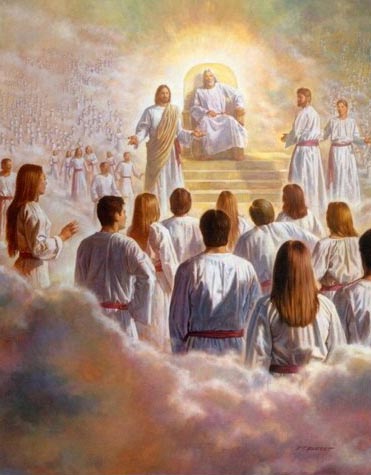
Heaven Starts Now
by Reiner Kremer
The Bible Is Not an Evacuation Plan—It Is God’s Apprenticeship for New Creation
Part 1: Seeing Our Calling “In Christ”
Scripture Reading: Ephesians 1:15–23 (NKJV)
“…the eyes of your understanding being enlightened; that you may know what is the hope of His calling…and what is the exceeding greatness of His power toward us who believe…which He worked in Christ when He raised Him from the dead and seated Him at His right hand in the heavenly places…” (Ephesians 1:18–20)
Introduction: A Bigger Gospel Than We Have Imagined
Grace and peace to you from God our Father and from our Lord Jesus Christ.
There are few ideas that have shaped modern Christianity more than the belief that the primary purpose of salvation is to leave this earth and go somewhere else. For generations, many sincere Christians have summarized the Bible with a clever expression:
B.I.B.L.E.—Basic Instructions Before Leaving Earth.
Although memorable, that statement unintentionally reduces the breathtaking story of Scripture into something much smaller than God intended. It suggests that the Christian faith is primarily about surviving until evacuation. It paints the world as a sinking ship from which believers simply await rescue. It can leave us with the impression that earth is disposable, our bodies are temporary inconveniences, culture is beyond redemption, and history is merely counting down until destruction.
But is that really the story the Bible tells?
When we open the Scriptures from Genesis to Revelation, we discover something far more beautiful. The Bible is not fundamentally the story of humanity escaping creation. It is the story of the Creator entering His creation to redeem it.
The Bible begins not with souls in heaven but with God walking with humanity in a garden. It ends not with redeemed people permanently leaving the earth, but with the holy city descending from heaven and God dwelling with humanity forever. The movement of Scripture is not humanity climbing upward to find God, but God coming down in love to dwell with His people.
The heart of Christianity is not escape.
It is restoration.
It is renewal.
It is reconciliation.
It is redemption.
This is the Gospel that captivated the Apostle Paul.
More than anyone else in Scripture, Paul unfolds the astonishing truth that believers are now “in Christ.” That little phrase appears well over one hundred times in his letters. It is not merely one doctrine among many. It is the very atmosphere of the Christian life. Everything God has done for us, He has done in Christ. Everything we hope to become, we become in Christ. Everything we receive from the Father comes through our union with His Son.
Paul does not invite us merely to believe certain facts about Jesus. He invites us into participation with Jesus Himself.
This changes everything.
If we are truly “in Christ,” then His story becomes our story.
His death becomes our death to sin.
His resurrection becomes our new life.
His ascension becomes our hope.
His reign becomes our confidence.
His future becomes our inheritance.
The Christian life is not simply waiting for Christ to return someday. It is learning to live today from the reality of what Christ has already accomplished.
That is why I believe the Bible is not an evacuation manual.
It is God’s apprenticeship for New Creation.
It is the lifelong training of men and women who are being transformed into the likeness of Jesus Christ so they may reflect His kingdom here and now while anticipating the glorious day when He makes all things new.
The Eyes of Your Heart
Paul begins his prayer in Ephesians with remarkable words.
“That the God of our Lord Jesus Christ, the Father of glory, may give to you the spirit of wisdom and revelation…the eyes of your understanding being enlightened…” (Ephesians 1:17–18)
Notice what Paul prays for.
He does not first pray that believers would receive more possessions.
He does not first pray for greater political influence.
He does not first pray for easier circumstances.
Instead, he prays that they would see.
The greatest need of the Christian is often not more information but clearer vision.
Many believers already possess treasures they have never discovered.
Like heirs living in poverty while unaware of an inheritance, Christians sometimes live beneath the riches already given to them in Christ.
Paul asks God to open “the eyes of your understanding.” A more literal expression is “the eyes of your heart.” In the Hebrew way of thinking, the heart is not merely the center of emotion. It is the seat of the whole person—our thinking, willing, desiring, and loving. Paul prays that our deepest inner being would be flooded with divine light so that we might perceive reality as God sees it.
This prayer remains desperately needed today.
We live in a culture that measures reality by headlines, economic reports, elections, wars, disease, natural disasters, and social upheaval. The twenty-four-hour news cycle trains us to interpret the world through anxiety. Fear sells newspapers, fills television screens, and keeps people endlessly scrolling. The enemy of our souls delights when our imagination is captive to despair rather than to the promises of God.
Yet Paul invites believers to see from a different vantage point.
Not from earth upward.
But from heaven downward.
He invites us to view history through the enthroned Christ.
Christ Is Already Enthroned
Paul continues:
“…which He worked in Christ when He raised Him from the dead and seated Him at His right hand in the heavenly places.” (Ephesians 1:20)
The Resurrection was not the conclusion of Christ’s work.
Neither was the Cross.
The Ascension is equally essential to the Gospel.
Too often we preach Good Friday.
We rejoice on Resurrection Sunday.
Yet we rarely linger on Ascension Day.
But Paul does.
Again and again, he points us to the exalted Christ.
Jesus did not merely rise from the tomb.
He ascended to the Father.
He sat down.
Throughout Scripture, sitting signifies a completed priestly work and an established kingly authority. The Son who humbled Himself in the Incarnation, who washed feet, who bore our griefs, who carried our sins upon the Cross, and who triumphed over death now reigns at the Father’s right hand.
This means that history is not out of control.
Christ is not anxiously awaiting the outcome of world events.
He is not pacing the halls of heaven wondering whether evil will prevail.
He reigns now.
Every empire rises beneath His authority.
Every nation exists under His sovereignty.
Every ruler ultimately answers to Him.
Every power is temporary.
Only His kingdom is everlasting.
Paul is telling frightened believers living under the might of the Roman Empire that the true Emperor of the universe is Jesus Christ.
The throne of heaven is occupied.
That simple truth changes how we face every uncertainty.
The Incarnation Reveals the Heart of God
Before we go further, we must ask a profound question.
Why would the eternal Son of God leave the glory of heaven?
Why would the Creator enter His own creation?
Why would the infinite One become an infant?
The answer is love.
Not sentimental love.
Not fleeting affection.
Not self-serving emotion.
The Bible reveals the everlasting agapē of God—a love that gives itself without demanding repayment. A love beautifully described in the great hymn of 1 Corinthians 13.
Love is patient.
Love is kind.
Love does not seek its own.
Love bears all things.
Believes all things.
Hopes all things.
Endures all things.
Love never fails.
These words are not merely moral instructions for Christians.
They are first a portrait of Jesus Himself.
Every phrase became flesh in the Incarnation.
When humanity rebelled, God did not respond by abandoning His creation. Instead, the eternal Word became flesh and dwelt among us. He entered the dust He had formed. He embraced the humanity that had fallen. He came not to condemn the world but to save it.
The Incarnation forever settles the question of God’s attitude toward creation.
If God intended simply to discard the world, why would He enter it?
If matter were inherently worthless, why would the Son permanently unite Himself to human nature?
In Jesus Christ, heaven and earth meet.
God does not rescue us from humanity by making us less human.
He redeems humanity by showing us true humanity in Christ.
Jesus is not merely God appearing as a man.
He is perfect humanity as God intended humanity to be.
To look at Jesus is to see what Adam was created to become.
Humanity’s Original Calling
This brings us back to the opening pages of Scripture.
Genesis declares:
“Then God said, ‘Let Us make man in Our image, according to Our likeness; let them have dominion…'” (Genesis 1:26).
Notice the sequence.
Image.
Then dominion.
Humanity was never commissioned to dominate creation selfishly. Dominion flows from bearing God’s image. We were created to reflect God’s loving character into the world, cultivating, protecting, ordering, and blessing creation as God’s royal representatives.
King David marveled at this astonishing privilege:
“When I consider Your heavens, the work of Your fingers…what is man that You are mindful of him?…You have made him to have dominion over the works of Your hands.” (Psalm 8:3–6)
What dignity!
What purpose!
What grace!
God entrusted His beautiful world to human beings made in His image.
The Garden of Eden was never meant to remain a small enclosed sanctuary. Adam and Eve were commissioned to fill the earth, extending God’s order, beauty, peace, and life throughout creation. In other words, humanity’s original vocation was to make the whole earth increasingly reflect the goodness of God’s kingdom.
Sin interrupted that calling, but it did not erase God’s purpose.
God did not abandon His original design.
Instead, He began the long story of redemption that reaches its climax in Jesus Christ.
The mission of redemption is not the cancellation of creation.
It is the restoration of creation through the Second Adam.
Seeing History Through Christ
When we read the daily news without Scripture, we can easily conclude that darkness is winning.
Wars.
Violence.
Disease.
Division.
Hatred.
Fear.
Every generation has looked at the brokenness of the world and wondered whether evil has gained the upper hand.
Paul answers with one breathtaking vision.
Look higher.
Look to the throne.
Look to Christ.
History is not ultimately interpreted by the evening news.
It is interpreted by the empty tomb and the occupied throne.
The Cross looked like defeat.
It became the greatest victory in the history of the universe.
The Resurrection looked impossible.
It became the beginning of New Creation.
The Ascension looked like departure.
It became Christ’s universal enthronement.
Everything depends upon where we are looking.
If we look only at earth, we become discouraged.
If we look to Christ, we become hopeful.
The Christian is called to live from heaven’s perspective because our life is hidden with Christ in God.
Paul’s prayer is therefore our prayer:
“Lord, open the eyes of our hearts.
Help us to see that You are reigning.
Help us to see that Your kingdom has already begun.
Help us to see that Your love is stronger than sin.
Help us to see that Your grace is greater than our failures.
Help us to see that Your redemption is more powerful than Satan’s corruption.”
For when our vision changes, our lives begin to change as well.
And that is where Paul now takes us next.
Join us for Part Two in this series, “In Christ” — The Engine of New Creation


Article
Why Many Religions Teach the Nonbiblical View of Eternal Torment or Hell
Why Many Religions Teach the Nonbiblical View of Eternal Torment (Hell) Below is a careful, historical, and theological explanation of why some religions...
Why Many Religions Teach the Nonbiblical View of Eternal Torment (Hell)
Below is a careful, historical, and theological explanation...