

Part 2: The Church—Christ’s Living Body and the Beginning of New Creation
by Reiner Kremer
Paul has prayed that the eyes of our hearts would be opened. He has lifted our gaze beyond the uncertainty of this world to the certainty of Christ’s enthronement. Now he brings that glorious truth to an astonishing conclusion.
Listen again to these magnificent words:
“And He put all things under His feet, and gave Him to be head over all things to the church, which is His body, the fullness of Him who fills all in all.” (Ephesians 1:22–23, NKJV)
These are among the most breathtaking verses in all of Scripture.
Think carefully about what Paul is saying.
The One who created the galaxies…
The One through whom all things were made…
The One who calmed the sea…
The One who conquered death…
The One who now sits at the Father’s right hand…
has chosen to express His life in the world through His Church.
Not because He needs us.
But because He loves us enough to include us in His redeeming work.
The Church is not an afterthought.
The Church is not merely an organization.
The Church is not simply a place where Christians gather once a week.
The Church is the living Body of Jesus Christ.
His life flows through His people.
His compassion reaches the hurting through His people.
His truth is proclaimed through His people.
His forgiveness is extended through His people.
His mercy is demonstrated through His people.
His kingdom becomes visible through His people.
When people encounter a community transformed by the Holy Spirit, they are meant to catch a glimpse of the character of Jesus Himself.
That is why the Church matters.
Not because buildings matter.
Not because denominations matter.
But because Christ has chosen to make His people His visible presence in the world.
Christ Is the Head
Paul says that God has “put all things under His feet.”
This language immediately reminds us of Psalm 8.
David looked into the night sky and exclaimed,
“When I consider Your heavens, the work of Your fingers,
The moon and the stars, which You have ordained,
What is man that You are mindful of him,
And the son of man that You visit him?For You have made him a little lower than the angels,
And You have crowned him with glory and honor.You have made him to have dominion over the works of Your hands;
You have put all things under his feet.” (Psalm 8:3–6)
Originally, these words described humanity’s God-given vocation.
Created in God’s image, men and women were crowned with glory and entrusted with dominion—not domination, but loving stewardship reflecting God’s own character.
Sin distorted that calling.
Instead of serving creation, humanity exploited it.
Instead of ruling under God, humanity sought to rule independently of God.
Instead of reflecting divine love, humanity reflected selfish ambition.
Yet God’s purpose was never abandoned.
The New Testament reveals that Psalm 8 ultimately finds its fulfillment in Jesus Christ.
Jesus is the true Human.
The Second Adam.
The perfect Image of God.
Everything Adam failed to accomplish, Christ accomplishes perfectly.
He reigns with humility.
He rules with mercy.
He exercises authority through self-sacrificing love.
Notice how different Jesus’ kingdom is from every earthly kingdom.
Earthly rulers often increase their power by taking.
Jesus revealed His power by giving.
Earthly rulers demand sacrifice.
Jesus became the sacrifice.
Earthly rulers protect themselves.
Jesus poured Himself out for others.
This is the astonishing nature of God’s kingdom.
The greatest throne in the universe is occupied by the One whose hands still bear the scars of Calvary.
Love reigns.
God’s Kingdom Is Built on Self-Giving Love
The world often assumes that power belongs to those who dominate.
But heaven tells another story.
The greatest power in existence is not coercion.
It is love.
Not sentimental love.
Not emotional affection.
But the agapē love revealed in Jesus Christ.
The Apostle Paul gives us the clearest description of that love in 1 Corinthians 13.
Love is patient.
Love is kind.
Love does not envy.
Love does not boast.
Love is not proud.
Love is not self-seeking.
Love keeps no record of wrongs.
Love bears all things.
Believes all things.
Hopes all things.
Endures all things.
Love never fails.
These are not simply virtues we should imitate.
They describe the eternal character of God Himself.
They describe Jesus.
The Incarnation was love entering history.
The Cross was love absorbing hatred without returning hatred.
The Resurrection was love triumphing over death.
The Ascension was love enthroned over the universe.
Pentecost was love poured into human hearts through the Holy Spirit.
Every stage of the Gospel reveals the same unchanging God.
God has never ceased loving His creation.
His love has always moved toward us.
Even after Eden.
Even after the Flood.
Even after Israel’s repeated failures.
Even after our own failures.
The story of Scripture is not the story of God becoming loving.
It is the story of everlasting Love refusing to give up on His children.
Seated with Christ
Many Christians think of heaven only as a destination.
Paul speaks of heaven as a present reality.
Later in Ephesians he writes:
“God…made us alive together with Christ…and raised us up together, and made us sit together in the heavenly places in Christ Jesus.” (Ephesians 2:4–6)
Notice the tense.
Not “will someday seat us.”
He made us sit with Christ.
How can this be?
Obviously, we still walk on earth.
We still experience suffering.
We still await Christ’s visible return.
Yet Paul insists that something decisive has already happened.
Because we are united with Christ, His position has become our position.
His victory has become our victory.
His acceptance has become our acceptance.
His inheritance has become our inheritance.
His relationship with the Father has become our relationship with the Father.
Everything depends upon those two extraordinary words that echo throughout Ephesians:
In Christ.
Outside Christ, humanity remains separated from the life of God.
In Christ, everything changes.
In Christ we are chosen.
In Christ we are redeemed.
In Christ we are forgiven.
In Christ we are adopted.
In Christ we are reconciled.
In Christ we receive the Holy Spirit.
In Christ we become God’s workmanship.
In Christ we become one new humanity.
In Christ we become members of His Body.
The Christian life is therefore not primarily imitation.
It is participation.
We are not merely trying to act like Jesus.
His own life is being formed within us through the Holy Spirit.
That is why Christianity is never reduced to moral improvement.
It is resurrection life.
Heaven Begins Here
This changes how we understand heaven itself.
Too often heaven has been imagined merely as another location somewhere beyond the stars.
Certainly, there is a glorious future awaiting God’s people.
Scripture never diminishes that hope.
Jesus will return.
The dead will be raised.
Every tear will be wiped away.
Sin will be forever abolished.
Death itself will die.
That future hope fills every page of the New Testament.
But Paul refuses to postpone everything until then.
The age to come has already broken into the present.
The kingdom has already begun.
The Holy Spirit has already been poured out.
Christ already reigns.
Believers already belong to the coming world.
In that sense, heaven begins now.
Every time forgiveness triumphs over revenge…
heaven breaks into earth.
Every time enemies embrace as brothers and sisters…
heaven becomes visible.
Every act of generosity…
every word of encouragement…
every prayer offered in faith…
every child taught the love of Jesus…
every meal shared with the lonely…
every burden carried for another…
every act of mercy…
is evidence that another kingdom is already present.
Jesus taught us to pray,
“Your kingdom come.
Your will be done
On earth as it is in heaven.”
He would never teach us to pray for something impossible.
The Church becomes the place where heaven’s values begin to flourish in advance of Christ’s glorious return.
We become living demonstrations of the future.
The Holy Spirit—Tomorrow’s Life Today
How does this happen?
Not through human effort alone.
Paul has already answered.
“Having believed, you were sealed with the Holy Spirit of promise, who is the guarantee of our inheritance.” (Ephesians 1:13–14)
The Holy Spirit is God’s pledge that what He has begun, He will complete.
Imagine placing a seed into the soil.
At first, almost nothing appears to happen.
Yet hidden within that tiny seed is the life of a magnificent tree.
The seed is not the finished tree.
But neither is it unrelated to the tree.
The future is already present in miniature.
That is what the Holy Spirit is for every believer.
He is heaven’s life planted within us.
He is tomorrow’s kingdom living in today’s disciples.
He teaches us to love as Jesus loved.
He convicts us when we wander.
He comforts us in sorrow.
He strengthens us in weakness.
He renews our minds.
He transforms our character.
He reminds us that we belong to Christ.
This is why Christianity is never merely about escaping judgment.
It is about becoming increasingly alive to God.
The Spirit prepares us not only for the world to come but also for faithful living in this world.
He makes us apprentices of Jesus.
He forms Christ within us day by day.
We Need Not Fear
Our world has become saturated with fear.
Fear of war.
Fear of economic collapse.
Fear of political division.
Fear of disease.
Fear of persecution.
Fear of death.
There are voices—even among Christians—that seem to delight in announcing destruction.
Every disaster is interpreted as proof that everything is about to end.
Every crisis becomes another reason to panic.
Some have become what might be called “spiritual pyromaniacs”—people whose imagination is captivated almost entirely by fire, catastrophe, and ruin.
But the New Testament never calls believers to be fascinated by destruction.
It calls us to be captivated by Jesus Christ.
The center of biblical prophecy is not catastrophe.
The center is Christ.
The center of Revelation is not the Beast.
It is the Lamb.
The center of history is not Antichrist.
It is the risen Lord.
The center of our hope is not the end of the world.
It is the renewal of the world through Jesus Christ.
Therefore, Christians are the least fearful people on earth.
Not because we deny suffering.
Not because we ignore evil.
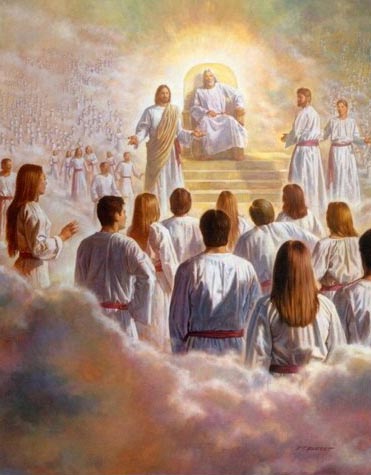
But because we know who sits upon the throne.
The throne is occupied.
The Lamb reigns.
Love reigns.
Grace reigns.
Christ reigns. And because He reigns, we need not live in fear.
Instead, we become ambassadors of hope in a frightened world.
For heaven has already begun—in Christ.