




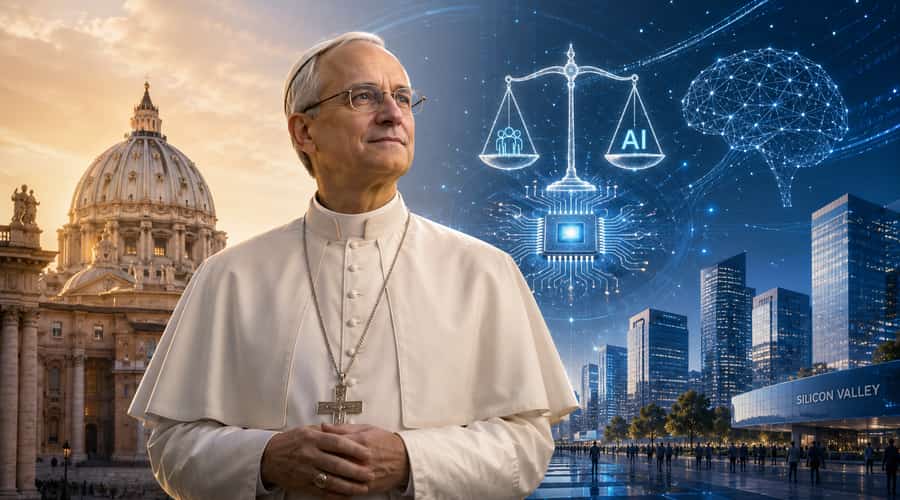
Silicon Valley, the Papacy, and the Final Conflict: A Great Controversy Perspective
Introduction
As artificial intelligence transforms civilization and technological power becomes increasingly concentrated in the hands of global elites, a remarkable debate has emerged between influential voices in Silicon Valley and leaders within the Roman Catholic Church. To many observers, this appears to be a political disagreement concerning ethics, regulation, and the future of technology. Yet from a Seventh-day Adventist perspective, the controversy touches something far deeper.
Behind the headlines stands the great controversy between Christ and Satan—a conflict that began in heaven before the creation of the world and continues until the Second Coming of Jesus Christ.
Scripture reveals that history is not merely a succession of political events. Rather, it is the unfolding of a cosmic struggle over worship, authority, truth, and allegiance.
In Revelation 12:7-9, John describes the origin of this conflict:
“And there was war in heaven. Michael and his angels fought against the dragon; and the dragon fought and his angels.”
After his expulsion from heaven, Satan continued his rebellion on earth.
Revelation 12:9 states:
“That ancient serpent called the devil, or Satan, who leads the whole world astray.”
The central issue throughout the great controversy has always been authority.
Who has the right to rule?
Who determines truth?
Whose law governs the universe?
Will humanity trust God’s Word or human authority?
These same questions appear throughout Daniel and Revelation.
Daniel’s Little Horn
In Daniel 7, four beasts represent successive world empires. After the rise and fall of Babylon, Medo-Persia, Greece, and Rome, Daniel sees a “little horn” emerge among the divisions of the Roman Empire.
The little horn possesses several identifying characteristics:
- It arises from Rome (Daniel 7:8).
- It becomes different from previous kingdoms (Daniel 7:24).
- It speaks “great words against the Most High” (Daniel 7:25).
- It persecutes God’s people (Daniel 7:25).
- It attempts to change God’s law (Daniel 7:25).
- It exercises authority for a prophetic period of 1,260 years (Daniel 7:25).
Seventh-day Adventists, following the Protestant Reformers, identify this power with the medieval papal system.
Martin Luther, John Calvin, John Knox, William Tyndale, and numerous other Reformers likewise saw the papacy as fulfilling these prophecies.
The Man of Sin
Paul describes another power in 2 Thessalonians 2:3-4:
“That man of sin be revealed, the son of perdition; who opposes and exalts himself above all that is called God.”
Paul predicts a religious power arising within the Christian era that would exalt itself and assume prerogatives belonging only to God.
Ellen White writes in The Great Controversy:
“The prophecy of the eleventh chapter of Daniel has nearly reached its complete fulfillment. Much of the history that has taken place in fulfillment of this prophecy will be repeated.”
Elsewhere she states:
“It is one of the leading doctrines of Romanism that the pope is the visible head of the universal church of Christ, invested with supreme authority over bishops and pastors throughout the world.”
The concern in Adventist theology is not the existence of church leadership itself, but claims of authority that supersede Scripture.
Revelation 13 and the Sea Beast
Revelation 13 describes a beast arising from the sea.
John writes:
“And all the world wondered after the beast.” (Revelation 13:3)
The beast receives:
- worldwide influence,
- religious authority,
- political power,
- and worship.
It also persecutes believers and seeks control over economic activity.
The famous number 666 appears in connection with this power (Revelation 13:18).
Adventist interpreters historically view the sea beast as the same power represented by Daniel’s little horn and Paul’s man of sin.
Ellen White writes:
“The line of prophecy in which these symbols are found begins with Revelation 12, with the dragon that sought to destroy Christ at His birth. The dragon is said to be Satan; he it was that moved upon Herod to put the Saviour to death. But the chief agent of Satan in making war upon Christ and His people during the first centuries of the Christian Era was the Roman Empire.”
She then traces the transfer of authority from pagan Rome to papal Rome.
The Final Crisis
According to Adventist eschatology, the final issue will not primarily concern technology, economics, climate, or politics, although all may play important roles.
The ultimate issue is worship.
Revelation repeatedly contrasts two groups:
Those who worship the beast (Revelation 13).
And those who:
“keep the commandments of God and the faith of Jesus.” (Revelation 14:12)
Ellen White writes:
“The last great conflict between truth and error is but the final struggle of the long-standing controversy concerning the law of God.”
In Adventist understanding, the Sabbath becomes the visible point of controversy because it represents God’s authority as Creator.
The great controversy is therefore not fundamentally about one pope, one government, one technology, or one generation.
It is about whether humanity will accept God’s authority or substitute human authority in its place.
Technology and the End-Time Deception
Artificial intelligence introduces a new dimension to this prophetic landscape.
Technology itself is morally neutral.
Daniel predicted that knowledge would increase (Daniel 12:4).
Yet Revelation warns of unprecedented global deception.
Technology may become a powerful instrument through which persuasion, surveillance, economic control, and propaganda operate on a worldwide scale.
The danger is not found in machines themselves but in fallen human hearts.
Neither artificial intelligence nor political power can solve humanity’s deepest problem.
The Bible identifies that problem as sin.
Only Christ can redeem humanity.
Only Christ can transform the heart.
Only Christ can establish the everlasting kingdom described in Daniel 2:44:
“The God of heaven shall set up a kingdom, which shall never be destroyed.”
The great controversy concludes not with the triumph of technology, religion, governments, or human institutions, but with the return of Jesus Christ.
The final victory belongs to the Lamb.
Revelation 17:14 declares:
“The Lamb shall overcome them: for he is Lord of lords, and King of kings.”
That is the believer’s hope in every age—including the age of artificial intelligence.