



A Biblical Reflection Through Daniel and Revelation
The 21st century may witness one of the strangest ideological confrontations in modern history. It is not merely East versus West, capitalism versus socialism, or secularism versus religion. Increasingly, it appears to be a contest between two competing visions of what it means to be human — and what humanity is destined to become.
On one side stands the emerging technological elite of Silicon Valley: visionaries, billionaires, artificial intelligence architects, venture capitalists, and transhumanists who believe humanity’s salvation lies in technological acceleration. Their gospel is innovation. Their creed is progress. Their hope is transcendence through science and technology.
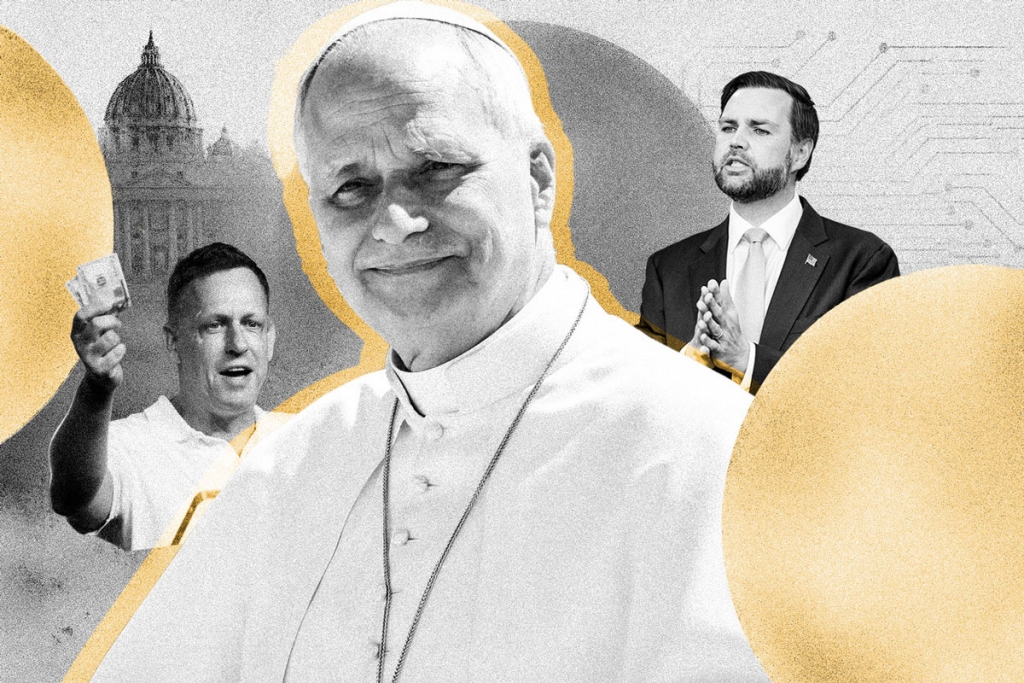
Among the most intellectually influential figures in this movement is Peter Thiel, co-founder of PayPal and Palantir, a man deeply interested in theology, apocalyptic thought, and the future of civilization. Thiel has repeatedly argued that stagnation is humanity’s greatest danger and has warned that systems designed to suppress innovation in the name of safety could become tyrannical.
On the other side stands Pope Leo XIV and the Vatican, warning that artificial intelligence, unchecked technological power, and algorithmic governance threaten human dignity itself. Pope Leo’s sweeping encyclical on AI portrays a world increasingly vulnerable to manipulation, dehumanization, centralized control, and moral confusion.
What makes this confrontation remarkable is that both sides increasingly speak in apocalyptic language. Both believe civilization stands at a crossroads. Both fear humanity may lose its soul. Both speak, in different ways, about the danger of false salvation.
And for thoughtful students of Scripture, especially the prophetic books of Daniel and Revelation, this raises profound questions.
Are we witnessing merely a political disagreement over technology? Or are we seeing the emergence of the very tensions the Bible foresaw long ago?
The Silicon Valley Vision: Salvation Through Innovation
Modern Silicon Valley is not merely an economic ecosystem. Increasingly, it functions as a quasi-religious worldview.
Many technological elites openly speak about:
- defeating death,
- transcending biology,
- merging humans with machines,
- creating artificial general intelligence,
- colonizing space,
- and reshaping human evolution itself.
This worldview often carries a hidden theological assumption: humanity can save itself.
In previous centuries, salvation was associated with God, redemption, forgiveness, and eternal life through Christ. In today’s technological imagination, salvation is increasingly associated with data, intelligence, longevity science, neural interfaces, and AI.
Peter Thiel occupies a unique place within this world because he does not approach technology with naive secular optimism. He is deeply aware of biblical themes and often references Christian theology. Yet his concern is that fear-based global systems could suppress innovation and impose centralized control over humanity.
Thiel has discussed the biblical idea of the Antichrist not primarily as a cartoon villain, but as a figure or system promising false peace through universal control. He has suggested that humanity’s fear of catastrophe could justify unprecedented global authority, especially during crises involving climate, pandemics, war, or artificial intelligence.
This concern reflects a deeper fear within Silicon Valley:
that excessive regulation and centralized governance may freeze civilization into permanent stagnation.
To many techno-optimists, innovation is not merely useful — it is morally necessary.
Without progress:
- disease remains undefeated,
- poverty persists,
- energy shortages continue,
- and civilization risks collapse.
Thus, technological acceleration becomes a moral imperative.
Some even view artificial intelligence as humanity’s next evolutionary step.
But here the Bible raises immediate concerns.
The Vatican’s Vision: Defending Human Dignity
In contrast, Pope Leo XIV warns that technology without moral boundaries becomes spiritually dangerous.
The Vatican’s concern is not simply about gadgets or computers. It is about anthropology — the biblical understanding of what a human being is.
According to historic Christianity:
- human beings are created in the image of God,
- moral agency belongs to persons, not machines,
- truth cannot be reduced to algorithms,
- and human dignity cannot be measured by efficiency.
Pope Leo argues that modern society increasingly treats people as data points to be optimized rather than souls to be loved.
The Vatican fears:
- surveillance systems,
- AI-assisted warfare,
- algorithmic manipulation,
- digital propaganda,
- economic displacement,
- and the concentration of power among technological elites.
At its core, the Pope’s warning is deeply biblical:
when humanity seeks power without wisdom, civilization becomes dangerous.
This echoes the ancient story of the Tower of Babel in Genesis 11. Humanity unified technologically and politically in order to “make a name” for itself apart from God. The problem was not architecture; it was spiritual pride.
Similarly, Daniel and Revelation repeatedly warn about kingdoms that centralize power, exalt themselves, and attempt to redefine human authority apart from divine truth.
Daniel’s Prophetic Framework: Technology and Empire
The Book of Daniel describes successive world empires rising in power and sophistication:
- Babylon,
- Medo-Persia,
- Greece,
- Rome,
- and finally a divided global order represented by iron mixed with clay.
Daniel 2 presents a striking image of human civilization growing increasingly powerful externally while becoming internally unstable.
The feet of iron and clay symbolize a final civilization that possesses immense strength but profound fragmentation.
Many modern observers see echoes of this today:
- unprecedented technological power,
- global communication networks,
- AI systems,
- digital currencies,
- biotechnology,
- and surveillance infrastructure,
Combined with:
- social fragmentation,
- political polarization,
- spiritual confusion,
- and declining trust.
Daniel 7 goes further, portraying global empires as beasts rising from chaos. These kingdoms are powerful, intelligent, and terrifying, yet fundamentally dehumanizing.
This matters profoundly for the AI debate.
Technology promises efficiency, prediction, optimization, and control. But biblical prophecy repeatedly warns that systems obsessed with control often diminish human freedom and dignity.
The issue is not whether technology is evil. Scripture never condemns knowledge itself. Daniel 12:4 even predicts that “knowledge shall increase.”
The danger arises when knowledge becomes detached from wisdom and humility before God.
Revelation and the Fear of Global Control
The Book of Revelation intensifies these themes.
Revelation describes a final global system characterized by:
- centralized economic power,
- political coercion,
- propaganda,
- image worship,
- and the regulation of buying and selling.
For centuries, Christians debated how such worldwide systems could ever exist. Today, for the first time in history, the technological infrastructure for global coordination and surveillance actually exists.
Artificial intelligence dramatically expands this possibility.
AI systems can:
- monitor populations,
- influence beliefs,
- generate persuasive propaganda,
- track transactions,
- predict behavior,
- and shape public opinion at massive scale.
This is why many Christians become uneasy when technological systems merge with centralized authority.
But the biblical warning cuts both ways.
Some people fear authoritarian government. Others fear unregulated corporate power. Revelation warns humanity about idolatrous power itself — whether political, economic, religious, or technological.
In Revelation 13, the Beast gains authority through fear, spectacle, economics, and deception. The issue is worship: who ultimately receives humanity’s allegiance?
This becomes especially relevant in a culture increasingly tempted to place ultimate hope in technology.
The Temptation of False Salvation
At the heart of this confrontation lies a profoundly spiritual question:
What saves humanity?
Silicon Valley often answers:
innovation, intelligence, disruption, and technological mastery.
The Vatican answers:
moral truth, human dignity, spiritual accountability, and God.
The Bible offers an even deeper answer:
Jesus Christ alone.
Both technological utopianism and authoritarian moralism can become counterfeit salvations.
The Bible warns repeatedly against systems promising heaven on earth apart from God.
Babylon promised greatness.
Rome promised peace.
Modern ideologies promise progress.
Technological elites promise optimization.
Yet Scripture insists the human problem is ultimately spiritual, not merely technical.
Artificial intelligence may cure diseases, improve logistics, and accelerate research. But it cannot remove greed, pride, lust, hatred, violence, or sin.
A machine cannot regenerate the human heart.
Daniel and Revelation consistently reveal that humanity’s deepest crisis is worship — what humanity ultimately trusts, serves, and obeys.
The Most Important Question
The most important issue is not whether AI becomes powerful.
It almost certainly will.
The deeper question is:
Who governs the governors?
Who shapes the moral framework behind these systems?
Will humanity pursue wisdom or merely capability?
Will technology remain a tool, or become an object of devotion?
Will human beings continue to believe they are created in the image of God, or merely biological machines awaiting upgrade?
These questions explain why the debate between Silicon Valley and the Vatican feels so emotionally charged. Beneath economics and politics lies a spiritual struggle over the meaning of humanity itself.
A Christian Response in an Age of AI
Christians should avoid two extremes.
The first extreme is technological worship — believing innovation itself will redeem humanity.
The second extreme is fearful paranoia — assuming every technological development is automatically satanic.
Biblically, technology is a tool. Like all tools, it reflects the moral condition of those who wield it.
The Christian response should therefore include:
- discernment,
- wisdom,
- moral courage,
- compassion,
- humility,
- and unwavering allegiance to Christ.
Daniel himself served within powerful pagan empires without surrendering his loyalty to God.
Likewise, believers today may work within technological systems while refusing to idolize them.
Revelation ultimately does not end in despair about human corruption. It ends with hope.
The kingdoms of this world do not have the final word.
Christ does.
The Bible’s final vision is not humanity ascending into godhood through technology. It is God restoring creation through righteousness, justice, resurrection, and eternal life.
That hope cannot be engineered.
It can only be received.
And perhaps that is the deepest divide between the visions now emerging before the world:
one believes humanity must save itself;
the other believes humanity desperately needs redemption beyond itself.
In the coming decades, this conflict may shape politics, economics, ethics, religion, and civilization itself.
But Scripture reminds believers that no empire, no algorithm, no ruler, and no technological revolution ultimately sits upon history’s throne.
“The kingdom of the world has become the kingdom of our Lord and of His Messiah, and He will reign for ever and ever.”
— Revelation 11:15